Opinion - (2025) Volume 15, Issue 5
Received: 02-Oct-2025, Manuscript No. jeat-26-188653;
Editor assigned: 06-Oct-2025, Pre QC No. P-188653;
Reviewed: 20-Oct-2025, QC No. Q-188653;
Revised: 23-Oct-2025, Manuscript No. R-188653;
Published:
30-Oct-2025
, DOI: 10.37421/2161-0525.2025.15.873
Citation: Rahman, Farah. ”Industrial Pollutants Threaten Aquatic
Life and Health.” J Environ Anal Toxicol 15 (2025):873.
Copyright: © 2025 Rahman F. This is an open-access article distributed under the terms of the Creative Commons Attribution License, which permits unrestricted use,
distribution and reproduction in any medium, provided the original author and source are credited.
The escalating scale of industrial activities worldwide has brought about significant environmental challenges, particularly concerning the discharge of complex chemical effluents into aquatic ecosystems. These discharges often contain a cocktail of pollutants, including heavy metals, persistent organic pollutants, endocrine-disrupting chemicals, pharmaceuticals, personal care products, and microplastics, all of which pose substantial threats to the health and integrity of these vital environments. The ecotoxicological impact of these effluents is a growing area of concern, necessitating rigorous scientific investigation to understand the multifaceted effects on aquatic life and ecosystem functions.
The study by Halim et al. [1] delves into the environmental toxicology of chemical discharges from industrial zones, emphasizing their detrimental impact on aquatic ecosystems. They highlight the presence of specific heavy metals and persistent organic pollutants, detailing their bioaccumulation in key indicator species and underscoring the urgent need for stricter regulatory frameworks and advanced wastewater treatment technologies to mitigate these adverse effects on biodiversity and ecosystem health. Liu et al. [2] examine the chronic toxicity of industrial wastewater discharges, elucidating the long-term effects of endocrine-disrupting chemicals (EDCs) on fish populations. Their research identifies specific biomarkers of exposure and assesses reproductive impairments, emphasizing the challenge of regulating complex EDC mixtures and advocating for integrated monitoring approaches. Li et al. [3] address the critical issue of heavy metal contamination in sediments and its subsequent transfer to benthic organisms in areas affected by industrial discharges. Their work quantifies levels of lead, cadmium, and mercury and assesses their toxicity to key invertebrate species, highlighting the importance of sediment remediation for reducing long-term ecological risks. Fracassi et al. [4] focus on the impact of pharmaceuticals and personal care products (PPCPs) discharged from industrial facilities on freshwater ecosystems. They report on the detection of various PPCPs and their sub-lethal effects on aquatic invertebrates, including altered behavior and reduced reproductive success, calling for improved monitoring and management of these emerging contaminants. Fadel et al. [5] investigate the genotoxic effects of industrial chemical discharges on fish populations inhabiting downstream environments. Using molecular biomarkers, their study demonstrates DNA damage in fish exposed to effluent samples, underscoring the potential for industrial pollution to induce long-term genetic damage and evolutionary consequences in aquatic life. Hassan et al. [6] explore the occurrence, distribution, and ecotoxicity of polycyclic aromatic hydrocarbons (PAHs) in water and sediment samples collected near industrial discharge points. They quantify various PAHs and evaluate their impact on the growth and survival of aquatic invertebrates, emphasizing the persistent environmental threat posed by PAHs from industrial activities. Al-Juwair et al. [7] provide a comprehensive assessment of the impact of textile industrial wastewater on the aquatic environment, focusing on its effects on primary producers like algae. Their study examines the toxicity of dyes and heavy metals present in the effluent, observing significant inhibition of algal growth and photosynthetic efficiency and making recommendations for advanced treatment of textile effluents. Ahmed et al. [8] analyze the bioaccumulation of organochlorine pesticides in fish species from a river system receiving industrial discharges. They quantify pesticide residues and assess their potential to cause oxidative stress and physiological disruption in fish, highlighting the enduring environmental legacy of persistent organic pollutants from industrial sources. Zhang et al. [9] investigate the toxic effects of emerging contaminants, specifically microplastics, originating from industrial processes on aquatic organisms. Their research explores the ingestion and subsequent effects of microplastics on the gut microbiome and physiological functions of aquatic invertebrates, pointing to a novel and pervasive threat from industrial waste streams. Finally, Zhang et al. [10] evaluate the combined toxicity of different chemical mixtures found in industrial wastewater on fish embryos. They examine synergistic, antagonistic, and additive effects and identify specific endpoints of toxicity, such as developmental abnormalities and mortality, highlighting the complexity of assessing risks from real-world industrial discharge scenarios.The environmental toxicology of industrial effluents is a critical global concern, with numerous studies investigating the diverse array of pollutants and their profound effects on aquatic ecosystems. Halim et al. [1] initiated this line of inquiry by assessing the ecotoxicological impact of industrial effluents on aquatic organisms in a tropical river system. Their research highlighted the presence of specific heavy metals and persistent organic pollutants, detailing their bioaccumulation in key indicator species and underscoring the urgent need for stricter regulatory frameworks and advanced wastewater treatment technologies to mitigate detrimental effects on biodiversity and ecosystem health.
Following this, Liu et al. [2] examined the chronic toxicity of industrial wastewater discharges, elucidating the long-term effects of endocrine-disrupting chemicals (EDCs) on fish populations. Their work identified specific biomarkers of exposure and assessed reproductive impairments, emphasizing the challenge of identifying and regulating complex mixtures of EDCs and calling for integrated monitoring approaches. In parallel, Li et al. [3] addressed the critical issue of heavy metal contamination in sediments and its subsequent transfer to benthic organisms in areas affected by industrial discharges. Their study quantified levels of lead, cadmium, and mercury and assessed their toxicity to key invertebrate species, highlighting the importance of sediment remediation as a strategy for reducing long-term ecological risks. Fracassi et al. [4] shifted focus to the impact of pharmaceuticals and personal care products (PPCPs) discharged from industrial facilities on freshwater ecosystems. Their research reported on the detection of various PPCPs and their sub-lethal effects on aquatic invertebrates, including altered behavior and reduced reproductive success, thereby calling for improved monitoring and management of these emerging contaminants. Fadel et al. [5] investigated the genotoxic effects of industrial chemical discharges on fish populations inhabiting downstream environments. Utilizing molecular biomarkers, their study demonstrated DNA damage in fish exposed to effluent samples, underscoring the potential for industrial pollution to induce long-term genetic damage and evolutionary consequences in aquatic life. Hassan et al. [6] explored the occurrence, distribution, and ecotoxicity of polycyclic aromatic hydrocarbons (PAHs) in sediments and water samples collected near industrial discharge points. Their work quantified various PAHs and evaluated their impact on the growth and survival of aquatic invertebrates, emphasizing the persistent environmental threat posed by PAHs from industrial activities. Al-Juwair et al. [7] provided a comprehensive assessment of the impact of textile industrial wastewater on the aquatic environment, specifically focusing on its effects on primary producers such as algae. Their study examined the toxicity of dyes and heavy metals present in the effluent, observing significant inhibition of algal growth and photosynthetic efficiency, and consequently making recommendations for advanced treatment of textile effluents. Ahmed et al. [8] analyzed the bioaccumulation of organochlorine pesticides in fish species from a river system receiving industrial discharges. Their research quantified pesticide residues and assessed their potential to cause oxidative stress and physiological disruption in fish, highlighting the enduring environmental legacy of persistent organic pollutants from industrial sources. Zhang et al. [9] investigated the toxic effects of emerging contaminants, specifically microplastics, originating from industrial processes on aquatic organisms. Their research explored the ingestion and subsequent effects of microplastics on the gut microbiome and physiological functions of aquatic invertebrates, pointing to a novel and pervasive threat from industrial waste streams. Finally, Zhang et al. [10] evaluated the combined toxicity of different chemical mixtures found in industrial wastewater on fish embryos. Their study examined synergistic, antagonistic, and additive effects and identified specific endpoints of toxicity, such as developmental abnormalities and mortality, thus highlighting the complexity of assessing risks from real-world industrial discharge scenarios.Industrial activities release a wide range of pollutants into aquatic ecosystems, including heavy metals, persistent organic pollutants, endocrine disruptors, pharmaceuticals, personal care products, PAHs, microplastics, and chemical mixtures. These contaminants exert significant ecotoxicological effects, impacting indicator species, fish reproduction, benthic organisms, primary producers like algae, and invertebrate populations. Studies have documented bioaccumulation, chronic toxicity, genotoxicity, developmental abnormalities, and disruptions to physiological functions and behavior. Addressing these issues requires advanced wastewater treatment technologies, integrated monitoring approaches, sediment remediation, and stricter regulatory frameworks to protect aquatic biodiversity and ecosystem health. The complexity of mixed chemical exposures necessitates careful assessment to understand synergistic, antagonistic, and additive toxicological effects.
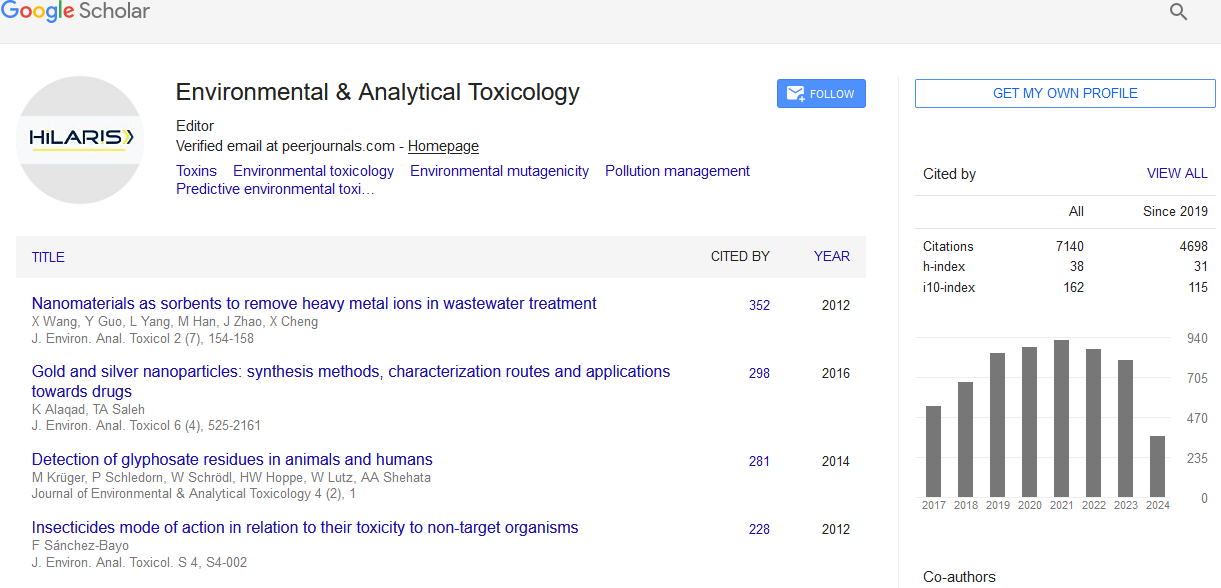
Environmental & Analytical Toxicology received 6818 citations as per Google Scholar report