Brief Report - (2025) Volume 16, Issue 6
Received: 01-Dec-2025, Manuscript No. jbsbe-26-183326;
Editor assigned: 03-Dec-2025, Pre QC No. P-183326;
Reviewed: 17-Dec-2025, QC No. Q-183326;
Revised: 22-Dec-2025, Manuscript No. R-183326;
Published:
29-Dec-2025
, DOI: 10.37421/2165-6210.2025.16.532
Citation: Noor, Faisal. ”Hybrid Biosensors: Enhanced Detection for Health.” J Biosens Bioelectron 16 (2025):532.
Copyright: © 2025 Noor F. This is an open-access article distributed under the terms of the Creative Commons Attribution License, which permits unrestricted use, distribution and reproduction in any medium, provided the original author and source are credited.
The integration of multiple detection modalities within biosensor systems represents a significant advancement in analytical science, offering synergistic benefits that enhance overall performance. By combining diverse sensing techniques, researchers are developing hybrid biosensors that achieve unprecedented levels of sensitivity, selectivity, and reliability, crucial for complex biological sample analysis and advanced point-of-care diagnostics. These multi-modal approaches are designed to overcome the limitations of single-mode sensors, leading to more robust and accurate diagnostic tools. One prominent area of research involves the fusion of electrochemical, optical, and piezoelectric sensing techniques. This integration allows for a more comprehensive analysis of biological samples, reducing the likelihood of false positives and broadening the dynamic range of detection. Furthermore, such hybrid systems can often detect multiple analytes simultaneously, a capability vital for comprehensive health assessments and disease profiling. A dual-modal detection approach, specifically integrating surface plasmon resonance (SPR) with fluorescence, is gaining traction for its ability to combine label-free interaction detection with sensitive, quantitative signal generation. SPR offers real-time monitoring of biomolecular binding events without the need for labeling, while fluorescence provides a highly sensitive readout for quantification, making this combination particularly valuable in drug discovery and diagnostics. Microfluidic platforms have also become integral to the development of hybrid biosensors. By integrating electrochemical detection with colorimetric readouts within a microfluidic channel, researchers can achieve precise sample handling and reagent delivery. This enables the simultaneous and accurate detection of multiple analytes, minimizing cross-interference and paving the way for portable diagnostic devices. Field-effect transistors (FETs) coupled with optical detection represent another promising hybrid architecture. FETs provide an ultrasensitive platform for detecting minute changes in surface charge, while optical methods offer complementary confirmation. This synergy is particularly beneficial for the early screening of cancer biomarkers, where detecting low-abundance analytes is critical for timely diagnosis. The combination of piezoelectric sensing with electrochemical impedance spectroscopy (EIS) offers a powerful approach for pathogen detection. The piezoelectric element provides label-free mass detection, while EIS delivers insights into surface binding kinetics and electrochemical activity. This synergistic combination allows for both rapid and sensitive identification of microbial contaminants, addressing critical needs in food safety and environmental monitoring. A hybrid optoelectronic biosensor integrating fluorescence and electrochemiluminescence detection allows for the simultaneous monitoring of multiple analytes in complex biological matrices. This multiplexing capability, coupled with high sensitivity, is a key advancement for rapid and accurate diagnosis, particularly in areas like cardiovascular disease, enabling timely point-of-care interventions. The use of graphene-based field-effect transistors (GFETs) within a microfluidic system creates a highly sensitive hybrid biosensing platform for genetic analysis. The GFETs' exceptional surface-to-volume ratio facilitates the detection of subtle molecular interactions like DNA hybridization, while the microfluidic system ensures efficient sample handling and reaction optimization, leading to high sensitivity and specificity. Integrating electrochemical detection with surface-enhanced Raman spectroscopy (SERS) provides a hybrid biosensor with dual-modal capabilities for biomarker detection. The electrochemical component offers quantitative concentration data, while SERS provides molecular fingerprinting for enhanced specificity, making this system effective for early disease diagnosis by capturing both quantitative and qualitative information. Quantum dots (QDs) combined with microelectrodes create a hybrid biosensing platform leveraging both fluorescence and electrochemical detection. The QDs deliver bright and stable fluorescence signals, while microelectrodes provide electrochemical transduction. This multi-modal strategy significantly enhances the sensitivity and reliability of detecting crucial biomarkers like microRNAs for disease diagnostics.
Hybrid biosensor systems are emerging as a transformative technology by integrating multiple detection modalities to achieve synergistic improvements in analytical performance. The inherent advantages of combining techniques such as electrochemical, optical, and piezoelectric sensing include enhanced sensitivity, improved selectivity, and increased reliability, which are essential for accurately analyzing complex biological samples and enabling advanced point-of-care diagnostics. These integrated systems are adept at reducing false positives and expanding dynamic ranges, allowing for the simultaneous detection of multiple analytes, a critical feature for comprehensive biological assessments. Specifically, research has focused on combining surface plasmon resonance (SPR) with fluorescence detection to create dual-modal biosensors. This combination is advantageous as SPR facilitates label-free detection of biomolecular interactions, while fluorescence provides a sensitive and quantitative readout. Such hybrid architectures are vital for real-time monitoring of biomolecular binding events, contributing significantly to drug discovery and diagnostic applications. Microfluidic technology plays a pivotal role in the development of hybrid biosensors, enabling precise control over sample handling and reagent delivery. For instance, integrating electrochemical detection with colorimetric readouts on a microfluidic platform allows for the simultaneous determination of multiple analytes like glucose and uric acid. This multi-modal strategy ensures high accuracy and minimizes cross-interference, making it suitable for developing compact and portable diagnostic devices. A hybrid biosensor combining field-effect transistors (FETs) with optical detection offers a highly sensitive approach for early cancer biomarker screening. The FETs excel at detecting subtle changes in surface charge, while optical methods provide complementary data for enhanced diagnostic accuracy, especially for low-abundance analytes that are indicative of early-stage disease. The integration of piezoelectric sensing with electrochemical impedance spectroscopy (EIS) presents a robust platform for pathogen detection. The piezoelectric element offers label-free mass detection, complementing EIS, which provides information on binding kinetics and electrochemical properties. This synergistic approach facilitates rapid and sensitive identification of microbial contaminants, an important capability for public health and safety. Optoelectronic biosensors represent another class of hybrid systems, effectively combining fluorescence and electrochemiluminescence detection. Such systems are designed for the simultaneous monitoring of multiple targets, for example, cardiac markers in serum. The multiplexing capability and high sensitivity are key advancements for rapid and accurate diagnosis of cardiovascular diseases at the point of care. Graphene-based field-effect transistors (GFETs) integrated with microfluidic devices form a hybrid biosensing platform with exceptional sensitivity for genetic analysis. The GFETs leverage their high surface-to-volume ratio for detecting DNA hybridization, while the microfluidics ensure efficient sample processing. This combined approach delivers high sensitivity and specificity for genetic detection applications. A hybrid biosensor that merges electrochemical detection with surface-enhanced Raman spectroscopy (SERS) enables the simultaneous identification of inflammatory biomarkers. The electrochemical component provides quantitative concentration data, while SERS offers molecular fingerprinting for improved specificity, thereby enhancing the effectiveness of early disease diagnosis. Quantum dots (QDs) are utilized in hybrid biosensors alongside microelectrodes to enhance both fluorescence and electrochemical detection capabilities, particularly for microRNA analysis. The QDs provide bright and stable fluorescence signals, while the microelectrodes offer electrochemical transduction. This multi-modal strategy significantly boosts the sensitivity and reliability of microRNA detection for diagnostic purposes. Wearable hybrid biosensor systems are being developed for continuous monitoring of sweat analytes, integrating electrochemical sensors with microfluidic sample collection. These systems allow for the simultaneous tracking of various physiological markers through multiple electrochemical sensing elements, providing a non-invasive method for health management and performance monitoring.
Hybrid biosensor systems integrate multiple detection modalities to enhance performance characteristics such as sensitivity, selectivity, and reliability. Techniques like electrochemical, optical, piezoelectric, surface plasmon resonance (SPR), fluorescence, field-effect transistors (FETs), and surface-enhanced Raman spectroscopy (SERS) are combined to achieve synergistic effects. Microfluidics and graphene-based sensors further augment these systems for precise sample handling and ultrasensitive detection. These advancements are driving progress in point-of-care diagnostics, early disease screening, genetic analysis, and continuous health monitoring, offering more accurate and comprehensive biological assessments.
None
None
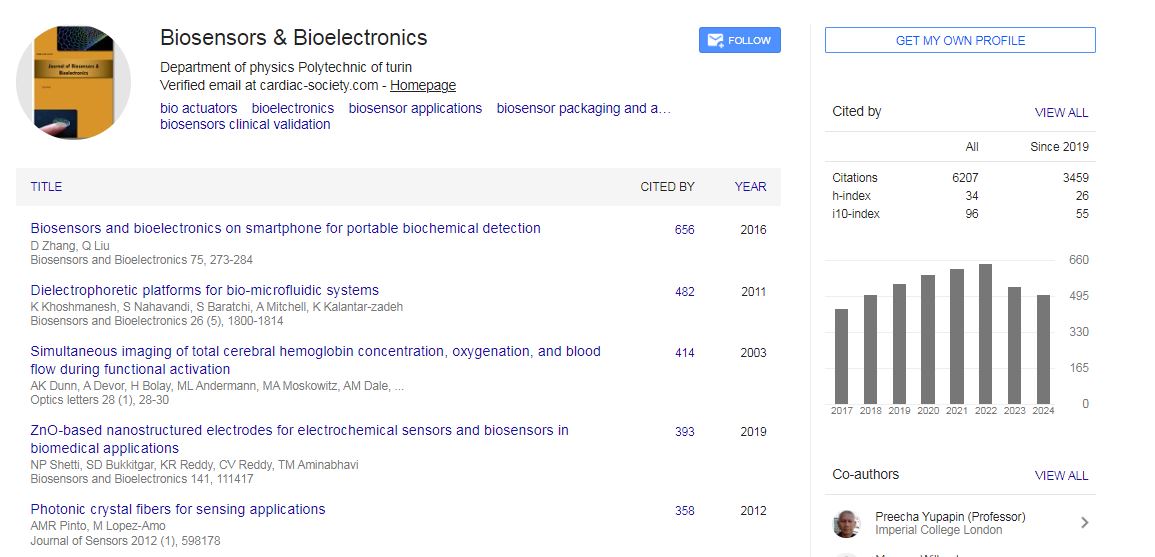
Biosensors & Bioelectronics received 6207 citations as per Google Scholar report