Opinion - (2025) Volume 16, Issue 3
Received: 01-Apr-2025, Manuscript No. hycr-25-172523;
Editor assigned: 03-Apr-2025, Pre QC No. P-172523;
Reviewed: 17-Apr-2025, QC No. Q-172523;
Revised: 22-Apr-2025, Manuscript No. R-172523;
Published:
29-May-2025
, DOI: 10.37421/2157-7587.2025.16.600
Citation: Walker, Ethan. Humanity alters global water cycle, escalating risks. Hydrol Current Res 16(2025):600.
Copyright: © 2025 Ethan W. This is an open-access article distributed under the terms of the Creative Commons Attribution License, which permits unrestricted use,
distribution and reproduction in any medium, provided the original author and source are credited.
The global water cycle, a fundamental Earth system process, is undergoing profound and unprecedented alterations driven primarily by anthropogenic climate change and a myriad of direct human activities. Understanding these complex changes is crucial given their significant implications for human societies, ecosystems, and the long-term sustainability of water resources worldwide. Recent scientific discourse highlights a rapidly evolving hydrological landscape, necessitating integrated approaches to mitigate risks and adapt to emerging conditions [1].
The profound influence of human activities extends from localized alterations, like irrigation and deforestation, to broad-scale climate change impacts, quantifying regional variability and global implications. This underscores the urgency for sustainable water management strategies to mitigate escalating water stress [2].
Hereâ??s the thing, recent trends reveal substantial shifts in global evaporation and its constituent processesâ??transpiration, open-water evaporation, and soil evaporation. Observations and model results consistently show how changes in land use, climate, and atmospheric demand collectively influence terrestrial and oceanic water fluxes, thereby impacting the overall water cycle [3].
What this really means is, the planet is experiencing significant shifts in extreme precipitation events. Updated syntheses confirm observed and projected changes worldwide, directly linking these shifts to a more energetic water cycle fueled by global warming. This phenomenon emphasizes regional disparities and heightens the risks of floods and droughts, which in turn pose severe challenges to critical infrastructure and societal resilience [4].
Meanwhile, advancements in monitoring and attributing changes in terrestrial water storage, including groundwater, soil moisture, and surface water, reveal a complex picture. Satellite gravity missions, combined with sophisticated hydrological models, show significant regional declines and increases in water storage, influenced by both natural climate variability and pronounced anthropogenic factors, such as groundwater abstraction [5].
A critical concern arising from a perturbed water cycle under climate change is the amplification of compound hydrological extremes. This includes events like concurrent droughts and heatwaves or sequential floods. These complex interactions pose greater risks than isolated extremes and demand more sophisticated risk assessment and adaptive strategies to manage their multifaceted consequences [6].
Furthermore, intricate feedback loops between the water cycle and land-atmosphere interactions are being increasingly recognized. Changes in soil moisture, vegetation cover, and surface energy balance can profoundly impact regional precipitation, temperature, and atmospheric circulation. Accurately representing these couplings in climate models is of paramount importance for generating improved regional climate projections [7].
The cryosphere, encompassing glaciers and ice sheets, plays a pivotal role in the global water cycle. Recent advances confirm its accelerating mass loss due to climate change, contributing significantly to river flow and global sea level rise. This rapid cryospheric melt dramatically alters water availability in mountain regions, impacting downstream ecosystems and human populations that rely on these vital water sources [8].
Beyond large-scale climate shifts, localized human impacts, such as urbanization, also exert a profound influence. A global meta-analysis quantifies the widespread impacts of urbanization on local and regional water cycles, revealing how increased impervious surfaces, altered drainage systems, and higher water demands lead to significant changes in runoff, infiltration, and evapotranspiration. This highlights the pressing need for sustainable urban planning to mitigate flood risks and secure water resources in rapidly growing cities [9].
Looking ahead, projections of the global water cycle from the latest CMIP6 climate models detail anticipated shifts in precipitation, evaporation, and runoff patterns under various emission scenarios. Discussions around the consistencies and uncertainties across these models highlight critical regions expected to experience significant hydrological changes, which are undeniably vital for future water resource planning and ensuring global water security [10].
The collective findings underscore a complex, dynamic system under immense pressure, demanding concerted global efforts for adaptation and mitigation.
Let's break it down further regarding specific components and extreme events. Recent global reviews have examined evaporation and its componentsâ??transpiration, open-water, and soil evaporationâ??showing that changes in land use, climate, and atmospheric demand collectively influence terrestrial and oceanic water fluxes, thereby impacting the overall water cycle [3]. Furthermore, global warming is driving a more energetic water cycle, which manifests as observed and projected increases in extreme precipitation events worldwide. This phenomenon leads to heightened risks of floods and droughts, posing significant challenges to infrastructure and societal resilience across regions [4].
Insights into terrestrial water storage reveal complex dynamics. Latest developments in monitoring and attributing changes in groundwater, soil moisture, and surface water leverage satellite gravity missions and hydrological models. These tools show significant regional declines and increases in water storage, influenced by both natural climate variability and anthropogenic factors such as groundwater abstraction, highlighting a delicate balance [5]. The cryosphere's contribution to the global water cycle is also undergoing critical changes. Accelerating glacier and ice sheet meltwater due to climate change significantly impacts river flow and sea level rise, fundamentally altering water availability in mountain regions and affecting downstream ecosystems and human populations [8].
Here's the thing about compounded risks: a perturbed water cycle under climate change amplifies the likelihood and severity of compound hydrological extremes. These include complex events like concurrent droughts and heatwaves or sequential floods. Such events pose greater risks than isolated extremes and demand more sophisticated risk assessment and adaptation strategies for effective mitigation [6]. Moreover, intricate feedback loops exist between the water cycle and land-atmosphere interactions. Changes in soil moisture, vegetation cover, and surface energy balance can profoundly affect regional precipitation, temperature, and atmospheric circulation. Accurately representing these couplings in climate models is vital for improved regional climate projections and better preparedness [7].
Finally, the localized anthropogenic footprint and future projections complete this picture. Urbanization impacts the water cycle significantly, as a global meta-analysis quantifies how increased impervious surfaces, altered drainage systems, and higher water demands in cities lead to substantial changes in runoff, infiltration, and evapotranspiration. This phenomenon underscores the need for sustainable urban planning to mitigate flood risks and secure water resources in rapidly growing areas [9]. Synthesizing future projections, CMIP6 climate models detail anticipated shifts in global precipitation, evaporation, and runoff patterns under various emission scenarios. This information, including consistencies and uncertainties across models, highlights critical regions expected to experience significant hydrological changes, providing essential guidance for future water resource planning [10]. This comprehensive overview stresses the multifaceted nature of changes in the global water cycle and the urgent need for informed action.
The global freshwater cycle is undergoing significant and rapid changes, primarily driven by anthropogenic climate change and a range of human activities. Recent research synthesizes these transformations, highlighting how global warming alters fundamental hydrological processes such as precipitation patterns, evaporation rates, and overall water storage, with substantial implications for human societies, ecosystems, and water resource management. Beyond climate, human interventions like irrigation, deforestation, and particularly urbanization, profoundly influence the water cycle at both regional and global scales by modifying runoff, infiltration, and evapotranspiration. These changes lead to escalating water stress and increased flood risks. Scientists observe critical shifts in extreme precipitation events, directly linked to a more energetic water cycle, and an accelerating loss of cryospheric mass, which significantly impacts river flow and contributes to sea level rise. The heightened frequency and severity of compound hydrological extremes, such as concurrent droughts and heatwaves, pose greater risks than isolated events. Advanced monitoring, including satellite gravity missions, reveals complex regional declines and increases in terrestrial water storage influenced by natural variability and human abstraction. Understanding the intricate feedback loops between the water cycle and land-atmosphere interactions is crucial for improved regional climate projections. Future climate model projections anticipate substantial shifts in precipitation, evaporation, and runoff patterns globally. This collective body of work underscores the urgent need for integrated approaches, sustainable water management strategies, and robust adaptation measures to mitigate the escalating risks associated with these evolving hydrological conditions and ensure water security.
None
None
Indexed at, Google Scholar, Crossref
Indexed at, Google Scholar, Crossref
Indexed at, Google Scholar, Crossref
Indexed at, Google Scholar, Crossref
Indexed at, Google Scholar, Crossref
Indexed at, Google Scholar, Crossref
Indexed at, Google Scholar, Crossref
Indexed at, Google Scholar, Crossref
Indexed at, Google Scholar, Crossref
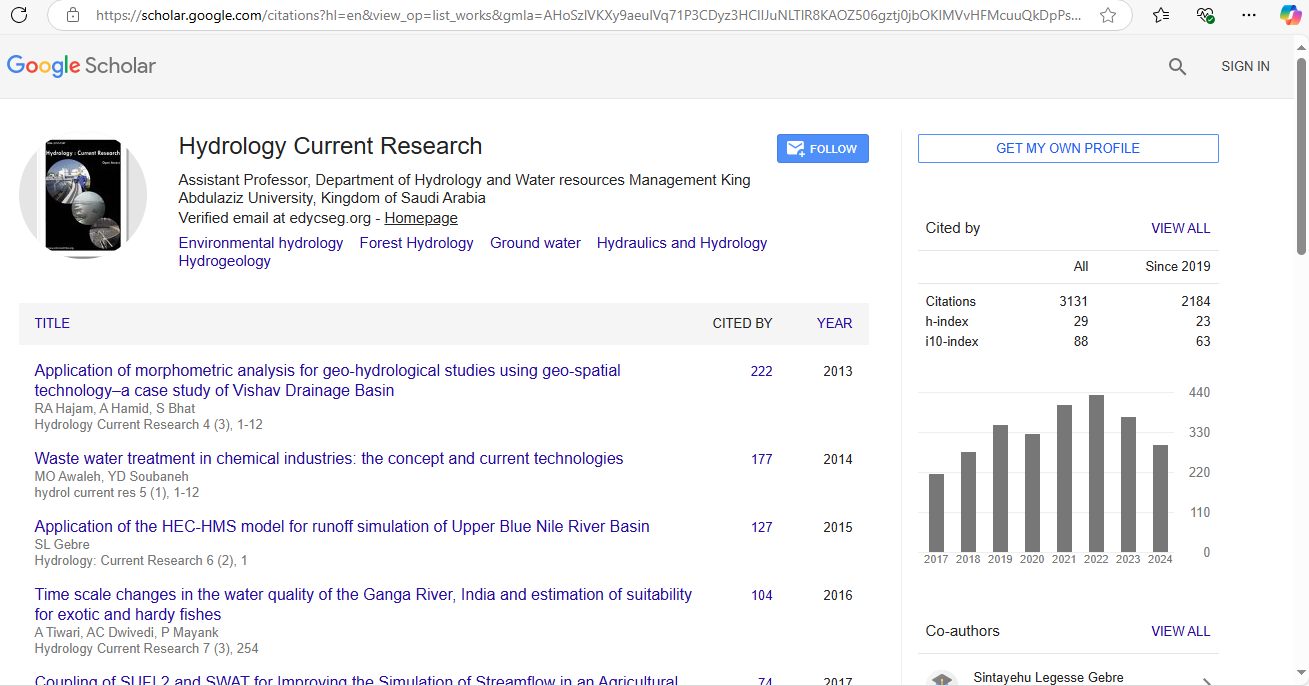
Hydrology: Current Research received 2843 citations as per Google Scholar report