Perspective - (2025) Volume 9, Issue 5
Received: 01-Oct-2025, Manuscript No. jmp-26-190050;
Editor assigned: 03-Oct-2025, Pre QC No. P-190050;
Reviewed: 17-Oct-2025, QC No. Q-190050;
Revised: 22-Oct-2025, Manuscript No. R-190050;
Published:
29-Oct-2025
, DOI: 10.37421/2684-4931.2025.9.274
Citation: Shevchenko, Olena. ”Host-Pathogen Interactions: A Systems Biology Perspective.” J Microb Path 09 (2025):274.
Copyright: © 2025 Shevchenko O. This is an open-access article distributed under the terms of the Creative Commons Attribution License, which permits unrestricted use, distribution and reproduction in any medium, provided the original author and source are credited.
The complex and dynamic interactions between host organisms and invading pathogens are fundamental to the study of infectious diseases. Understanding these intricate relationships at a molecular and cellular level is crucial for developing effective diagnostic and therapeutic strategies. Systems biology approaches have emerged as a powerful tool to dissect these interactions, offering a holistic view that traditional methods often miss. These methods allow researchers to unravel the complex networks of biological processes that are perturbed during infection, providing insights into host defense mechanisms and pathogen survival strategies. The field has seen significant advancements in recent years, with studies employing diverse omics technologies to map these interactions [1].
One of the primary focuses in this area is the dissection of host-pathogen interactomes, which represent the sum of all molecular interactions occurring between a host and a pathogen. By employing systems biology, researchers can identify critical vulnerabilities in pathogens and potential targets for intervention. This includes understanding how pathogens exploit host cellular machinery and how host defenses are activated in response. Such comprehensive analyses are vital for developing novel strategies to control infectious diseases by targeting specific interaction points [2].
Viral infections present a unique set of challenges, with viruses employing sophisticated mechanisms to manipulate host cell processes for their replication. Systems biology tools are instrumental in identifying these viral proteins and pathways that interfere with host immune signaling and metabolic functions. This research aims to provide a comprehensive view of viral strategies for establishing infection and evading host defenses, thereby offering new avenues for antiviral drug development [3].
Parasitic infections also involve complex host-parasite molecular dialogues. Systems immunology, a branch of systems biology, is employed to dissect the impact of these infections on host immune cell populations and their functional states. By characterizing how parasites reprogram immune responses to promote their survival, detailed maps of these interactions can be created, which are vital for designing interventions against parasitic diseases [4].
Metabolism plays a critical role in the interplay between host and pathogen during infection. Studies have examined the metabolic adaptations of both entities during the initial phase of infection, using metabolomics and network analysis to identify altered pathways. These alterations influence nutrient availability for pathogens and the host's immune response, highlighting the critical role of metabolism in infectious diseases [5].
The host microbiome also significantly influences the response to acute infection. Research investigating dynamic host-microbiome interactions during pathogen challenge uses metagenomic and metatranscriptomic approaches. These studies aim to understand how resident microbial communities interact with invading pathogens and influence host susceptibility and disease progression, underscoring the importance of the host-microbe axis [6].
Network pharmacology offers another systems-level approach to map the complex interactions between host and pathogen molecules. By constructing comprehensive interaction networks, researchers can identify key pathways and potential therapeutic intervention points. This holistic analysis provides a broad view of the disease process and potential drug targets, facilitating the development of targeted therapies [7].
Host cellular protein dynamics are central to understanding viral pathogenesis. Quantitative proteomics has been employed to identify host proteins hijacked by viruses or involved in antiviral defense. Creating detailed temporal maps of these protein changes is crucial for understanding viral life cycles and for developing effective antiviral agents [8].
Bacterial infections trigger a heterogeneous array of host responses. Single-cell technologies have become invaluable in dissecting this heterogeneity, allowing for the analysis of gene expression at the single-cell level. This approach identifies distinct immune cell subpopulations and their specific roles in combating infection, providing granular insights into the complexity of host defense mechanisms [9].
Furthermore, host epigenetics plays a modulatory role in the response to acute infection. Studies exploring epigenetic modifications, such as DNA methylation and histone modifications, reveal how these alterations can impact gene expression and immune cell function during the early stages of infection. Understanding these epigenetic dynamics is essential for developing targeted therapeutic interventions [10].
Systems biology offers a comprehensive framework for dissecting the intricate molecular and cellular interplay between hosts and pathogens during acute infections. This approach allows for the identification of critical host-pathogen interactomes, revealing vulnerabilities in pathogens and potential novel therapeutic targets or diagnostic markers. The focus is on unraveling the complex signaling pathways, metabolic shifts, and immune responses that define the early stages of infection, providing a holistic understanding essential for combating infectious diseases [1].
Understanding how host cells respond to bacterial invasion is a key area of research utilizing advanced omics technologies. By analyzing changes in gene expression and protein-protein interactions, scientists map the cellular machinery exploited by pathogens and the host defenses activated. These insights are crucial for elucidating the mechanisms of pathogenesis and for devising effective strategies to control bacterial infections from a systems biology perspective [2].
Viral manipulation of host cell processes during acute infection is another critical area investigated through systems biology. By identifying viral proteins that interfere with host immune signaling and metabolic pathways, researchers gain a comprehensive view of viral strategies to establish infection and evade host defenses. This knowledge paves the way for the development of targeted antiviral therapies [3].
In the context of parasitic infections, systems immunology is employed to dissect the impact on host immune cell populations and their functional states. By characterizing how parasites reprogram immune responses, researchers can map the detailed molecular dialogue between host and parasite, which is vital for designing effective interventions against parasitic diseases [4].
The metabolic rewiring occurring in both hosts and pathogens during acute infection is a significant area of study. Utilizing metabolomics and network analysis, researchers identify key metabolic pathways that are altered, influencing nutrient availability and the host's immune response. This systems biology perspective underscores the critical role of metabolism in the pathogenesis and progression of infectious diseases [5].
The dynamic interactions between the host and its resident microbiome are profoundly affected by acute infections. Metagenomic and metatranscriptomic approaches are used to understand how microbial communities interact with invading pathogens and influence host susceptibility. These studies highlight the crucial role of the host-microbe axis in infectious disease dynamics, requiring a systems biology approach for comprehensive understanding [6].
Network pharmacology provides a systems-level approach to map the complex web of interactions between host and pathogen molecules. By constructing comprehensive interaction networks, researchers can pinpoint key pathways and potential targets for therapeutic intervention. This holistic analysis offers a broad perspective on the disease process, aiding in the identification of novel drug targets for infectious diseases [7].
Host cellular protein dynamics during acute viral infection are investigated using quantitative proteomics. This technique identifies host proteins that are either hijacked by viruses for their replication or are mobilized as part of the host's antiviral defense. Detailed temporal maps of these protein changes are essential for understanding viral pathogenesis and for the development of new antiviral strategies [8].
Dissecting the heterogeneity of host responses to bacterial pathogens during acute infection is achieved through single-cell technologies. By analyzing gene expression at the individual cell level, distinct immune cell subpopulations and their specific roles in combating infection can be identified. This granular approach provides deeper insights into the complexity of host defense mechanisms [9].
Epigenetic regulation plays a significant role in modulating the host's response to acute infection. Studies explore how epigenetic modifications, such as DNA methylation and histone modifications, influence gene expression and immune cell function during the early stages of infection. Understanding these epigenetic dynamics is fundamental for developing precisely targeted therapies against infectious agents [10].
This collection of research explores the intricate host-pathogen interactions during acute infections through a systems biology lens. Studies examine the molecular and cellular dialogues, host immune responses, metabolic adaptations, and microbiome dynamics. Advanced omics technologies, including proteomics, transcriptomics, metabolomics, and network analysis, are employed to unravel complex pathways and identify therapeutic targets. The research covers viral, bacterial, and parasitic infections, highlighting host defense mechanisms, pathogen exploitation strategies, and the role of epigenetics and host-microbiome interactions. The insights gained are crucial for developing novel diagnostic markers and treatment strategies for infectious diseases.
None
None
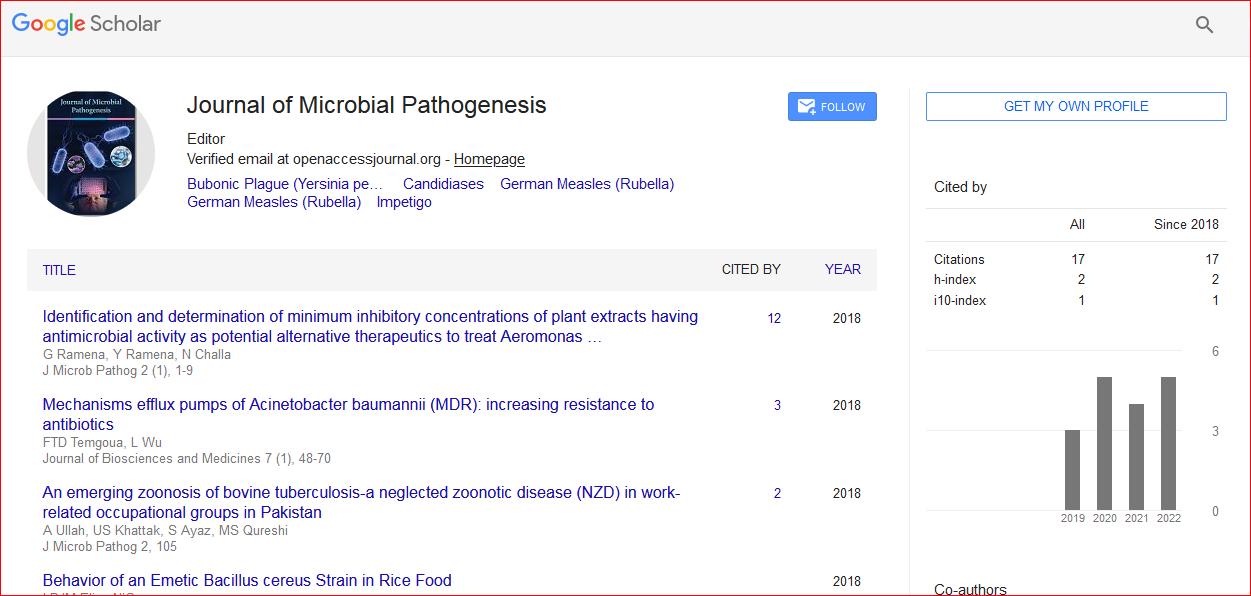
Journal of Microbial Pathogenesis received 17 citations as per Google Scholar report