Brief Report - (2025) Volume 16, Issue 4
Received: 04-Aug-2025, Manuscript No. jar-25-177602;
Editor assigned: 06-Aug-2025, Pre QC No. P-177602;
Reviewed: 20-Aug-2025, QC No. Q-177602;
Revised: 25-Aug-2025, Manuscript No. R-177602;
Published:
01-Sep-2025
, DOI: 10.37421/2155-6113.2025.16.1072
Citation: Al-Farhan, Hassan. ”HIV: Progress, Challenges, Equitable
Eradication.” J AIDS Clin Res 16 (2025):1072.
Copyright: © 2025 Al-Farhan H. This is an open-access article distributed under the terms of the Creative Commons Attribution License, which permits unrestricted use,
distribution and reproduction in any medium, provided the original author and source are credited.
This systematic analysis, drawing from the Global Burden of Disease Study 2019, provides a comprehensive overview of HIV incidence, prevalence, and mortality trends across various regions and countries from 2000 to 2019. It highlights significant reductions in new infections and deaths globally, yet reveals persistent disparities and ongoing challenges in specific populations and geographic areas, emphasizing the need for targeted interventions to achieve global eradication goals [1].
This systematic review and meta-analysis thoroughly examines the HIV prevention and care continuum for adolescent girls and young women globally. It identifies critical gaps in access to prevention services and retention in care, particularly in high-burden regions, underscoring the urgent need for tailored, gender-sensitive interventions to improve outcomes and reduce new infections among this vulnerable population [2].
This modeling study evaluates global access to Antiretroviral Treatment (ART) for both adults and children living with HIV up to 2020. It reveals significant progress in ART coverage, particularly among adults, but also highlights persistent disparities and insufficient access for specific populations, especially children and adolescents. The findings underscore the critical need to accelerate efforts to ensure universal ART coverage to end the HIV epidemic [3].
This systematic analysis from the Global Burden of Disease Study 2019 quantifies the intricate global burden of HIV/Tuberculosis co-infection. It details the substantial morbidity and mortality associated with this dual epidemic, highlighting the disproportionate impact on specific regions and populations. The findings underscore the urgency of integrated prevention, diagnosis, and treatment strategies to effectively mitigate the combined health challenges of HIV and TB [4].
This global systematic review and meta-analysis assesses the profound impact of the COVID-19 pandemic on HIV prevention and care services worldwide. It reveals widespread disruptions, including reduced access to testing, treatment initiation, and adherence support, leading to potential setbacks in the global HIV response. The study emphasizes the urgent need for resilient health systems and integrated approaches to maintain essential HIV services during future health crises [5].
This systematic review examines the economic costs associated with HIV treatment, prevention, and care services in low- and middle-income countries. It synthesizes evidence on resource allocation, cost-effectiveness, and financial sustainability of HIV programs. The review highlights the substantial economic burden of HIV, emphasizing the need for efficient resource mobilization and strategic investments to ensure the long-term viability of comprehensive HIV responses in these regions [6].
This qualitative synthesis explores the persistent and varied experiences of HIV-related stigma and discrimination across numerous global settings. It reveals how stigma continues to impede access to prevention, testing, and treatment services, significantly impacting the quality of life for people living with HIV. The study emphasizes the critical need for comprehensive interventions that address structural inequalities and promote social inclusion to achieve an effective and equitable HIV response [7].
This systematic review and meta-analysis provides a critical assessment of global HIV prevalence among key populations across 104 countries. It highlights alarmingly high prevalence rates within groups like men who have sex with men, people who inject drugs, and sex workers, often significantly higher than the general population. The findings underscore the urgent need for tailored, rights-based interventions and decriminalization efforts to effectively address the persistent epidemic among these marginalized communities [8].
This systematic review and meta-analysis assesses the progress made towards the UNAIDS 95-95-95 targets in East and Southern Africa, a region significantly impacted by HIV. It highlights considerable advancements in diagnosis, treatment coverage, and viral suppression, while also identifying persistent gaps and inequalities within and between countries. The findings emphasize the need for accelerated, equity-focused interventions to achieve these ambitious targets and effectively control the epidemic in high-burden settings [9].
This systematic review and meta-analysis provides up-to-date global estimates of pediatric HIV incidence, prevalence, and mortality. It reveals the persistent burden of HIV among children, particularly in Sub-Saharan Africa, despite advancements in prevention of mother-to-child transmission. The study emphasizes the critical need for intensified efforts in early infant diagnosis, timely ART initiation, and age-appropriate care to eliminate new pediatric infections and improve outcomes for children living with HIV [10].
The global landscape of HIV continues to evolve, characterized by both significant progress and persistent challenges across diverse populations and geographical areas. A comprehensive systematic analysis, utilizing the Global Burden of Disease Study 2019, detailed HIV incidence, prevalence, and mortality trends from 2000 to 2019, noting substantial reductions in new infections and deaths globally. However, it also revealed persistent disparities and ongoing challenges in specific populations and regions, underscoring the critical need for targeted interventions to achieve global eradication goals [1]. These challenges are particularly acute within the HIV prevention and care continuum for adolescent girls and young women. A global systematic review and meta-analysis identified critical gaps in their access to prevention services and retention in care, especially in high-burden regions, emphasizing the urgent need for tailored, gender-sensitive interventions to improve outcomes and reduce new infections among this vulnerable population [2].
Access to Antiretroviral Treatment (ART) represents a cornerstone of the global HIV response. A modeling study evaluating global ART access for adults and children living with HIV up to 2020 showed considerable progress in ART coverage, particularly for adults. Yet, it also highlighted persistent disparities and insufficient access for specific groups, notably children and adolescents, indicating an urgent need to accelerate efforts for universal ART coverage to end the HIV epidemic [3]. Concurrently, the intricate global burden of HIV/Tuberculosis (TB) co-infection was quantified by another systematic analysis from the Global Burden of Disease Study 2019. This analysis detailed the substantial morbidity and mortality linked to this dual epidemic, which disproportionately affects certain regions and populations. It stressed the urgency of integrated prevention, diagnosis, and treatment strategies to effectively mitigate the combined health challenges of HIV and TB [4].
The COVID-19 pandemic significantly impacted global HIV prevention and care services. A global systematic review and meta-analysis documented widespread disruptions, including reduced access to testing, treatment initiation, and adherence support, potentially leading to setbacks in the global HIV response. This underscores the necessity for resilient health systems and integrated approaches to maintain essential HIV services during future health crises [5]. Economically, a systematic review examined the costs associated with HIV treatment, prevention, and care in low- and middle-income countries. It synthesized evidence on resource allocation, cost-effectiveness, and financial sustainability of HIV programs, emphasizing the substantial economic burden and the need for efficient resource mobilization and strategic investments to ensure long-term viability [6].
Beyond clinical and economic considerations, HIV-related stigma and discrimination remain pervasive. A qualitative synthesis explored diverse experiences of stigma across global settings, revealing how it consistently impedes access to prevention, testing, and treatment services, profoundly affecting the quality of life for people living with HIV. The study advocated for comprehensive interventions addressing structural inequalities and promoting social inclusion for an effective and equitable HIV response [7]. Furthermore, understanding HIV prevalence among key populations is crucial. A systematic review and meta-analysis assessed global HIV prevalence among key populations across 104 countries, identifying alarmingly high rates in groups such as men who have sex with men, people who inject drugs, and sex workers, often significantly exceeding general population rates. This highlights the urgent need for tailored, rights-based interventions and decriminalization efforts to address the epidemic among these marginalized communities effectively [8]. Progress towards global targets, like the UNAIDS 95-95-95 goals in East and Southern Africa, shows considerable advancements in diagnosis, treatment coverage, and viral suppression, yet persistent gaps and inequalities remain [9]. Finally, pediatric HIV continues to be a significant burden, particularly in Sub-Saharan Africa. Updated global estimates of pediatric HIV incidence, prevalence, and mortality revealed this despite advancements in preventing mother-to-child transmission. The study emphasizes intensified efforts in early infant diagnosis, timely ART initiation, and age-appropriate care to eliminate new infections and improve outcomes for children living with HIV [10].
This collection of studies provides a comprehensive overview of the global HIV epidemic, highlighting both remarkable progress and enduring challenges. Research based on the Global Burden of Disease Study 2019 shows significant reductions in HIV incidence, prevalence, and mortality between 2000 and 2019, though disparities persist across regions and populations [1, 4]. A key focus is the prevention and care continuum for vulnerable groups, including adolescent girls and young women, where critical gaps in access and retention demand tailored, gender-sensitive interventions [2]. Access to Antiretroviral Treatment (ART) has advanced considerably for adults, yet children and adolescents continue to face insufficient coverage, underscoring the need for universal ART access to end the epidemic [3, 10]. The broader context of HIV management includes addressing co-infections like HIV/Tuberculosis, which disproportionately affect certain populations and require integrated strategies [4]. The COVID-19 pandemic presented a significant setback, disrupting essential HIV prevention and care services globally, necessitating resilient health systems [5]. Economic analyses reveal the substantial costs associated with HIV programs in low- and middle-income countries, emphasizing the need for efficient resource mobilization [6]. Social barriers, such as pervasive HIV-related stigma and discrimination, continue to impede access to care and quality of life, calling for interventions that promote social inclusion [7]. Alarmingly high HIV prevalence rates persist among key populations, underscoring the urgent need for tailored, rights-based interventions and decriminalization efforts for marginalized communities [8]. Despite considerable advancements in regions like East and Southern Africa towards UNAIDS 95-95-95 targets, inequalities remain, demanding equity-focused approaches to control the epidemic [9]. Overall, the data points to a complex fight against HIV, where gains are made but targeted efforts are still crucial for equitable eradication.
Indexed at, Google Scholar, Crossref
Indexed at, Google Scholar, Crossref
Indexed at, Google Scholar, Crossref
Indexed at, Google Scholar, Crossref
Indexed at, Google Scholar, Crossref
Indexed at, Google Scholar, Crossref
Indexed at, Google Scholar, Crossref
Indexed at, Google Scholar, Crossref
Indexed at, Google Scholar, Crossref
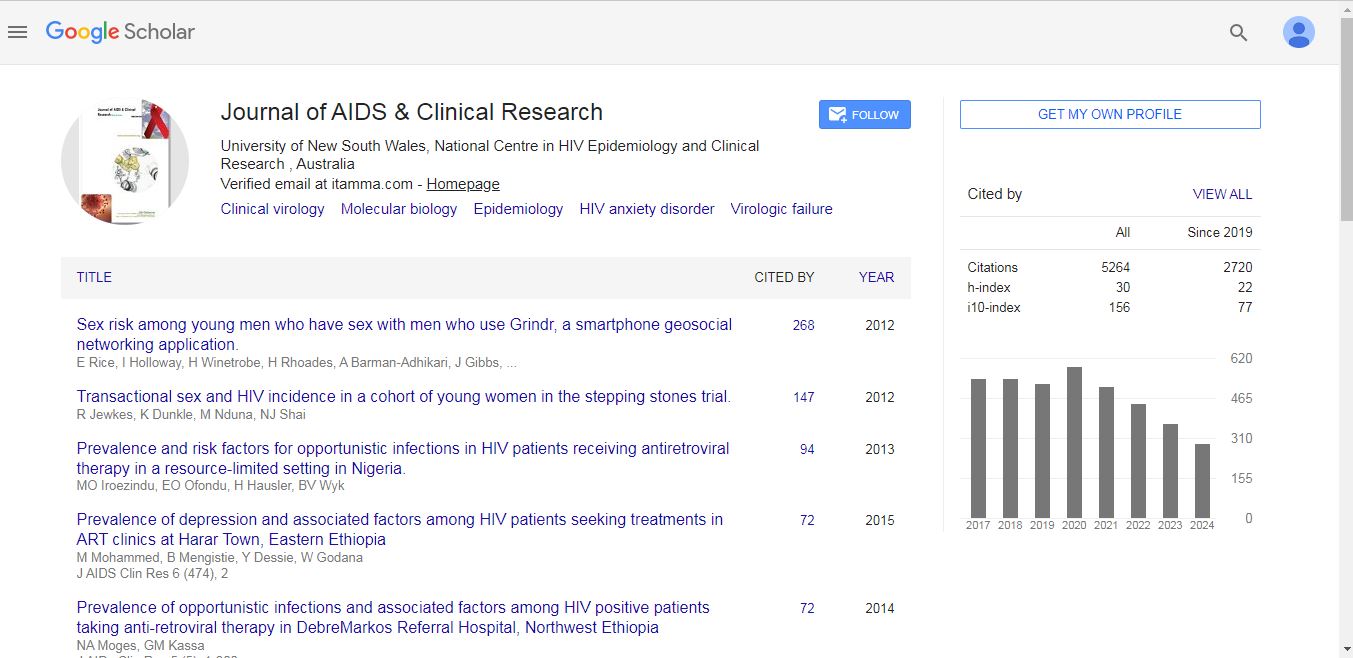
Journal of AIDS & Clinical Research received 5264 citations as per Google Scholar report