Brief Report - (2025) Volume 16, Issue 4
Received: 04-Aug-2025, Manuscript No. jar-25-177601;
Editor assigned: 06-Aug-2025, Pre QC No. p-177601;
Reviewed: 20-Aug-2025, QC No. Q-177601;
Revised: 25-Aug-2025, Manuscript No. R-177601;
Published:
01-Sep-2025
, DOI: 10.37421/2155-6113.2025.16.1071
Citation: Patel, Maya. ”HIV Prevention: Risks, Vulnerabilities,
Tailored Strategies.” J AIDS Clin Res 16 (2025):1071.
Copyright: © 2025 Patel M. This is an open-access article distributed under the terms of the Creative Commons Attribution License, which permits unrestricted use, distribution
and reproduction in any medium, provided the original author and source are credited.
This systematic review and meta-analysis confirmed a strong association between good adherence to Pre-Exposure Prophylaxis (PrEP) and a significantly reduced risk of HIV acquisition. This really highlights the critical role of consistent PrEP use in preventing new infections, making it clear that staying on your regimen truly matters[1]. This study shed light on the high HIV prevalence and specific risk factors among men who have sex with men (MSM) in South Africa. They found that unprotected anal sex and a history of sexually transmitted infections were key drivers, underscoring the urgent need for prevention efforts tailored directly to this community[2].
This research clearly showed that various social determinants of healthâ??things like poverty, lack of education, and barriers to healthcare accessâ??significantly increase HIV risk among women in the United States. What this really means is that structural inequalities are playing a huge role in HIV prevention[3]. This systematic review and meta-analysis spelled out the high prevalence of HIV among people who inject drugs in China. They pointed to shared needles, sexual contact, and a lack of harm reduction services as critical risk factors, making a strong case for integrating prevention strategies across the board[4]. This systematic review highlighted stark geographic disparities in HIV burden among cisgender women in the U.S. They found higher prevalence and incidence particularly in the Southern states, which suggests regional socioeconomic factors and access to prevention services play a pivotal role in these differences[5]. This study uncovered high rates of mental health disorders and substance use among young gay and bisexual men, noting a significant link to increased sexual risk behaviors. The takeaway here is that we really need to connect mental health support with HIV prevention services for this vulnerable population[6]. This systematic review revealed persistently high HIV incidence among adolescents and young adults in sub-Saharan Africa. Transactional sex, multiple partners, and limited comprehensive HIV knowledge were identified as key risk factors, clearly pointing to an urgent need for prevention programs specifically designed for this age group[7]. This systematic review brought to light how intersecting oppressionsâ??including race, gender, class, and sexual orientationâ??significantly worsen HIV risk and create prevention hurdles for Black women in the United States. It's a call for multi-level, culturally sensitive interventions that truly meet their needs[8]. This systematic review pinpointed the unique challenges and effective interventions for HIV prevention in regions affected by conflict. It really emphasizes that integrating health services, engaging communities, and tackling gender-based violence are crucial steps to lowering HIV risk in these incredibly vulnerable populations[9]. This systematic review demonstrated that digital health interventions, like mobile apps and online platforms, are effective in improving HIV prevention behaviors and helping people stay engaged in care. It suggests they have real potential to cut down HIV risk and make services more accessible, especially for groups that are typically hard to reach[10].HIV prevention efforts must address a complex web of risk factors and vulnerabilities across diverse populations. For instance, high HIV prevalence among men who have sex with men (MSM) in South Africa is linked to unprotected anal sex and a history of sexually transmitted infections, showing a clear need for tailored prevention programs for this community [2]. Similarly, people who inject drugs in China face high HIV prevalence due to shared needles, sexual contact, and insufficient harm reduction services, suggesting the necessity for integrated prevention strategies [4]. In sub-Saharan Africa, adolescents and young adults exhibit persistently high HIV incidence, driven by transactional sex, multiple partners, and limited comprehensive HIV knowledge, which calls for urgent age-specific prevention initiatives [7]. Addressing these distinct risk profiles is fundamental to curbing the spread of the virus.
Social and geographic factors also play a critical role in shaping HIV risk. Research shows that women in the United States experience increased HIV risk due to social determinants such as poverty, lack of education, and barriers to healthcare access, emphasizing the significant impact of structural inequalities on prevention outcomes [3]. Building on this, stark geographic disparities in HIV burden among cisgender women in the U.S. are observed, with higher prevalence and incidence concentrated in Southern states. These regional differences are likely influenced by socioeconomic factors and varying access to prevention services [5]. Understanding these broader societal and spatial dynamics is vital for effective interventions.
Certain groups face heightened vulnerability due to intersecting challenges. Young gay and bisexual men exhibit high rates of mental health disorders and substance use, which are significantly linked to increased sexual risk behaviors. This highlights the urgent need to integrate mental health support with HIV prevention services for this population [6]. Furthermore, Black women in the United States encounter intersecting oppressionsâ??including race, gender, class, and sexual orientationâ??that worsen HIV risk and create significant prevention hurdles. This necessitates multi-level, culturally sensitive interventions to truly meet their needs [8]. Even in conflict-affected contexts, HIV prevention presents unique challenges, underscoring the importance of integrating health services, engaging communities, and tackling gender-based violence to lower HIV risk among these incredibly vulnerable populations [9].
Effective prevention strategies are critical for reducing HIV acquisition and improving engagement in care. One key finding is the strong association between good adherence to Pre-Exposure Prophylaxis (PrEP) and a significantly reduced risk of HIV acquisition, highlighting the critical role of consistent PrEP use [1]. Moreover, digital health interventions, such as mobile apps and online platforms, have proven effective in improving HIV prevention behaviors and helping people stay engaged in care. These tools offer real potential to cut down HIV risk and make services more accessible, especially for groups that are typically hard to reach [10]. This dual focus on medical adherence and innovative digital solutions offers promising pathways forward in the fight against HIV.
Current research provides a comprehensive look at HIV prevention, highlighting critical risk factors, vulnerable populations, and effective interventions. Consistent adherence to Pre-Exposure Prophylaxis (PrEP) is crucial, significantly reducing HIV acquisition risk. Various studies pinpoint specific risk factors, including unprotected anal sex and sexually transmitted infections among men who have sex with men (MSM) in South Africa, and shared needles and sexual contact for people who inject drugs in China. Social determinants like poverty, lack of education, and healthcare access barriers increase HIV risk for women in the United States. Geographic disparities in HIV burden, especially among cisgender women in the Southern U.S., reflect regional socioeconomic factors and access to services. Additionally, young gay and bisexual men face elevated sexual risk behaviors linked to mental health disorders and substance use, underscoring a need for integrated support. Intersectionality, encompassing race, gender, class, and sexual orientation, worsens HIV risk for Black women in the U.S., calling for culturally sensitive interventions. Adolescents and young adults in sub-Saharan Africa show persistently high HIV incidence due to transactional sex and limited knowledge. Even conflict-affected regions require integrated health services and community engagement for prevention. Digital health interventions, like mobile apps, prove effective in improving prevention behaviors and care engagement, making services more accessible. Overall, effective HIV prevention demands tailored, multi-level strategies that address both individual behaviors and broader structural inequalities.
Indexed at, Google Scholar, Crossref
Indexed at, Google Scholar, Crossref
Indexed at, Google Scholar, Crossref
Indexed at, Google Scholar, Crossref
Indexed at, Google Scholar, Crossref
Indexed at, Google Scholar, Crossref
Indexed at, Google Scholar, Crossref
Indexed at, Google Scholar, Crossref
Indexed at, Google Scholar, Crossref
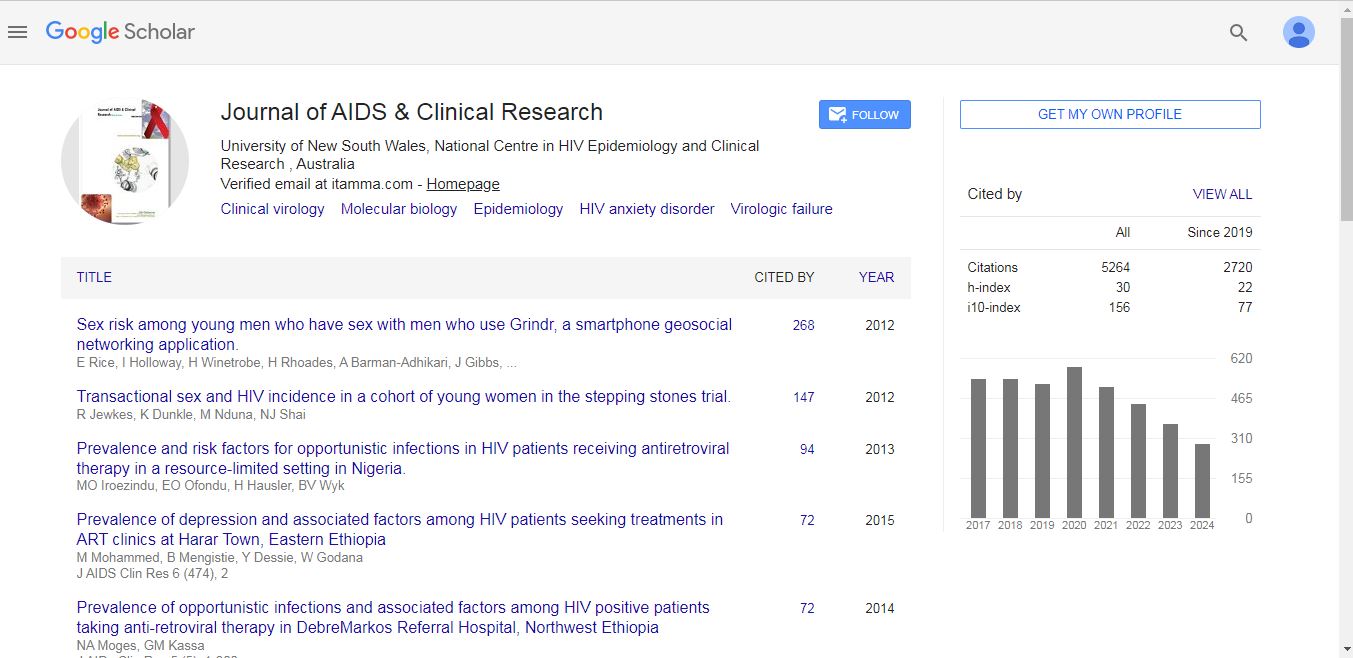
Journal of AIDS & Clinical Research received 5264 citations as per Google Scholar report