Perspective - (2025) Volume 16, Issue 6
Received: 01-Dec-2025, Manuscript No. jar-25-177636;
Editor assigned: 03-Dec-2025, Pre QC No. P-177636;
Reviewed: 17-Dec-2025, QC No. Q-177636;
Revised: 22-Dec-2025, Manuscript No. R-177636;
Published:
29-Dec-2025
, DOI: 10.37421/2155-6113.2025.16.1098
Citation: Aisyah, Siti Nur. ”HIV: Gains, Gaps, and the Path Forward.”
J AIDS Clin Res 16 (2025):1098.
Copyright: © 2025 Aisyah N. Siti This is an open-access article distributed under the terms of the Creative Commons Attribution License, which permits unrestricted use,
distribution and reproduction in any medium, provided the original author and source are credited.
The global HIV epidemic remains a significant public health challenge, yet substantial progress has been made in its control through various comprehensive strategies. Understanding the current epidemiological trends, the ongoing challenges in prevention, and advancements in treatment strategies is crucial to achieving global targets. The uneven distribution of the epidemic necessitates integrated approaches to meet the 95-95-95 targets, emphasizing combination prevention, early diagnosis, and sustained access to antiretroviral therapy (ART). Despite considerable strides, disparities in access and outcomes persist, particularly in resource-limited settings, which means targeted interventions and robust health systems are essential [1].
Africa, a region disproportionately affected, has seen significant advancements and persistent hurdles in the fight against HIV/AIDS. Progress in scaling up ART and prevention initiatives has led to a notable decline in new infections and AIDS-related deaths. Still, inequities in access to services, pervasive stigma, resource constraints, and the need for sustained political commitment continue to challenge efforts to end the epidemic [2].
A critical HIV prevention tool, oral Pre-Exposure Prophylaxis (PrEP), has seen global expansion, with its effectiveness and implementation progress being well-documented. Successes in scaling up PrEP have occurred in various settings, but significant challenges remain concerning awareness, uptake, adherence, and equitable access, especially among key populations and in resource-limited regions. Diversified PrEP delivery models, sustained funding, and integrated sexual health services are necessary to maximize its impact and contribute to ending the HIV epidemic [3].
Significant global efforts and advancements have been made in eliminating mother-to-child transmission (EMTCT) of HIV. This progress is largely due to the widespread implementation of antiretroviral regimens for pregnant and breastfeeding women living with HIV. Strategic frameworks have driven these successes, although challenges persist in ensuring universal access to testing, treatment, and follow-up care, particularly in high-burden settings. Integrated maternal and child health services are vital to achieve complete EMTCT and sustain these gains [4].
Innovations in HIV diagnostic technologies are profoundly impacting global testing efforts and linkage to care. Recent advancements in rapid diagnostic tests, point-of-care assays, and methods for early infant diagnosis are crucial for reaching the UNAIDS 95-95-95 targets. However, ensuring equitable access to these technologies, especially in resource-limited settings, remains a challenge. Robust health systems and strategic implementation are key to maximizing their public health benefit [5].
The financial landscape of the global HIV response also plays a pivotal role. Assessing the sustainability of current funding models and proposing future directions is important. Trends in international and domestic resource allocation highlight the critical need for continued investment to sustain progress and achieve ambitious epidemic control targets. Potential funding plateaus pose challenges, making it important to optimize resource utilization, strengthen local ownership, and innovate financing mechanisms to ensure a resilient and effective global response [6].
Implementation science is crucial for translating effective HIV prevention interventions into widespread public health practice. Reviewing the current state of the field highlights successful strategies for integrating research findings into policy and programs worldwide. Key gaps and challenges include adapting interventions to diverse contexts, ensuring equity, and scaling up evidence-based approaches. Stronger partnerships between researchers, implementers, and policymakers are advocated to accelerate the impact of prevention efforts and work toward ending the HIV epidemic [7].
The growing global challenge of managing multimorbidity in people aging with HIV is another critical area. As this demographic increasingly benefits from effective ART, the prevalence and impact of non-AIDS comorbidities such as cardiovascular disease, renal disease, and bone disorders across different geographical regions become more apparent. Integrated, patient-centered care models are necessary to address both HIV and co-occurring conditions, with interdisciplinary approaches improving quality of life and long-term health outcomes for this population [8].
HIV cure research is a dynamic field, with promising strategies being investigated globally despite significant hurdles. Approaches like "shock and kill," gene therapy, and immune-based interventions aim to achieve viral remission or eradication. The complexities of the HIV reservoir, the challenges in translating laboratory findings into clinical practice, and the critical need for sustained international collaboration and funding are all factors that need attention to accelerate progress towards a functional or sterilizing cure [9].
Finally, the profound influence of social determinants of health on the global HIV epidemic is evident. Factors like poverty, inequality, education, and access to healthcare shape vulnerability to HIV infection and access to treatment. This global overview illustrates how these structural inequities perpetuate the epidemic, particularly among marginalized and key populations. Comprehensive, rights-based approaches that address these underlying social and economic drivers are advocated to achieve equitable and sustainable progress in the HIV response worldwide [10].
The global HIV epidemic continues to be a major health concern, yet the collective efforts to combat it have led to remarkable progress. A comprehensive understanding of the epidemic involves detailing current epidemiological trends, ongoing prevention challenges, and significant advancements in treatment strategies. It is clear that the epidemicâ??s uneven distribution requires integrated approaches, with a focus on meeting the UNAIDS 95-95-95 targets through combination prevention, early diagnosis, and consistent access to Antiretroviral Therapy (ART). Despite these gains, inequities in access to care and varying outcomes persist, particularly in resource-limited settings, highlighting the need for targeted interventions and robust health systems [C001].
Africa, a region severely impacted by HIV, has made substantial strides while still facing considerable hurdles. The scaling up of ART and widespread prevention initiatives have significantly reduced new infections and AIDS-related deaths. However, persistent challenges like unequal access to services, social stigma, resource constraints, and the ongoing need for political commitment complicate the efforts to completely end the epidemic on the continent [C002]. A key prevention strategy, oral Pre-Exposure Prophylaxis (PrEP), has seen extensive global implementation, proving its effectiveness. Yet, issues of public awareness, uptake rates, adherence, and equitable access remain, particularly for key populations and in areas with limited resources. To maximize PrEP's impact and contribute to ending the HIV epidemic, diversified delivery models, sustained funding, and integrated sexual health services are essential [C003]. Additionally, significant global progress has been achieved in eliminating Mother-to-Child Transmission (EMTCT) of HIV, largely due to broad implementation of antiretroviral regimens for pregnant and breastfeeding women. While strategic frameworks have driven these successes, challenges endure in guaranteeing universal access to testing, treatment, and follow-up care, especially in high-burden settings. Integrated maternal and child health services are vital for achieving complete EMTCT and maintaining these important gains [C004].
Advancements in HIV diagnostic technologies are transforming global testing efforts and linkage to care. Innovations such as rapid diagnostic tests, point-of-care assays, and methods for early infant diagnosis are critical for achieving the UNAIDS 95-95-95 targets. Ensuring fair access to these technologies, particularly in resource-limited settings, presents an ongoing challenge. Effective public health benefits depend on robust health systems and strategic implementation [C005]. The financial aspects of the global HIV response are also under scrutiny, with an assessment of current funding models and future directions being paramount. Trends in international and domestic resource allocation highlight the crucial need for continued investment to sustain progress and meet ambitious epidemic control targets. Overcoming potential funding plateaus means optimizing resource utilization, strengthening local ownership, and innovating financing mechanisms to ensure a resilient and effective global response [C006].
Implementation science plays a crucial role in translating effective HIV prevention interventions into widespread public health practice. A review of the field reveals successful strategies for integrating research findings into policy and programs worldwide. Key gaps include adapting interventions to diverse contexts, ensuring equity, and scaling up evidence-based approaches. Stronger partnerships between researchers, implementers, and policymakers are essential to accelerate the impact of prevention efforts and hasten the end of the HIV epidemic [C007]. As people with HIV age, benefiting from effective ART, managing multimorbidity presents a growing global challenge. The prevalence and impact of non-AIDS comorbidities like cardiovascular disease, renal disease, and bone disorders vary across regions. Integrated, patient-centered care models are necessary, addressing both HIV and co-occurring conditions through interdisciplinary approaches to improve quality of life and long-term health outcomes for this population [C008].
Research into an HIV cure is a dynamic area, with promising strategies being explored globally, despite significant remaining hurdles. Approaches like "shock and kill," gene therapy, and immune-based interventions aim for viral remission or eradication. The complexities of the HIV reservoir, the difficulties in translating laboratory findings into clinical practice, and the critical need for sustained international collaboration and funding are all factors that influence the pace of progress towards a functional or sterilizing cure [C009]. Lastly, social determinants of health profoundly influence the global HIV epidemic. Factors such as poverty, inequality, education, and access to healthcare shape vulnerability to infection and treatment access. These structural inequities perpetuate the epidemic, especially among marginalized and key populations. Comprehensive, rights-based approaches addressing these underlying social and economic drivers are advocated to achieve equitable and sustainable progress in the HIV response worldwide [C010].
The global fight against HIV has seen significant progress, marked by advancements in Antiretroviral Therapy (ART), expanded prevention strategies like oral Pre-Exposure Prophylaxis (PrEP), and near elimination of mother-to-child transmission. Diagnostic technologies have evolved, enhancing early detection and linkage to care. However, substantial challenges persist, including the uneven distribution of the epidemic, inequities in access to services, and the pervasive impact of social stigma and resource constraints, particularly in Africa and other resource-limited settings. Addressing the financial sustainability of the global response, optimizing funding, and leveraging implementation science are crucial. Furthermore, managing multimorbidity in aging people with HIV and accelerating cure research remain key priorities. Ultimately, a comprehensive, rights-based approach that tackles underlying social determinants of health is essential to achieve equitable and lasting control of the HIV epidemic worldwide.
Indexed at, Google Scholar, Crossref
Indexed at, Google Scholar, Crossref
Indexed at, Google Scholar, Crossref
Indexed at, Google Scholar, Crossref
Indexed at, Google Scholar, Crossref
Indexed at, Google Scholar, Crossref
Indexed at, Google Scholar, Crossref
Indexed at, Google Scholar, Crossref
Indexed at, Google Scholar, Crossref
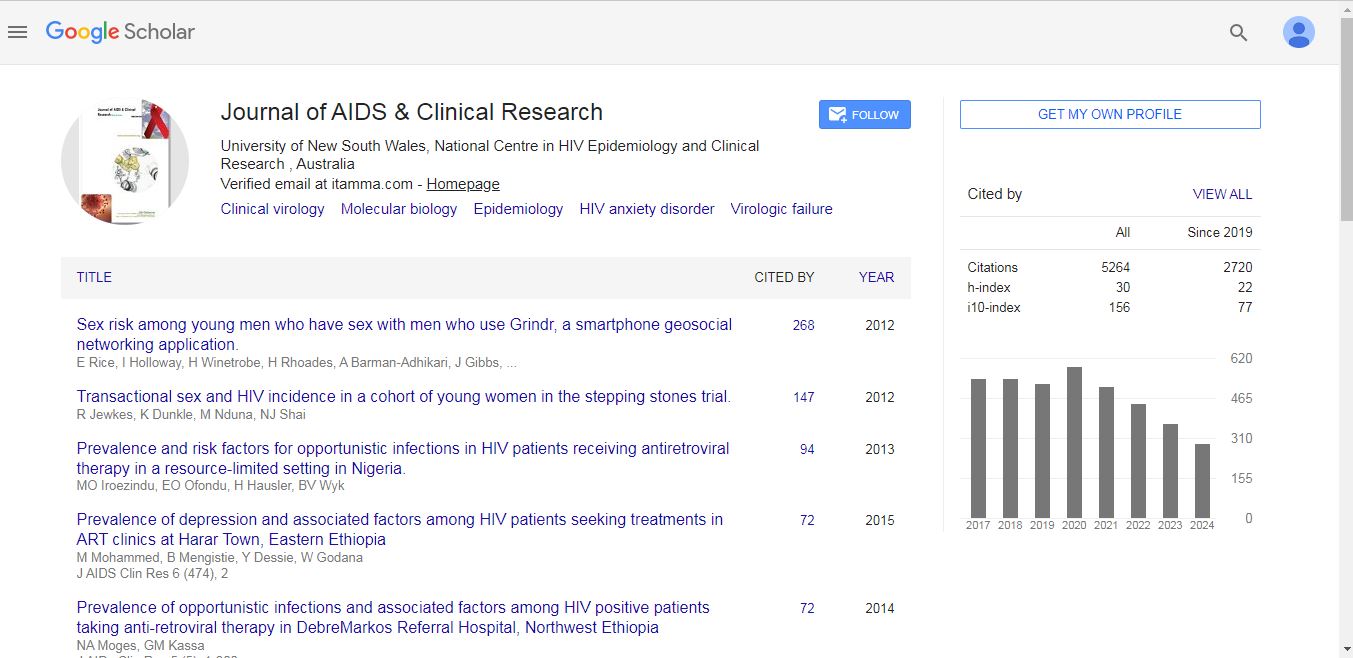
Journal of AIDS & Clinical Research received 5264 citations as per Google Scholar report