Commentary - (2025) Volume 16, Issue 4
Received: 04-Aug-2025, Manuscript No. jar-25-177603;
Editor assigned: 06-Aug-2025, Pre QC No. P-177603;
Reviewed: 20-Aug-2025, QC No. Q-177603;
Revised: 25-Aug-2025, Manuscript No. R-177603;
Published:
01-Sep-2025
, DOI: 10.37421/2155-6113.2025.16.1073
Citation: Martínez, Laura. ”HIV Diagnosis: Progress, Accessibility,
and Hurdles.” J AIDS Clin Res 16 (2025):1073.
Copyright: © 2025 Martínez L. This is an open-access article distributed under the terms of the Creative Commons Attribution License, which permits unrestricted use,
distribution and reproduction in any medium, provided the original author and source are credited.
HIV self-testing has emerged as a groundbreaking approach, proving itself a powerful tool, particularly beneficial for younger demographics who might otherwise face barriers to traditional testing sites. Extensive research consistently demonstrates its high effectiveness and widespread acceptability, underscoring the critical need to make these tests readily available to reach broader populations. [1].
Rapid diagnostic tests (RDTs) serve as a cornerstone for widespread HIV screening initiatives globally. A comprehensive review firmly establishes their strong performance across diverse populations, significantly reinforcing their vital role in streamlining diagnosis and expanding testing coverage, especially in areas with limited resources. [2].
The early infant diagnosis of HIV holds paramount importance for timely intervention and improved outcomes. Recent work confirms that dried blood spots (DBS), a method offering considerable simplification in sample collection and transport, exhibit diagnostic accuracy comparable to more conventional whole blood samples. This makes DBS a remarkably viable and practical option for infants, particularly those residing in remote and underserved regions. [3].
A precise understanding of the HIV seroconversion window period for modern assays is absolutely essential for achieving accurate and timely diagnoses. A thorough analysis highlights the substantially reduced window period associated with 4th generation combination tests, indicating that HIV infections can now be detected much earlier than was possible with previous testing generations, a critical advancement for patient management. [4].
Point-of-care (POC) molecular tests present significant advantages, particularly for HIV viral load monitoring and early infant diagnosis. This review compellingly emphasizes their accuracy and considerable potential to decentralize testing services. By speeding up the delivery of results, POC tests enable more timely clinical decisions, which is especially impactful in settings where robust laboratory infrastructure is scarce. [5].
Consistent HIV testing during the course of pre-exposure prophylaxis (PrEP) is fundamental for preventing new infections and ensuring the safety of patients. Research in this area indicates that adherence to established testing guidelines can vary considerably, thereby pointing to specific areas where educational efforts and support mechanisms must be improved for both healthcare providers and individuals using PrEP. [6].
The effective implementation of the World Health Organizationâ??s (WHO) HIV diagnostic testing algorithms within routine care settings is foundational for ensuring accurate and efficient diagnosis on a broad scale. A comprehensive review examines how these critical algorithms are being adopted in real-world scenarios, concurrently identifying both practical challenges encountered and successful strategies employed for their widespread and effective deployment. [7].
The HIV testing cascade, which encompasses the entire journey from initial testing to subsequent linkage to care, is inherently a complex process. A detailed analysis reveals significant gaps within this cascade, particularly evident in resource-limited settings. This pinpoints specific junctures where individuals are frequently lost along the pathway, and addressing these points is unequivocally key to enhancing overall treatment and prevention outcomes. [8].
Key populations often confront unique and profound challenges when attempting to access HIV testing services and subsequent linkage to care. This comprehensive review meticulously identifies pervasive barriers, such as pervasive stigma and widespread discrimination. Conversely, it also highlights crucial facilitators, including innovative community-led initiatives. This underscores the urgent need for highly tailored interventions designed specifically to reach these vulnerable groups in low- and middle-income countries. [9].
The rigorous evaluation of the diagnostic accuracy of rapid diagnostic tests for HIV-1/2 antibodies holds immense importance for global health programs dedicated to combating the epidemic. This systematic review provides robust and compelling evidence of their inherent reliability, definitively confirming their suitability for expansive, large-scale screening efforts and initial diagnosis, a factor absolutely vital for effective control of the epidemic. [10].
Advances in HIV diagnostics are fundamentally transforming how infections are detected and managed globally. HIV self-testing has emerged as a crucial innovation, especially effective for younger demographics, by improving access and acceptability where traditional sites might fall short [1]. These self-tests facilitate early engagement with the healthcare system, bridging gaps in reaching those at higher risk. Rapid diagnostic tests (RDTs) remain foundational for widespread screening, consistently showing strong performance across diverse populations. Their ability to simplify diagnosis is particularly beneficial in resource-limited settings, where they expand testing coverage significantly [2]. Furthermore, the development of 4th generation combination assays represents a major leap, substantially reducing the HIV seroconversion window period. This means infections can be identified much earlier, enabling quicker intervention and potentially limiting further transmission [4].
Beyond general screening, specialized testing methods address particular needs. Early infant diagnosis (EID) of HIV is critical for the health of newborns. Research confirms that dried blood spots (DBS) provide diagnostic accuracy comparable to whole blood samples, making sample collection and transport far simpler and more practical for infants, especially in remote areas [3]. Point-of-care (POC) molecular tests offer another significant advantage, particularly for viral load monitoring and EID. These tests are accurate and have the potential to decentralize testing, thereby accelerating result delivery and supporting timely clinical decisions in areas with limited laboratory infrastructure [5]. Meanwhile, for individuals on pre-exposure prophylaxis (PrEP), consistent HIV testing is paramount. Studies indicate that adherence to these testing guidelines can vary, underscoring the need for improved education and support for both healthcare providers and PrEP users to ensure patient safety and prevent new infections [6].
The effectiveness of these advanced diagnostic tools hinges on robust implementation strategies and overcoming systemic challenges. Implementing the World Health Organizationâ??s (WHO) HIV diagnostic testing algorithms in routine care settings is essential for accurate and efficient diagnosis. A comprehensive review highlights the practical challenges in their real-world adoption and identifies successful strategies for widespread and effective use, emphasizing the need for tailored approaches to integration [7]. Here's the thing, the entire HIV testing cascadeâ??from initial diagnosis through linkage to careâ??is a complex pathway. Analysis reveals significant gaps within this cascade, especially in resource-limited settings, where people are often lost along the way. Addressing these specific points of attrition is crucial for improving overall treatment and prevention outcomes [8].
What this really means is that specific attention must be paid to key populations, who frequently face unique challenges in accessing HIV testing and subsequent linkage to care. This review identifies formidable barriers, including pervasive stigma and entrenched discrimination. However, it also brings to light powerful facilitators, such as community-led initiatives, emphasizing the urgent necessity for interventions that are specifically tailored to reach these vulnerable groups in low- and middle-income countries [9]. Moreover, a critical look at the diagnostic accuracy of rapid diagnostic tests for HIV-1/2 antibodies confirms their reliability. This strong evidence reinforces their suitability for large-scale screening and initial diagnosis, which remains a vital component of global health programs and epidemic control efforts [10]. Overall, continuous innovation in testing methodologies combined with strategic implementation and targeted interventions is essential to advance global efforts against HIV.
The landscape of HIV diagnosis is continuously evolving, with significant advancements aimed at improving accessibility and accuracy. HIV self-testing has emerged as a crucial tool, particularly for younger demographics, proving effective and acceptable while extending reach beyond traditional clinics. Rapid diagnostic tests form the bedrock of widespread screening, consistently demonstrating strong performance across diverse populations and simplifying diagnosis, especially in resource-limited areas. For early infant diagnosis, dried blood spots offer a practical and accurate alternative to whole blood samples, easing collection and transport challenges. Modern diagnostic approaches also include 4th generation combination assays, which significantly reduce the HIV seroconversion window period, allowing for earlier detection. Point-of-care molecular tests further enhance viral load monitoring and early infant diagnosis by offering accurate, decentralized testing, thus enabling quicker clinical decisions where laboratory infrastructure is limited. However, implementing these advancements effectively faces challenges. Adherence to HIV testing guidelines during PrEP can vary, highlighting the need for better education and support. The implementation of WHO's diagnostic testing algorithms in routine settings also presents practical hurdles, requiring strategic approaches for widespread success. Moreover, the entire HIV testing cascade, from initial diagnosis to linkage to care, reveals critical gaps in resource-limited settings where individuals are often lost. Key populations, in particular, encounter unique barriers such as stigma and discrimination, though community-led initiatives serve as important facilitators. Ultimately, the diagnostic accuracy of rapid tests for HIV-1/2 antibodies remains high, underpinning their vital role in global health programs for large-scale screening and initial diagnosis, crucial for epidemic control.
Indexed at, Google Scholar, Crossref
Indexed at, Google Scholar, Crossref
Indexed at, Google Scholar, Crossref
Indexed at, Google Scholar, Crossref
Indexed at, Google Scholar, Crossref
Indexed at, Google Scholar, Crossref
Indexed at, Google Scholar, Crossref
Indexed at, Google Scholar, Crossref
Indexed at, Google Scholar, Crossref
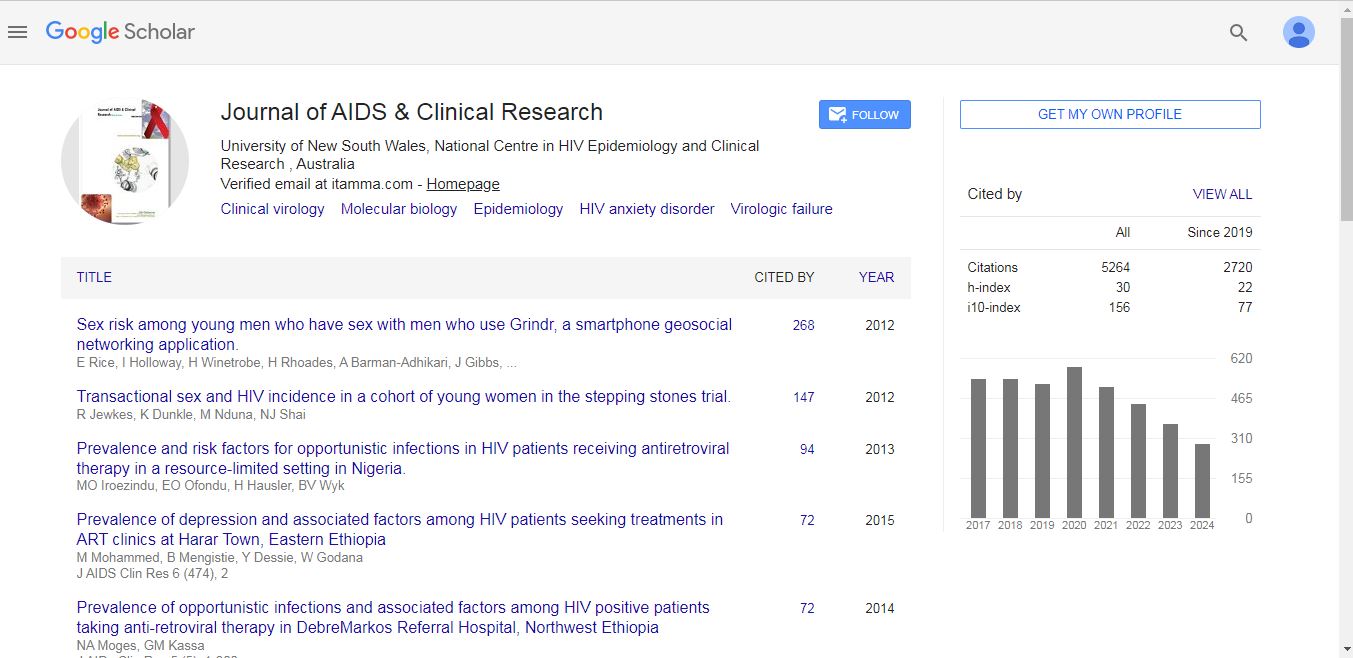
Journal of AIDS & Clinical Research received 5264 citations as per Google Scholar report