Opinion - (2025) Volume 16, Issue 2
Received: 01-Apr-2025, Manuscript No. jar-25-176269;
Editor assigned: 03-Apr-2025, Pre QC No. P-176269;
Reviewed: 17-Apr-2025, QC No. Q-176269;
Revised: 22-Apr-2025, Manuscript No. R-176269;
Published:
29-Apr-2025
, DOI: 10.37421/2155-6113.2025.16.1055
Citation: Appiah, Kofi. "HIV: Advances, Cure, Prevention, and
Care." J AIDS Clin Res 16 (2025):1055.
Copyright: © 2025 Appiah K. This is an open-access article distributed under the terms of the Creative Commons Attribution License, which permits unrestricted use,
distribution and reproduction in any medium, provided the original author and source are credited.
This review discusses the complex nature of the HIV-1 latent reservoir, which persists despite effective antiretroviral therapy (ART) and represents the main barrier to an HIV cure. It explores the mechanisms underlying reservoir establishment and maintenance, and evaluates current strategies, including 'shock and kill' and 'block and lock,' along with promising immunotherapeutic approaches aimed at reducing or eliminating the reservoir [1].
This review delves into the evolving understanding of HIV-associated neurocognitive disorder (HAND) in the context of effective antiretroviral therapy (ART). It highlights the ongoing challenges, including persistent inflammation and neuronal injury, that contribute to HAND even when systemic viral load is suppressed. The article discusses various cellular and molecular mechanisms involved and proposes future research avenues for diagnosis and treatment [2].
This review provides an overview of long-acting antiretroviral therapy (LA-ART), emphasizing its potential to improve adherence, reduce pill burden, and overcome stigma associated with daily oral medication. It covers the current state of injectable LA-ART regimens, such as cabotegravir and rilpivirine, and discusses emerging agents and formulations that could further transform HIV prevention and treatment landscapes [3].
This article reviews significant advancements in HIV prevention strategies, particularly focusing on the widespread implementation and impact of pre-exposure prophylaxis (PrEP). It explores the efficacy of oral and injectable PrEP, discusses implementation challenges, and examines future directions, including new PrEP modalities and the integration of PrEP into broader sexual health services to maximize its public health benefit [4].
This review addresses the increasing complexity of managing HIV in an aging population, as advances in antiretroviral therapy have led to improved longevity for people with HIV. It highlights the elevated risk of age-associated non-AIDS comorbidities, such as cardiovascular disease, kidney disease, and neurocognitive decline, emphasizing the need for integrated, multidisciplinary care models tailored to older adults living with HIV [5].
This article examines the ongoing challenge of HIV-1 drug resistance in the era of potent antiretroviral therapy. It discusses the mechanisms of resistance development, the impact of transmitted and acquired resistance on treatment outcomes, and the importance of routine resistance testing. The review also explores strategies for managing drug-resistant HIV, including the development of new drug classes and optimal sequencing of therapies [6].
This review focuses on the current understanding of HIV-1 latency, a critical barrier to eradicating the virus. It describes the characteristics of latently infected cells and the molecular mechanisms that maintain latency. The authors discuss various strategies under investigation for reactivating and eliminating these cells, including "shock and kill" approaches and gene editing, emphasizing the multidisciplinary effort required to achieve a functional or sterile cure [7].
This article provides a comprehensive overview of HIV-1 pathogenesis, from initial infection to the establishment of chronic infection and AIDS, highlighting the intricate interplay between the virus and the host immune system. It also discusses how advances in understanding viral replication and immune evasion have informed the development of antiretroviral therapies and the ongoing efforts towards finding a definitive cure for HIV [8].
This review outlines the dramatic transformation of the clinical landscape of HIV infection since the advent of effective antiretroviral therapy. It details how HIV has shifted from a rapidly fatal disease to a manageable chronic condition, but also emphasizes the emergence of new clinical challenges, such as non-AIDS comorbidities, and the importance of lifelong adherence to ART for maintaining health and preventing transmission [9].
This article explores the current state of the global HIV-1 epidemic and the persistent challenges in developing an effective vaccine. It discusses the biological complexities of HIV-1, including its high genetic variability and ability to evade immune responses, which have hampered vaccine development efforts. The review highlights promising avenues of research, such as broadly neutralizing antibodies and novel vaccine platforms, necessary to achieve durable protection [10].
Effective antiretroviral therapy (ART) has dramatically transformed HIV infection from a rapidly fatal disease into a manageable chronic condition, significantly extending the lifespan for people living with HIV [9]. Despite this success, a major barrier to a definitive cure is the complex HIV-1 latent reservoir, where the virus persists in cells despite ART [1]. This reservoir necessitates advanced strategies to reduce or eliminate it, presenting a substantial research challenge in the field [1].
Current research delves deep into the mechanisms underlying the establishment and maintenance of the HIV-1 latent reservoir, exploring innovative approaches. Strategies such as 'shock and kill' and 'block and lock' are being evaluated, alongside promising immunotherapeutic techniques aimed at reservoir reduction or elimination [1]. Moreover, understanding the molecular mechanisms that maintain latency and characteristics of latently infected cells is crucial. Investigators are actively exploring various methods for reactivating and eliminating these cells, including gene editing, highlighting the multidisciplinary effort required for a functional or sterile cure [7].
A comprehensive understanding of HIV-1 pathogenesis, spanning from initial infection to the establishment of chronic infection and AIDS, continues to inform both the development of antiretroviral therapies and ongoing cure efforts. This intricate interplay between the virus and the host immune system is central to therapeutic advancements [8]. In this context, long-acting antiretroviral therapy (LA-ART) offers significant potential to improve patient adherence, reduce daily pill burden, and overcome the social stigma often associated with daily oral medication. Current injectable LA-ART regimens, such as cabotegravir and rilpivirine, are already making an impact, and future formulations promise further transformation in HIV prevention and treatment [3].
Significant strides have been made in HIV prevention, notably through the widespread implementation of pre-exposure prophylaxis (PrEP). The efficacy of both oral and injectable PrEP is well-established, though challenges in implementation persist. Future efforts focus on new PrEP modalities and integrating PrEP into broader sexual health services [4]. However, HIV-1 drug resistance remains an evolving concern. It demands routine testing and the development of new drug classes and optimal treatment sequencing to effectively manage transmitted and acquired resistance [6]. Furthermore, as individuals with HIV live longer thanks to ART, managing an aging population introduces complexities, including an elevated risk of non-AIDS comorbidities like cardiovascular disease and neurocognitive decline. Tailored, multidisciplinary care models are increasingly necessary for these older adults [5].
HIV-associated neurocognitive disorder (HAND) continues to be a persistent issue, even when systemic viral loads are suppressed. This disorder is driven by ongoing inflammation and neuronal injury, prompting research into its cellular and molecular mechanisms to improve diagnosis and treatment strategies [2]. Finally, addressing the global HIV-1 epidemic includes the persistent challenge of developing an effective vaccine. The biological complexities of HIV-1, characterized by high genetic variability and immune evasion, have historically hindered vaccine development. Nevertheless, promising research avenues, such as broadly neutralizing antibodies and novel vaccine platforms, are being explored to achieve durable protection against the virus [10].
HIV remains a significant global health challenge, despite advancements in antiretroviral therapy (ART) that have transformed it into a manageable chronic condition. A major barrier to a definitive cure is the HIV-1 latent reservoir, where the virus persists in cells, evading ART. Research explores mechanisms of reservoir establishment and maintenance, evaluating strategies like 'shock and kill' and 'block and lock,' alongside immunotherapeutic approaches to reduce or eliminate this reservoir. Concurrently, the management of HIV is evolving. With increased longevity due to ART, clinicians now face an aging HIV-positive population with a heightened risk of non-AIDS comorbidities, including cardiovascular disease, kidney disease, and neurocognitive decline. Integrated, multidisciplinary care models are becoming essential for these older adults. HIV-associated neurocognitive disorder (HAND) continues to pose challenges, marked by persistent inflammation and neuronal injury even with suppressed viral loads, necessitating further research into diagnosis and treatment. Innovations in treatment and prevention are critical. Long-acting ART (LA-ART), including injectable regimens like cabotegravir and rilpivirine, offers potential to improve adherence, lessen pill burden, and reduce stigma. Significant progress in prevention includes widespread Pre-Exposure Prophylaxis (PrEP) implementation, with ongoing efforts to address challenges, explore new modalities, and integrate PrEP into broader sexual health services. However, HIV-1 drug resistance remains an evolving concern, requiring routine testing and the development of new drug classes to manage resistant strains. Understanding HIV-1 pathogenesis, from initial infection to chronic disease, continues to inform therapeutic developments and cure efforts. The persistent challenge of developing an effective HIV vaccine highlights the virus's biological complexities, such as high genetic variability and immune evasion. Research in this area focuses on promising avenues like broadly neutralizing antibodies and novel vaccine platforms. Overall, the landscape of HIV care is dynamic, balancing effective treatment with the pursuit of a cure, enhanced prevention, and comprehensive management of long-term complications.
Indexed at, Google Scholar, Crossref
Indexed at, Google Scholar, Crossref
Indexed at, Google Scholar, Crossref
Indexed at, Google Scholar, Crossref
Indexed at, Google Scholar, Crossref
Indexed at, Google Scholar, Crossref
Indexed at, Google Scholar, Crossref
Indexed at, Google Scholar, Crossref
Indexed at, Google Scholar, Crossref
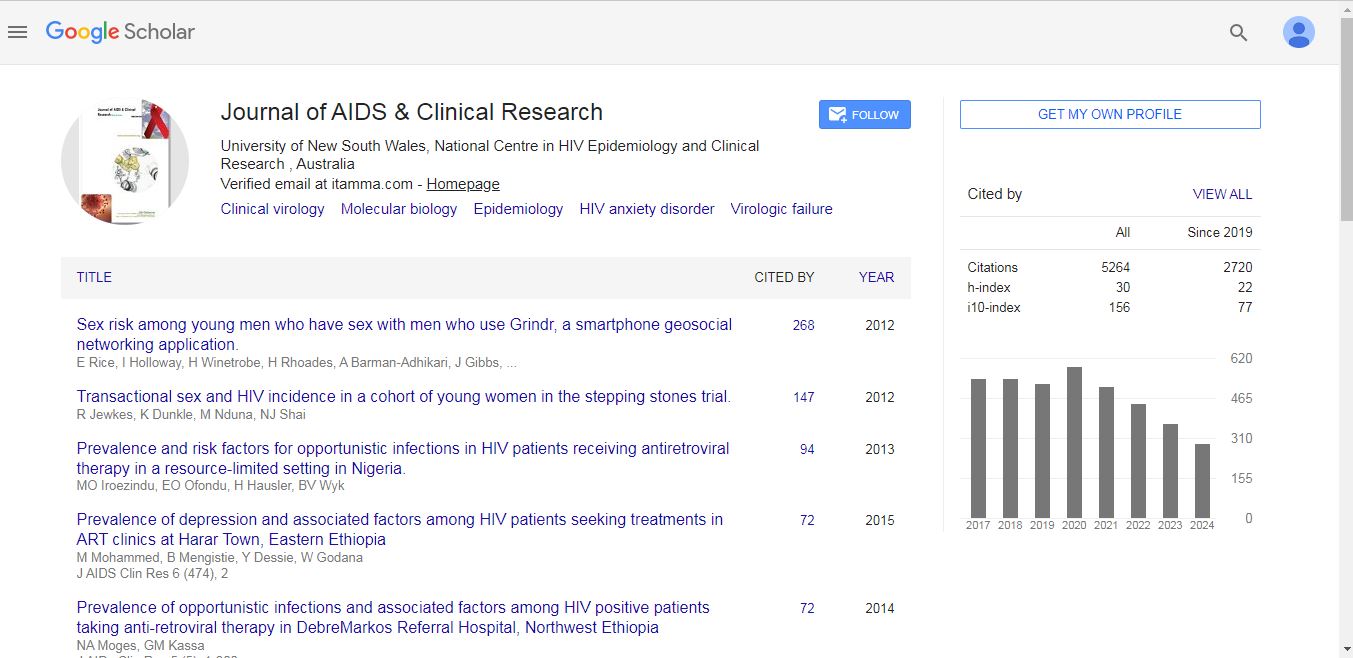
Journal of AIDS & Clinical Research received 5264 citations as per Google Scholar report