Perspective - (127) Volume 16, Issue 2
Received: 03-Mar-2025, Manuscript No. jch-26-178751;
Editor assigned: 05-Mar-2025, Pre QC No. P-178751;
Reviewed: 19-Mar-2025, QC No. Q-178751;
Revised: 24-Mar-2025, Manuscript No. R-178751;
Published:
31-Mar-2025
, DOI: 10.37421/2157-7099.2025.16.789
Citation: Mokoena, Thandiwe S.. ”Histological Tumor Grading: Progress and Future Directions.” J Cytol Histol 16 (2025):789.
Copyright: © 2025 Mokoena S. Thandiwe This is an open-access article distributed under the terms of the Creative Commons Attribution License, which permits unrestricted use, distribution and reproduction in any medium, provided the original author and source are credited.
Histological grading systems are fundamental in pathology, providing objective criteria to classify tumors based on cellular morphology and differentiation. These systems are crucial for predicting prognosis, guiding treatment decisions, and facilitating standardized communication among clinicians. The clinical relevance lies in how these grades translate into patient outcomes and therapeutic strategies [1].
The Gleason grading system for prostate cancer exemplifies the impact of histological grading on clinical management. Its systematic approach, combining primary and secondary patterns, significantly influences treatment choices, particularly for localized disease, and remains a cornerstone in predicting biochemical recurrence [2].
For breast cancer, the Nottingham grading system assesses tubule formation, nuclear pleomorphism, and mitotic activity. This tripartite system provides critical prognostic information and is integral to treatment planning, impacting decisions on endocrine therapy and chemotherapy [3].
The challenge in histological grading lies in achieving inter-observer reproducibility. Efforts to refine existing systems and develop new, more objective grading tools, often incorporating molecular markers, are ongoing to enhance diagnostic accuracy and prognostic power [4].
Beyond traditional morphological assessment, the integration of immunohistochemistry and molecular pathology is increasingly vital. These adjuncts can refine diagnoses, identify prognostically significant features not apparent morphologically, and predict response to targeted therapies, thereby augmenting the utility of histological grading [5].
The World Health Organization (WHO) Classification of Tumors provides a framework that often incorporates grading systems. Advances in the WHO classification reflect a deeper understanding of tumor biology, influencing how histological features are interpreted and graded, with direct clinical implications for patient care [6].
Specific grading systems exist for various tumor types, each tailored to their unique biological behavior and morphological characteristics. The accurate application of these site-specific grading systems is paramount for effective patient management [7].
The clinical relevance of histological grading extends to the design and interpretation of clinical trials. Standardized grading ensures that patient populations within trials are comparable, leading to more reliable conclusions about treatment efficacy [8].
Emerging technologies, such as artificial intelligence (AI) and digital pathology, are poised to revolutionize histological grading. AI algorithms can analyze vast amounts of image data, potentially improving accuracy, consistency, and efficiency in grading, thus enhancing clinical decision-making [9].
Ultimately, histological grading systems serve as a critical bridge between cellular morphology observed in tissue samples and the clinical reality faced by patients. Their ongoing refinement and integration with newer technologies are essential for advancing oncological care [10].
Histological grading systems are foundational in pathology, offering objective criteria for classifying tumors based on their cellular morphology and degree of differentiation. These classifications are indispensable for predicting patient prognosis, informing therapeutic strategies, and establishing standardized communication channels among healthcare professionals. The direct clinical significance of these grades is evident in their correlation with patient outcomes and the selection of appropriate treatment regimens [1].
A prime example of histological grading's influence on clinical practice is the Gleason grading system used for prostate cancer. This system systematically evaluates primary and secondary growth patterns, which profoundly impacts treatment decisions, especially for localized prostate cancer, and remains a key determinant in forecasting biochemical recurrence [2].
In the context of breast cancer, the Nottingham grading system, a modification of the Bloom-Richardson and Elston-Ellis methods, meticulously evaluates tubule formation, nuclear pleomorphism, and mitotic activity. This comprehensive three-component assessment yields crucial prognostic data and is integral to developing personalized treatment plans, including decisions regarding endocrine therapy and chemotherapy [3].
A significant hurdle in histological grading is the variability in interpretation among different pathologists, known as inter-observer reproducibility. Consequently, continuous efforts are dedicated to refining existing grading methodologies and developing novel, more objective grading tools, often incorporating molecular markers, to improve diagnostic precision and prognostic accuracy [4].
Complementing traditional morphological evaluations, the incorporation of immunohistochemistry and molecular pathology is becoming increasingly important. These advanced techniques can enhance diagnostic accuracy, identify prognostically relevant features that may not be discernible through morphology alone, and predict a patient's response to targeted therapies, thereby amplifying the value of histological grading [5].
The World Health Organization (WHO) Classification of Tumors provides a widely adopted framework that frequently integrates grading systems. Recent updates to the WHO classification reflect a more profound understanding of tumor biology, which in turn shapes the interpretation and grading of histological features, leading to direct clinical benefits for patients [6].
Each specific type of tumor has its own dedicated grading system, meticulously designed to reflect its unique biological behavior and distinct morphological characteristics. The precise and consistent application of these tumor-specific grading systems is crucial for ensuring optimal patient management [7].
The utility of histological grading extends significantly into the realm of clinical trials. By ensuring uniformity in the assessment of tumor grade across different study sites and patient cohorts, standardized grading facilitates the comparability of patient populations, leading to more robust and reliable conclusions regarding the efficacy of various treatments [8].
The advent of cutting-edge technologies like artificial intelligence (AI) and digital pathology heralds a transformative era for histological grading. AI algorithms possess the capability to analyze extensive volumes of image data, potentially leading to enhanced accuracy, consistency, and efficiency in the grading process, ultimately improving clinical decision-making [9].
In essence, histological grading systems act as a vital conduit connecting the microscopic observations of tumor cells in tissue samples with the tangible clinical realities experienced by patients. The continuous improvement of these systems and their integration with emerging technologies are paramount for the advancement of cancer care and patient outcomes [10].
Histological grading systems are essential in pathology for classifying tumors based on morphology and differentiation, aiding prognosis, treatment decisions, and clinical communication. Systems like Gleason for prostate cancer and Nottingham for breast cancer significantly impact management. Challenges include inter-observer variability, driving efforts toward more objective tools, including molecular markers and immunohistochemistry. The WHO Classification of Tumors incorporates these grading systems, reflecting advances in tumor biology. Site-specific systems are crucial for accurate patient care. Standardized grading improves clinical trial design and interpretation. Emerging technologies like AI and digital pathology promise to enhance grading accuracy and efficiency. Ultimately, grading bridges morphology and clinical reality, driving progress in oncological care.
None
None
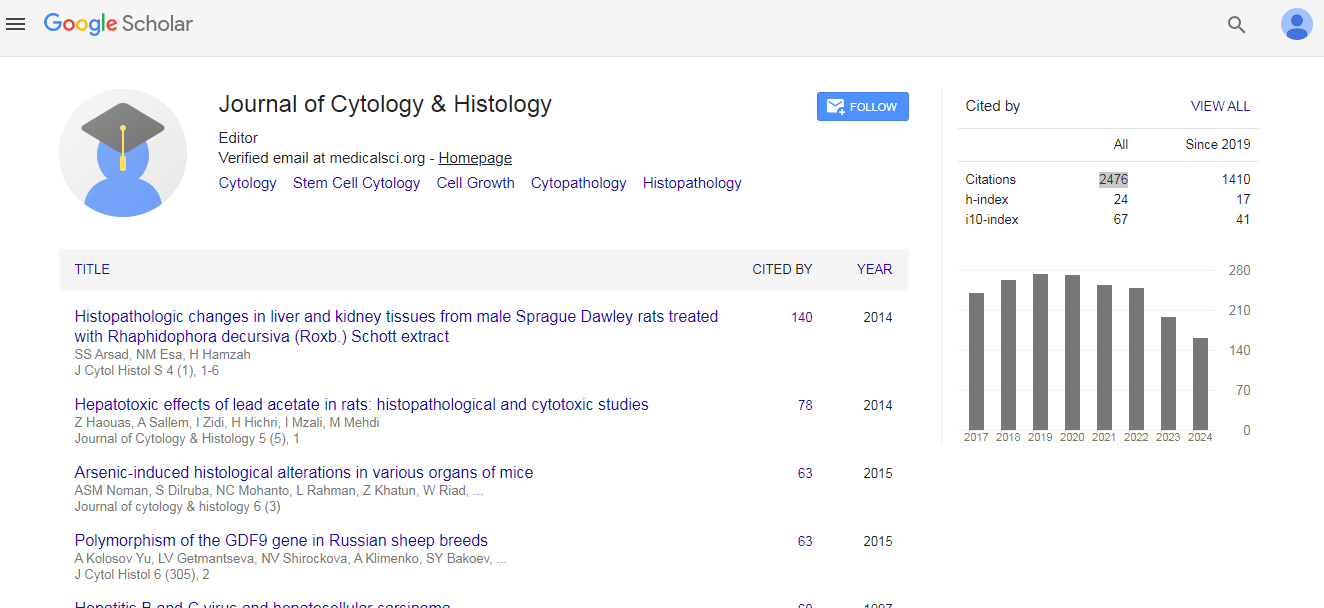
Journal of Cytology & Histology received 2476 citations as per Google Scholar report