Commentary - (2025) Volume 16, Issue 4
Received: 02-Jul-2025, Manuscript No. jch-26-178766;
Editor assigned: 04-Jul-2025, Pre QC No. P-178766;
Reviewed: 17-Jul-2026, QC No. Q-178766;
Revised: 23-Jul-2025, Manuscript No. R-178766;
Published:
30-Jul-2025
, DOI: 10.37421/2157-7099.2025.16.802
Citation: Fernandez, Maria T.. ”Histological and Cytological Markers for Precancerous Lesions.” J Cytol Histol 16 (2025):802.
Copyright: © 2025 Fernandez T. Maria This is an open-access article distributed under the terms of the Creative Commons Attribution License, which permits unrestricted use, distribution and reproduction in any medium, provided the original author and source are credited.
The early detection and management of precancerous lesions are paramount in modern oncology, demanding sophisticated diagnostic tools and strategies to prevent malignant transformation. Histological and cytological markers play a critical role in this endeavor, offering insights into cellular and tissue-based features that can predict the likelihood of progression. Advancements in these areas are crucial for improving diagnostic precision and enabling personalized patient stratification, which ultimately leads to more timely and targeted interventions. This approach aims to intercept the natural history of disease, preventing invasive cancers from developing. The integration of novel biomarkers and advanced imaging techniques with traditional histopathology further refines our ability to diagnose and manage these early-stage abnormalities. These efforts are vital for improving patient outcomes and reducing the burden of cancer [1].
In parallel, the field of molecular cytology has emerged as a powerful tool for identifying precancerous changes, particularly in areas like cervical cancer screening. The development and application of sensitive and specific molecular markers are revolutionizing our ability to detect infections like human papillomavirus (HPV) and cellular abnormalities that indicate early-stage disease. These molecular insights enhance risk assessment, guide treatment decisions, and contribute to a more personalized approach in screening and prevention programs. The findings from molecular techniques often complement and extend the information provided by traditional cytological methods, offering a more comprehensive diagnostic picture [2].
The gastrointestinal tract presents another significant area where advancements in diagnostic approaches for precancerous lesions are being made. Detailed histological analysis, coupled with immunophenotyping and genetic profiling, provides a more nuanced understanding of lesion progression. This detailed analysis allows for a refined prognostication and the tailoring of surveillance strategies for individuals at risk of gastrointestinal cancers. The evolution of these diagnostic methods is critical for early intervention and improved management of these at-risk populations [3].
Lung cancer screening and early detection strategies also heavily rely on the accurate identification of precancerous lesions. Cytological atypia and specific histological features observed in lung biopsies or cytologic samples are investigated for their correlation with the risk of developing lung cancer. The meticulous interpretation of cytopathological findings, alongside the exploration of emerging biomarkers, holds significant promise for improving the accuracy of early diagnosis and prognostication in the assessment of lung nodules, which can often be challenging to interpret [4].
Potentially malignant disorders in the oral cavity represent a significant public health concern, necessitating effective diagnostic tools for early detection. The analysis of various morphological changes and the expression of specific proteins in oral biopsies can indicate an increased risk of malignant transformation. This highlights the critical need for consistent and accurate pathological assessment to guide clinical management and, most importantly, to prevent the development of oral cancer through timely intervention [5].
The urinary bladder is another critical site where precancerous lesions, such as urothelial carcinoma in situ, require accurate diagnostic markers. Immunohistochemical markers are being employed to enhance diagnostic accuracy, helping to differentiate benign conditions from those with a high risk of progression to invasive urothelial carcinoma. This precise differentiation is crucial for guiding therapeutic strategies and ultimately improving patient outcomes by ensuring appropriate management based on risk stratification [6].
Endometrial precancerous lesions, particularly endometrial hyperplasia with varying degrees of atypia, pose a risk for developing endometrial cancer. Evaluating cytological and histological markers in these lesions is essential for correlating them with the risk of malignant transformation. The aim is to refine diagnostic criteria and improve the prediction of malignant potential, thereby optimizing patient management and follow-up strategies for women at risk [7].
In dermatological oncology, the assessment of precancerous skin lesions, such as actinic keratoses and squamous cell carcinoma in situ, benefits significantly from advanced histological techniques and molecular markers. These markers enhance diagnostic precision and allow for patient stratification based on their risk of progression. This detailed risk assessment informs treatment strategies and surveillance protocols, ensuring that patients receive appropriate care based on their individual risk profile [8].
The early detection of breast cancer often involves the evaluation of precancerous lesions within the breast tissue. Cytological and histological evaluations play a crucial role in distinguishing benign abnormalities from those with a high risk of malignant transformation. The accurate pathological assessment of these lesions is paramount for guiding clinical management and improving the overall effectiveness of breast cancer prevention strategies [9].
Finally, the prostate gland presents with precancerous lesions like prostatic intraepithelial neoplasia (PIN), which is associated with an increased risk of subsequent prostate cancer development. Subtle morphological changes and the expression of specific biomarkers are being investigated to improve risk stratification and guide prostate cancer screening and management. This focus on precise diagnosis and risk assessment is vital for optimizing the approach to prostate cancer detection and treatment [10].
The critical role of histological and cytological markers in the early detection and management of precancerous lesions is a cornerstone of preventive oncology. These markers, identified through microscopic examination of cellular and tissue morphology, provide indispensable information for predicting the likelihood of malignant transformation. By advancing diagnostic precision, clinicians can better stratify patients, enabling the implementation of timely and targeted interventions to halt disease progression. The integration of novel biomarkers and advanced imaging techniques with established histopathological methods further refines diagnostic capabilities and therapeutic decision-making, ultimately aiming to prevent the development of invasive cancers. This comprehensive approach ensures that individuals at risk receive the most appropriate and effective care, improving long-term outcomes [1].
Molecular cytology has emerged as a powerful adjunct in identifying precancerous changes, particularly in the context of cervical cancer screening. The development and application of sensitive and specific molecular markers for detecting human papillomavirus (HPV) infection and cellular abnormalities have significantly improved risk assessment and guided treatment decisions. This molecular approach contributes to a more personalized strategy for cervical cancer screening and prevention, often complementing traditional cytological methods by providing a deeper understanding of the underlying biological processes and risk factors [2].
Diagnostic approaches for precancerous lesions in the gastrointestinal tract are evolving, with a focus on advancements in histological grading and the identification of molecular markers. Detailed histological analysis, combined with immunophenotyping and genetic profiling, offers a more nuanced understanding of how these lesions progress. This comprehensive analysis is crucial for refining prognostication and tailoring surveillance strategies for patients identified as being at risk of gastrointestinal cancers, ensuring proactive management and early intervention [3].
In the realm of lung cancer, the diagnostic significance of cytological atypia and specific histological features in precancerous lesions is being rigorously investigated. Understanding the correlation between observed cellular morphology and the subsequent risk of developing lung cancer is critical. Meticulous cytopathological interpretation, coupled with the exploration of emerging biomarkers, holds substantial potential for enhancing the accuracy of early diagnosis and prognostication in the evaluation of lung nodules, a common challenge in clinical practice [4].
Potentially malignant disorders in the oral cavity necessitate precise diagnostic tools for early intervention. The investigation of various morphological changes and the expression of specific proteins in oral tissues serves to identify individuals at increased risk of malignant transformation. This underscores the vital importance of consistent and accurate pathological assessment to guide clinical management and effectively prevent the progression to oral cancer through prompt and appropriate treatment [5].
The accurate diagnosis of precancerous lesions in the urinary bladder, including urothelial carcinoma in situ, is significantly enhanced by the judicious use of immunohistochemical markers. These markers help to reliably differentiate benign conditions from those exhibiting a high risk of progression to invasive urothelial carcinoma. This precise distinction is fundamental in guiding therapeutic strategies and improving patient outcomes by ensuring that treatment is tailored to the specific risk profile of the individual [6].
Endometrial precancerous lesions, such as endometrial hyperplasia, require careful evaluation to predict the risk of developing endometrial cancer. The analysis of cytological and histological features of these lesions is crucial for correlating them with the likelihood of malignant transformation. Refining diagnostic criteria and improving the prediction of malignant potential are key objectives that enable optimized patient management and follow-up protocols, thereby enhancing the care of women at risk [7].
In the management of skin conditions, the assessment of precancerous skin lesions, including actinic keratoses and squamous cell carcinoma in situ, is significantly improved by advanced histological techniques and molecular markers. These tools enhance diagnostic precision and facilitate patient stratification based on their risk of progression. This detailed risk assessment is essential for informing treatment strategies and surveillance protocols, ensuring that interventions are appropriately matched to the individual's disease characteristics [8].
The early detection of breast cancer often relies on the careful evaluation of precancerous lesions within the breast tissue. Both cytological and histological assessments are vital in differentiating benign abnormalities from those with a heightened risk of malignant transformation. The accuracy of pathological assessment in these cases is paramount for guiding effective clinical management and advancing the overall strategies for breast cancer prevention [9].
Prostatic intraepithelial neoplasia (PIN) represents a significant precancerous lesion in the prostate, associated with an increased risk of subsequent prostate cancer development. The identification of subtle morphological changes and the expression of specific biomarkers are crucial for improving risk stratification and guiding prostate cancer screening and management decisions. This detailed approach to diagnosis and risk assessment is essential for optimizing the detection and treatment of prostate cancer [10].
This collection of research highlights the critical role of histological and cytological markers in the early detection and management of precancerous lesions across various anatomical sites, including the oral cavity, cervix, gastrointestinal tract, lungs, urinary bladder, endometrium, skin, breast, and prostate. Studies emphasize how analyzing cellular and tissue morphology, alongside molecular and immunohistochemical markers, improves diagnostic precision, risk stratification, and personalized treatment strategies. Advancements in these areas, including molecular cytology and advanced imaging, are crucial for preventing malignant transformation and improving patient outcomes. The research underscores the ongoing evolution of diagnostic approaches, aiming for earlier and more accurate identification of precancerous conditions to enable timely interventions and enhance cancer prevention efforts.
None
None
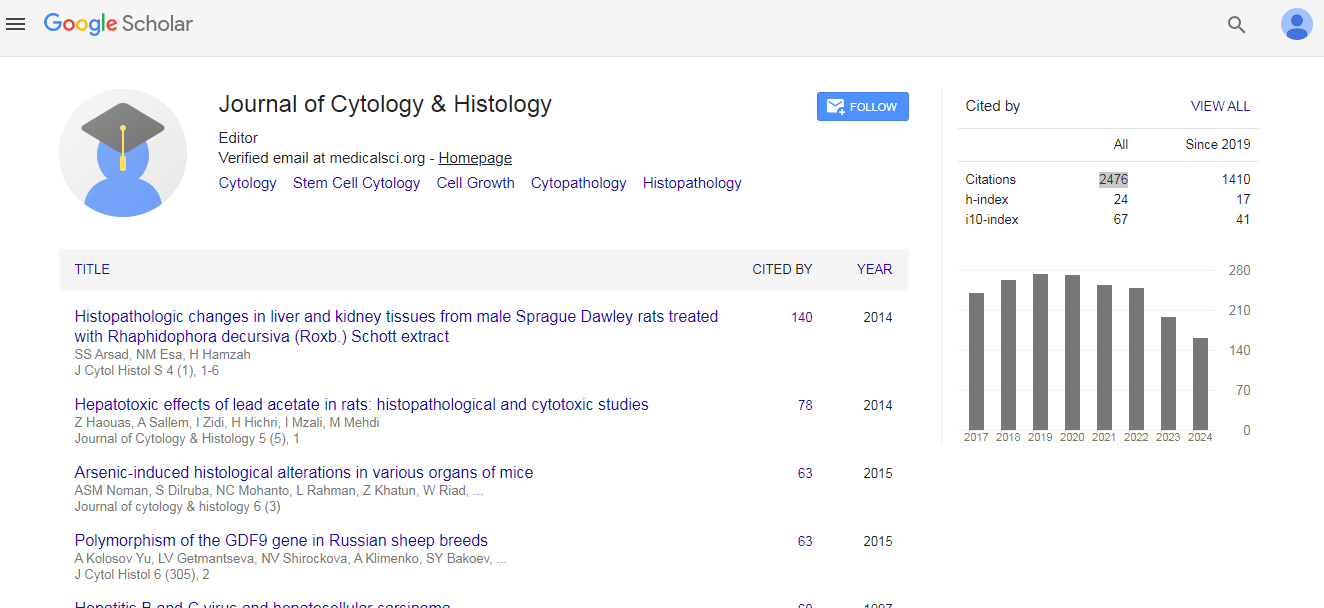
Journal of Cytology & Histology received 2476 citations as per Google Scholar report