Brief Report - (2025) Volume 15, Issue 3
Received: 01-Sep-2025, Manuscript No. jttr-25-175405;
Editor assigned: 03-Sep-2025, Pre QC No. P-175405;
Reviewed: 17-Sep-2025, QC No. Q-175405;
Revised: 22-Sep-2025, Manuscript No. R-175405;
Published:
29-Sep-2025
, DOI: 10.37421/2161-0991.2025.15.305
Citation: Marques, Helena. ”High-Resolution HLA: Transforming Diagnostics, Personalized Care.” J Transplant Technol Res 15 (2025):305.
Copyright: © 2025 Marques H. This is an open-access article distributed under the terms of the Creative Commons Attribution License, which permits unrestricted use, distribution and reproduction in any medium, provided the original author and source are credited.
Next-generation sequencing (NGS) has emerged as a superior method for high-resolution HLA typing, surpassing traditional sequence-specific oligonucleotide probe (SSOP) and sequence-specific primer (SSP) methods. This advanced approach provides enhanced resolution and accuracy in clinical settings, which is essential for successful transplantation outcomes by reducing ambiguity and offering a more comprehensive genetic profile [1].
The relationship between HLA typing and autoimmune diseases is a complex area of study, with direct implications for diagnosis, risk assessment, and broader insights into population genetics. Understanding specific HLA alleles can reveal susceptibilities to various diseases and influence progression, guiding the development of targeted therapeutic strategies [2].
Research continues to validate and develop accurate, high-throughput HLA typing methods utilizing NGS. This technology overcomes previous limitations, streamlining workflows for comprehensive allele identification, a critical factor for large-scale studies and efficient clinical assessments [3].
NGS-based HLA typing demonstrates significant clinical utility, particularly in solid organ transplantation. High-resolution HLA matching, made possible by NGS, directly improves donor-recipient compatibility. This leads to reduced rejection rates and significantly enhanced long-term graft survival for transplant recipients [4].
High-resolution HLA typing is critically important in managing patients with hematological malignancies, especially within the context of hematopoietic stem cell transplantation (HSCT). Precise HLA matching is fundamental for successful engraftment and mitigating graft-versus-host disease, ultimately improving patient prognosis in these severe conditions [5].
A comprehensive global view of HLA allele and haplotype frequencies across diverse populations highlights the fundamental role of HLA typing. This understanding is essential for population genetics, informing disease association studies, and optimizing donor matching internationally, also shedding light on ancestral migrations and evolutionary pressures [6].
HLA typing plays a pivotal role in determining an individual's susceptibility to infectious diseases and their subsequent response to vaccines. Specific HLA types can confer either resistance or vulnerability to pathogens and impact the effectiveness of various vaccine strategies, thereby informing personalized prevention and treatment approaches [7].
Recent advancements in HLA typing methodologies are continually transforming clinical applications. Innovations like high-throughput sequencing and advanced computational tools are boosting accuracy, resolution, and overall efficiency, providing more effective instruments for transplant matching, disease association research, and personalized medicine initiatives [8].
HLA genotyping is increasingly recognized for its importance in personalized medicine and pharmacogenomics. By identifying specific HLA alleles, clinicians gain the ability to predict adverse drug reactions, refine drug dosages, and select more effective treatments, moving closer to truly individualized patient care plans [9].
The ethical and societal implications of HLA typing in the era of precision medicine are critical considerations. Discussions focus on informed consent, data privacy, ensuring equitable access to testing, and addressing the potential for discrimination, balancing technological progress with individual rights and societal well-being [10].
High-resolution Human Leukocyte Antigen (HLA) typing has undergone a significant transformation with the advent of Next-Generation Sequencing (NGS). This advanced technology provides superior resolution and accuracy for HLA typing when compared to older, traditional methods such as sequence-specific oligonucleotide probe (SSOP) and sequence-specific primer (SSP) techniques [1]. NGS offers a more comprehensive genetic profile, crucial for reducing ambiguity in clinical settings. Furthermore, research consistently validates NGS as an accurate and high-throughput method, effectively overcoming the limitations of previous technologies by providing a streamlined workflow for comprehensive allele identification. This capability is vital for both large-scale studies and rapid clinical assessments, making NGS an indispensable tool in modern immunology [3].
The clinical utility of NGS-based HLA typing is particularly pronounced in the field of transplantation. For solid organ transplantation, high-resolution HLA matching, facilitated by NGS, directly translates to improved donor-recipient compatibility. This leads to significantly reduced rates of rejection and enhances the long-term survival of grafts in transplant recipients [4]. Similarly, in the management of patients with hematological malignancies, particularly those undergoing hematopoietic stem cell transplantation (HSCT), precise HLA matching is paramount. Such accuracy is critical for successful engraftment and minimizing the incidence and severity of graft-versus-host disease, ultimately improving overall patient outcomes in these severe conditions [5].
Beyond transplantation, HLA typing plays a crucial role in understanding and managing a spectrum of diseases. The intricate relationship between HLA typing and autoimmune diseases is well-documented, offering valuable insights for diagnosis, risk assessment, and guiding the development of targeted therapeutic strategies. Understanding specific HLA alleles can shed light on an individual's susceptibility to disease and how it might progress [2]. Moreover, HLA typing is pivotal in determining an individual's vulnerability to infectious diseases and their subsequent response to vaccines. Specific HLA types can confer either resistance or susceptibility to various pathogens and significantly influence the efficacy of different vaccine strategies, paving the way for personalized prevention and treatment approaches [7].
A broader, global perspective on HLA allele and haplotype frequencies across diverse populations underscores the fundamental importance of HLA typing. This detailed understanding is essential not only for population genetics but also for conducting comprehensive disease association studies. It is instrumental in optimizing donor matching on a global scale, providing critical insights into ancestral migrations and the evolutionary pressures that have shaped human populations over time [6].
Recent advancements in HLA typing methodologies continue to revolutionize clinical applications. Innovations such as high-throughput sequencing, coupled with sophisticated computational tools, are continuously enhancing the accuracy, resolution, and overall efficiency of HLA typing. These improvements provide increasingly effective tools for transplant matching, facilitating more precise disease association studies, and driving forward the field of personalized medicine [8]. In this context, HLA genotyping is becoming increasingly important for personalized medicine and pharmacogenomics. By accurately identifying specific HLA alleles, clinicians can anticipate potential adverse drug reactions, optimize drug dosages for individual patients, and select more effective treatments, thereby advancing towards truly individualized patient care [9].
Finally, as HLA typing becomes more integrated into precision medicine, addressing its ethical and societal implications is paramount. Critical considerations include ensuring informed consent, protecting data privacy, advocating for equitable access to testing services, and mitigating the potential for discrimination. These discussions are vital to ensure that technological advancements in HLA typing are balanced with the well-being and individual rights of patients and society at large [10].
High-resolution HLA typing, particularly with Next-Generation Sequencing (NGS), marks a significant advancement in clinical diagnostics and research. NGS offers superior accuracy and resolution compared to older methods like SSOP and SSP, providing comprehensive genetic profiles crucial for successful transplantation outcomes, including solid organ and hematopoietic stem cell transplants. This improved precision minimizes ambiguity, enhances donor-recipient compatibility, reduces rejection rates, and improves graft survival, vital for patients with hematological malignancies. Beyond transplantation, HLA typing holds considerable importance in understanding and managing various diseases. Specific HLA alleles are linked to susceptibility and progression in autoimmune diseases, guiding targeted therapeutic strategies. Similarly, HLA typing plays a pivotal role in determining vulnerability to infectious diseases and influencing vaccine efficacy, opening avenues for personalized prevention and treatment. The global perspective on HLA allele and haplotype frequencies provides fundamental insights into population genetics, disease association studies, and optimizing donor matching worldwide. Recent methodological advancements, including high-throughput sequencing and computational tools, continue to enhance HLA typing's accuracy and efficiency, supporting its growing role in personalized medicine and pharmacogenomics. Identifying specific HLA alleles helps predict adverse drug reactions, optimize dosages, and select more effective treatments, pushing towards individualized patient care. As these technologies advance, it becomes critical to consider the ethical and societal implications, addressing informed consent, data privacy, equitable access, and potential discrimination to ensure responsible integration into healthcare.
None
None
Antonella R, Marianna V, Mariantonietta S. "Next-generation sequencing-based high-resolution HLA typing: a comparison with sequence-specific oligonucleotide probe and sequence-specific primer methods in a large cohort of clinical samples".Transpl Immunol 69 (2021):101416.
Indexed at, Google Scholar, Crossref
Riccardo C, Alberto B, Martina C. "HLA Typing and Autoimmune Diseases: From Clinical Applications to Population Genetics".J Clin Med 12 (2023):4375.
Indexed at, Google Scholar, Crossref
Yuan S, Tian Y, Jinmei L. "Accurate and high-throughput HLA typing using next-generation sequencing".BMC Genomics 21 (2020):742.
Indexed at, Google Scholar, Crossref
Han C, Yanyan Z, Bin Z. "Clinical utility of next-generation sequencing-based HLA typing in solid organ transplantation".Front Immunol 13 (2022):951566.
Indexed at, Google Scholar, Crossref
Marianna V, Mariantonietta S, Antonella R. "Clinical Applications of High-Resolution HLA Typing in Patients with Hematological Malignancies".J Clin Med 11 (2022):4378.
Indexed at, Google Scholar, Crossref
Huaijun C, Ming L, Li W. "HLA Allele and Haplotype Frequencies in Diverse Populations: A Global Perspective on HLA Typing and Its Implications".Genes (Basel) 15 (2024):267.
Indexed at, Google Scholar, Crossref
Yan Z, Lei W, Xiaoli L. "The Role of HLA Typing in Infectious Disease Susceptibility and Vaccine Response".Viruses 15 (2023):1324.
Indexed at, Google Scholar, Crossref
Ming L, Huaijun C, Li W. "Recent Advances in HLA Typing Methodologies for Clinical Applications".J Immunol Res 2022 (2022):9972323.
Indexed at, Google Scholar, Crossref
Sergio R, David P, Marta V. "HLA Genotyping for Personalized Medicine and Pharmacogenomics".Front Genet 12 (2021):782019.
Indexed at, Google Scholar, Crossref
Alex T, Sarah W, Liam B. "Ethical and Societal Implications of HLA Typing in the Era of Precision Medicine".J Med Ethics 46 (2020):521-525.
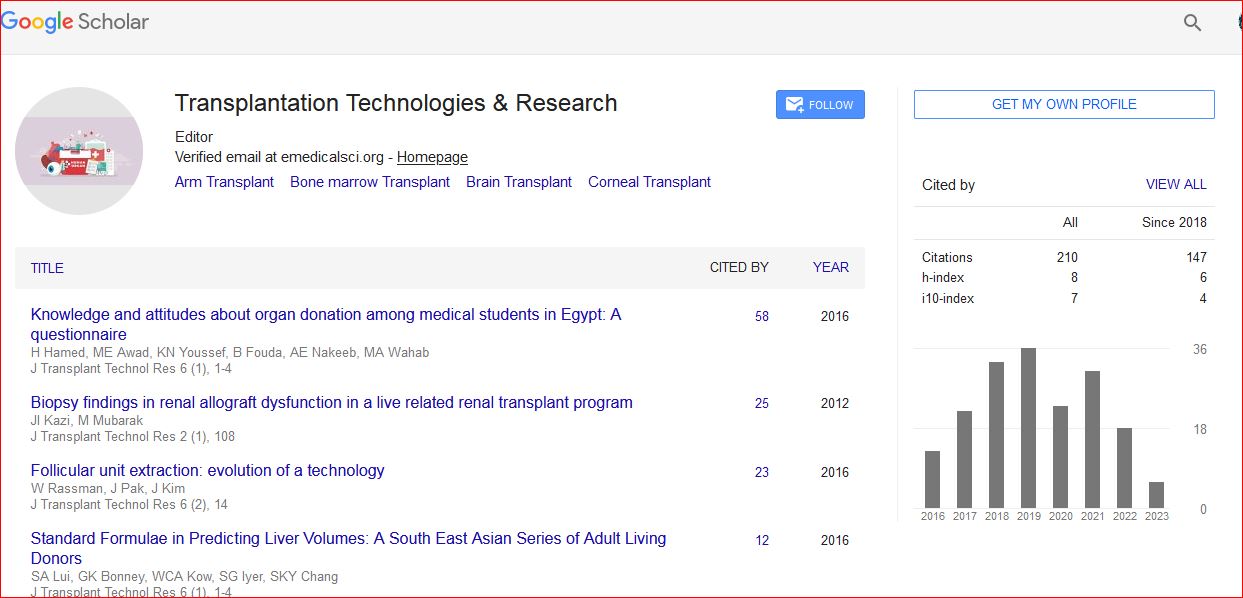
Transplantation Technologies & Research received 223 citations as per Google Scholar report