Perspective - (2025) Volume 15, Issue 5
Received: 01-Sep-2025, Manuscript No. jbpbt-25-178524;
Editor assigned: 03-Sep-2025, Pre QC No. P-178524;
Reviewed: 17-Sep-2025, QC No. Q-178524;
Revised: 22-Sep-2025, Manuscript No. R-178524;
Published:
29-Sep-2025
, DOI: 10.37421/2155-9821.2025.15.700
Citation: Bouzid, Salma N.. ”Probiotics and Biotherapeutics: Advancing Production and Application.” J Bioprocess Biotech 15 (2025):700.
Copyright: © 2025 Bouzid N. Salma This is an open-access article distributed under the terms of the Creative Commons Attribution License, which permits unrestricted use,
distribution and reproduction in any medium, provided the original author and source are credited.
The industrial-scale production and application of probiotics and live biotherapeutics have witnessed significant advancements, driven by innovative fermentation techniques and enhanced downstream processing for improved viability and stability. These developments are crucial for meeting the escalating demand for these products, with a particular emphasis on achieving manufacturing consistency and extending shelf-life through novel delivery systems designed for targeted gut colonization [1].
The efficient cultivation of probiotic microorganisms hinges on sophisticated bioreactor designs and optimized operational strategies. Control over environmental parameters such as pH, temperature, and dissolved oxygen is paramount for promoting robust cell growth and metabolic activity, with real-time monitoring and control systems playing a vital role in ensuring batch-to-batch reproducibility in large-scale production [2].
Downstream processing for probiotics presents unique challenges, especially concerning cell recovery and preservation. Techniques like microfiltration, ultrafiltration, and spray drying are continuously evaluated for their efficacy in maintaining high cell viability and activity, while the development of cryoprotectants and stabilizing agents is key to improving product shelf-life [3].
Innovative encapsulation technologies are emerging as critical tools for protecting probiotics and live biotherapeutics from harsh gastrointestinal conditions and facilitating targeted delivery. Various methods, including microencapsulation, nanoencapsulation, and integration into functional food matrices, are being explored to enhance probiotic survival and colonization within the gut [4].
Genetic engineering approaches are being actively employed to enhance the performance of probiotic strains for biotherapeutic applications. These modifications aim to improve survival rates, boost the production of beneficial metabolites, and confer specific therapeutic functionalities, alongside careful consideration of ethical and regulatory aspects [5].
The field is also exploring the transition from traditional batch fermentation to continuous bioprocessing techniques for probiotic production. This shift holds promise for increased productivity, improved product consistency, and reduced operational costs, though challenges related to microbial stability and contamination prevention in continuous systems require ongoing attention and innovative solutions [6].
Characterizing and selecting probiotic strains for specific health benefits is an area of intense research, utilizing advanced molecular techniques for identification, functional screening, and safety assessment. Robust quality control measures throughout the bioprocessing pipeline are indispensable for ensuring the efficacy and safety of live biotherapeutics [7].
Scaling up probiotic bioprocessing from laboratory to industrial levels poses significant challenges in maintaining optimal growth conditions and product quality. The use of pilot-scale facilities and advanced process modeling is instrumental in predicting and mitigating these scale-up issues, ensuring smooth transitions in production volume [8].
The regulatory landscape for live biotherapeutics and probiotics is evolving, with increasing scrutiny from regulatory bodies concerning product safety, efficacy, and manufacturing practices. Rigorous quality assurance and adherence to good manufacturing practices (GMP) are essential for successfully navigating these regulatory pathways [9].
Novel bioreactor configurations and advanced control strategies are being developed for the production of high-density probiotic cultures. The integration of sensor technology and data analytics is optimizing fermentation processes for improved yields and reduced production times, with potential applications for artificial intelligence in predictive process control [10].
Recent breakthroughs in the industrial-scale production and application of probiotics and live biotherapeutics involve novel fermentation techniques, improved downstream processing for enhanced viability and stability, and innovative delivery systems for targeted gut colonization. Overcoming challenges in manufacturing consistency and shelf-life is paramount to meet the growing demand for these products [1].
Sophisticated bioreactor designs and operational strategies are essential for the efficient cultivation of probiotic microorganisms. The impact of controlled environmental parameters, such as pH, temperature, and dissolved oxygen, on cell growth and metabolic activity is significant, and the integration of real-time monitoring and control systems ensures batch-to-batch reproducibility in large-scale probiotic production [2].
Downstream processing strategies for probiotics focus on enhancing cell recovery and preservation. Techniques like microfiltration, ultrafiltration, and spray drying are evaluated for their effectiveness in maintaining high cell viability and activity. The development of cryoprotectants and stabilizing agents is crucial for improving the shelf-life of probiotic products [3].
Innovative encapsulation technologies are being developed for probiotics and live biotherapeutics to protect them from harsh gastrointestinal conditions and improve targeted delivery. Methods such as microencapsulation, nanoencapsulation, and inclusion in functional food matrices are discussed for their role in enhancing probiotic survival and colonization in the gut [4].
Genetic engineering approaches are being employed to enhance the performance of probiotic strains for biotherapeutic applications. Modifications aim to improve probiotic survival, enhance the production of beneficial metabolites, and confer specific therapeutic functionalities, while also addressing ethical considerations and regulatory hurdles associated with genetically modified probiotics [5].
Continuous bioprocessing techniques are being explored for probiotic production to move beyond traditional batch fermentation. This approach offers potential for increased productivity, improved product consistency, and reduced operational costs, with ongoing discussions on challenges related to maintaining microbial stability and preventing contamination in continuous systems and proposed solutions [6].
Recent progress in characterizing and selecting probiotic strains for specific health benefits involves advanced molecular techniques for strain identification, functional screening, and safety assessment. Emphasis is placed on robust quality control measures throughout the bioprocessing pipeline to ensure the efficacy and safety of live biotherapeutics [7].
The scale-up of probiotic bioprocessing from laboratory to industrial production presents challenges in maintaining optimal growth conditions and product quality as volumes increase. The use of pilot-scale facilities and process modeling is key to predicting and mitigating these scale-up issues [8].
The regulatory landscape for live biotherapeutics and probiotics is characterized by increasing scrutiny regarding product safety, efficacy, and manufacturing practices. Navigating regulatory pathways successfully necessitates rigorous quality assurance and strict adherence to good manufacturing practices (GMP) [9].
Novel bioreactor configurations and advanced control strategies are being utilized for the production of high-density probiotic cultures. The application of sensor technology and data analytics optimizes fermentation processes for improved yields and reduced production times, with consideration given to the potential of artificial intelligence in predictive process control [10].
This collection of research highlights significant advancements in the production and application of probiotics and live biotherapeutics. Key areas of innovation include optimizing fermentation processes through sophisticated bioreactor designs and continuous bioprocessing techniques, as well as enhancing downstream processing for improved cell viability and stability. Novel encapsulation technologies are being developed to improve targeted delivery and survival in the gastrointestinal tract. Furthermore, genetic engineering offers pathways to enhance probiotic efficacy, while strain selection and characterization ensure specific health benefits. Addressing challenges in scale-up, regulatory navigation, and quality control remains crucial for bringing these products to market. The development of intelligent bioreactor systems also promises higher yields and reduced production times.
None
None
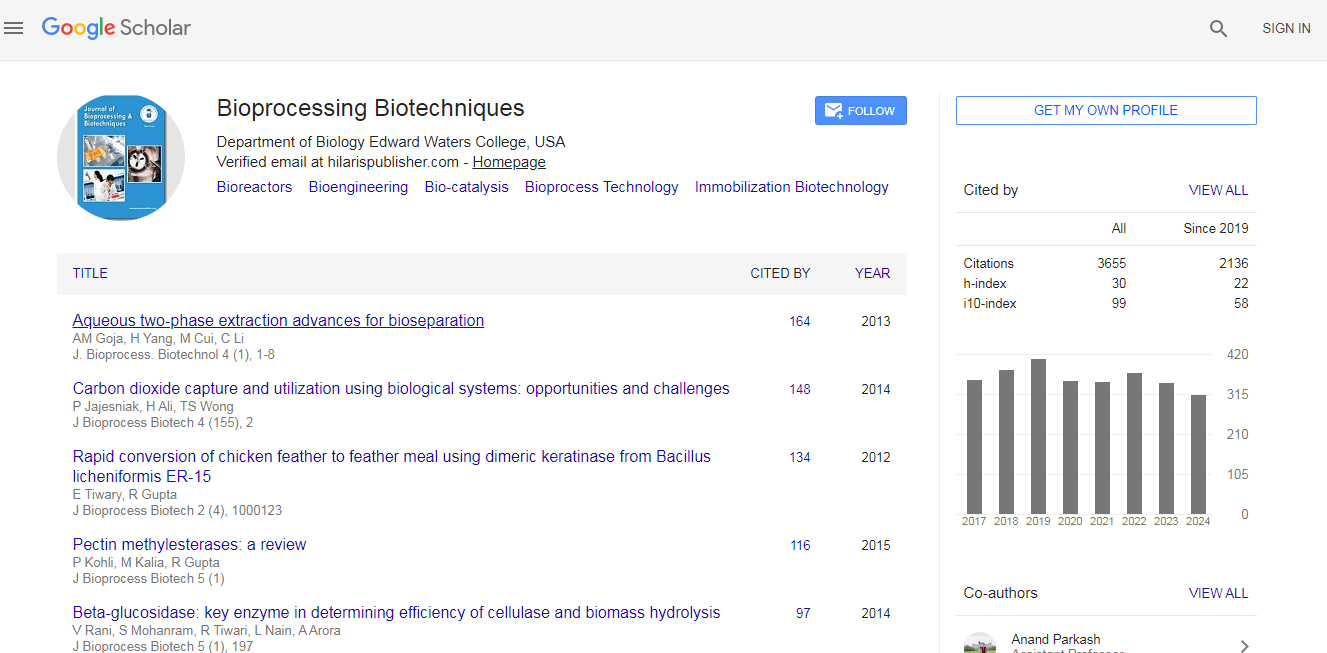
Journal of Bioprocessing & Biotechniques received 3351 citations as per Google Scholar report