Opinion - (2025) Volume 9, Issue 5
Received: 01-Sep-2025, Manuscript No. hps-26-184482;
Editor assigned: 03-Sep-2025, Pre QC No. P-184482;
Reviewed: 17-Sep-2025, QC No. Q-184482;
Revised: 22-Sep-2025, Manuscript No. R-184482;
Published:
29-Sep-2025
, DOI: 10.37421/2573-4563.2025.9.365
Citation: Wei, Chen. ”Gut-Liver Axis: Dysbiosis, Disease, and Therapeutics.” J Hepatol Pancreat Sci 09 (2025):365.
Copyright: © 2025 Wei C. This is an open-access article distributed under the terms of the Creative Commons Attribution License, which permits unrestricted use, distribution and reproduction in any medium, provided the original author and source are credited.
The intricate relationship between the gut microbiome and liver health, often termed the gut-liver axis, is central to understanding and managing a spectrum of chronic liver diseases. This axis plays a crucial role in the development and progression of conditions such as non-alcoholic fatty liver disease (NAFLD), alcoholic liver disease (ALD), and viral hepatitis, highlighting the profound impact of microbial communities on hepatic function [1].
Dysbiosis, characterized by an imbalance in the composition and function of gut microbes, is a significant contributor to the pathogenesis of these diseases. This imbalance can lead to increased gut permeability, allowing bacterial products to translocate into the portal circulation, thereby triggering inflammatory responses in the liver [1].
Specific alterations in the gut microbiome's composition and function are strongly linked to the development of non-alcoholic steatohepatitis (NASH), a more severe form of NAFLD. The production of microbial metabolites, including short-chain fatty acids (SCFAs) and trimethylamine N-oxide (TMAO), can directly influence hepatic inflammation and lipid accumulation [2].
Alcohol consumption, a well-established cause of liver damage, invariably leads to significant gut dysbiosis. This dysbiosis, coupled with increased intestinal permeability (often referred to as 'leaky gut'), facilitates the translocation of bacterial products into the portal circulation, initiating hepatic inflammation and promoting the development of alcoholic hepatitis and fibrosis [3].
The gut microbiome's influence extends to the immune response against viral infections, including hepatitis B virus (HBV). Alterations in gut microbial diversity and composition have been observed in patients with chronic HBV infection, suggesting a role for the microbiome in disease progression and immune modulation [4].
Fecal microbiota transplantation (FMT) has emerged as a promising therapeutic modality for various liver diseases characterized by dysbiosis. Its application is particularly noted in conditions like alcoholic hepatitis and recurrent Clostridioides difficile infection in patients with cirrhosis, aiming to restore a healthy gut microbial ecosystem [5].
Probiotics and prebiotics represent key strategies for modulating the gut microbiome with the goal of mitigating liver injury. Certain probiotic strains have shown efficacy in reducing inflammation and improving metabolic profiles, especially in patients with NAFLD, while prebiotics support the growth of beneficial bacteria [6].
Liver fibrosis, a common pathological outcome across many chronic liver diseases, is significantly influenced by gut-derived factors. Bacterial metabolites, such as lipopolysaccharide (LPS) and acetaldehyde, can activate hepatic stellate cells, thereby promoting the deposition of extracellular matrix and advancing fibrosis [7].
The gut-liver axis is also critically involved in the pathophysiology of cirrhosis. Portal hypertension and bacterial translocation contribute to a persistent proinflammatory state that exacerbates liver damage. Therapeutic interventions aimed at improving gut barrier function and reducing bacterial endotoxin load are being explored for their benefits in patients with cirrhosis [8].
Dietary interventions, such as a Mediterranean-style diet, can positively impact the gut microbiome and enhance liver health. These diets, rich in fiber, polyphenols, and healthy fats, promote beneficial bacterial growth and reduce inflammation, offering a protective effect against chronic liver diseases and supporting the bidirectional communication network of the gut-liver axis [9].
The gut-liver axis, a complex bidirectional communication network, is fundamental to maintaining hepatic homeostasis and plays a pivotal role in the pathogenesis of numerous chronic liver diseases, including non-alcoholic fatty liver disease (NAFLD), alcoholic liver disease (ALD), and viral hepatitis. Disruptions within this axis, stemming from factors such as dysbiosis and compromised gut barrier function, precipitate a cascade of events that contribute to liver injury and disease progression [1].
Dysbiosis, an imbalance in the gut microbial community, is a common thread in the progression of chronic liver conditions. This microbial imbalance can lead to increased intestinal permeability, allowing the passage of microbial products into the portal circulation, which subsequently triggers inflammation and oxidative stress within the liver. Therapeutic strategies targeting the gut microbiome, including probiotics, prebiotics, fecal microbiota transplantation (FMT), and dietary interventions, are being investigated for their potential to restore balance and ameliorate liver damage [1].
The pathogenesis of non-alcoholic steatohepatitis (NASH) is significantly influenced by alterations in the gut microbiome's composition and metabolic activity. Specific bacterial species and their metabolites, such as short-chain fatty acids (SCFAs) and trimethylamine N-oxide (TMAO), have been implicated in modulating hepatic inflammation and lipid accumulation. Consequently, interventions aimed at modulating the gut microbiota, particularly through fiber-rich diets or specific probiotics, represent a promising therapeutic avenue for NASH [2].
Alcohol consumption profoundly disrupts the gut microbiome, leading to a state of dysbiosis and increased intestinal permeability, often termed 'leaky gut.' This compromised gut barrier allows bacterial products to translocate into the portal circulation, initiating a robust inflammatory response in the liver that drives the development of alcoholic hepatitis and fibrosis. Strategies focused on enhancing gut barrier integrity and reducing the burden of bacterial endotoxins are considered potential therapeutic approaches for ALD [3].
Beyond metabolic and alcohol-induced liver diseases, the gut microbiome also influences the immune response to viral hepatitis, specifically hepatitis B virus (HBV) infection. Changes in the diversity and composition of the gut microbiota have been observed in individuals with chronic HBV infection, suggesting that microbial modulation could impact disease progression and immune responses. Research is exploring the potential of strategies like probiotic supplementation to restore gut microbial balance and improve outcomes in chronic hepatitis B [4].
Fecal microbiota transplantation (FMT) has gained considerable attention as a therapeutic intervention for various liver diseases associated with dysbiosis. It has shown promise particularly in conditions such as alcoholic hepatitis and in managing recurrent Clostridioides difficile infections in patients with cirrhosis. The core principle of FMT is to re-establish a healthy gut microbial ecosystem, thereby improving liver function and reducing inflammation [5].
Probiotics and prebiotics offer tangible strategies for modulating the gut microbiome to mitigate liver injury. Specific strains of probiotics have demonstrated beneficial effects, including the reduction of inflammation and the improvement of metabolic parameters in patients with NAFLD. Prebiotics, by selectively promoting the growth of beneficial gut bacteria, contribute to a healthier gut environment, which indirectly benefits liver health [6].
Liver fibrosis, a common terminal pathway for many chronic liver diseases, is intricately linked to gut-derived factors. Bacterial metabolites, including lipopolysaccharide (LPS) and acetaldehyde, can activate hepatic stellate cells, leading to an increase in extracellular matrix deposition. Targeting gut permeability and the production of these microbial metabolites is being investigated as a novel therapeutic strategy for preventing or reversing liver fibrosis [7].
Cirrhosis, a severe stage of chronic liver disease, is also critically influenced by the gut-liver axis. Portal hypertension and the subsequent bacterial translocation contribute to a chronic proinflammatory state that exacerbates liver damage. Interventions designed to bolster gut barrier function and decrease the load of bacterial endotoxins, such as the administration of rifaximin, have shown clinical benefits in patients suffering from cirrhosis and hepatic encephalopathy [8].
Dietary modifications, particularly those adhering to a Mediterranean-style diet, can significantly improve the gut microbiome and enhance overall liver health. These diets are characterized by a high intake of fiber, polyphenols, and healthy fats, all of which promote the proliferation of beneficial gut bacteria and reduce inflammation, thereby exerting a protective effect against chronic liver diseases and supporting the gut-liver axis [9].
The gut-liver axis is crucial in chronic liver diseases like NAFLD, ALD, and viral hepatitis. Dysbiosis, increased gut permeability, and altered microbial metabolites disrupt this axis, causing liver inflammation, oxidative stress, and fibrosis. Therapeutic strategies like probiotics, prebiotics, fecal microbiota transplantation (FMT), and dietary interventions show promise in ameliorating liver injury. Specific microbial metabolites, SCFAs and TMAO, influence NASH pathogenesis, while alcohol induces gut dysbiosis and leaky gut, leading to alcoholic hepatitis. Gut microbiome alterations also affect HBV infection outcomes. FMT aims to restore a healthy gut ecosystem, and probiotics/prebiotics reduce inflammation in NAFLD. Bacterial metabolites contribute to liver fibrosis, and interventions targeting gut permeability are being explored. Cirrhosis is linked to portal hypertension and bacterial translocation, with rifaximin showing benefits. Mediterranean diets improve gut microbiome and liver health by promoting beneficial bacteria and reducing inflammation.
None
None
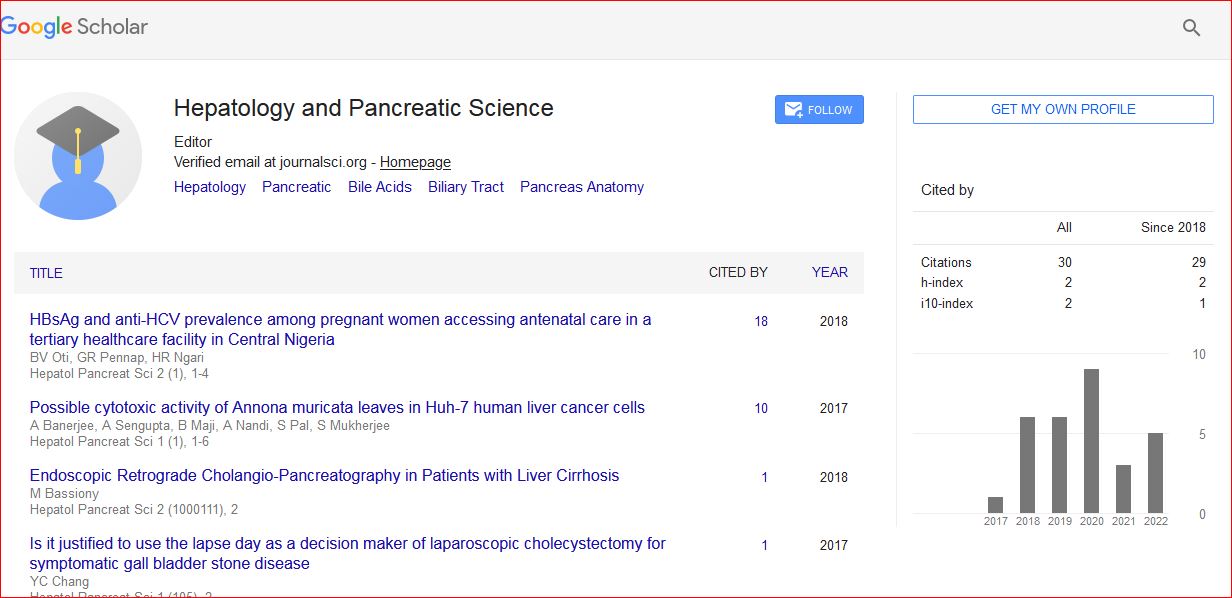
Hepatology and Pancreatic Science received 34 citations as per Google Scholar report