Perspective - (2025) Volume 10, Issue 3
Received: 01-Jun-2025, Manuscript No. jidm-26-188068;
Editor assigned: 03-Jun-2025, Pre QC No. P-188068;
Reviewed: 17-Jun-2025, QC No. Q-188068;
Revised: 23-Jun-2025, Manuscript No. R-188068;
Published:
30-Jun-2025
, DOI: 10.37421/2576-1420.2025.10.406
Citation: Rossi, Francesca. ”Global Waterborne Diseases: Challenges,
Interventions, and Climate.” J Infect Dis Med 10 (2025):406.
Copyright: © 2025 Rossi F. This is an open-access article distributed under the terms of the Creative Commons Attribution License, which permits unrestricted use, distribution
and reproduction in any medium, provided the original author and source are credited.
The global burden of waterborne infectious diseases remains a significant public health challenge, particularly in regions with limited resources. These diseases continue to pose a persistent threat due to various factors, including inadequate infrastructure and environmental changes. The transmission of pathogens such as Vibrio cholerae, Salmonella enterica, and enteric viruses is heavily reliant on contaminated water sources. These pathogens exploit compromised water supplies to spread, leading to widespread outbreaks and considerable morbidity and mortality. The persistent burden underscores the urgent need for effective interventions and sustained efforts to improve water quality and sanitation globally [1].
Cholera, a prime example of a waterborne disease, exhibits distinct spatiotemporal patterns influenced by environmental and demographic factors. Outbreaks are often linked to rainfall, flooding events, and higher population densities, which can overwhelm existing water and sanitation systems. Access to safe drinking water and improved sanitation facilities are critical in preventing the transmission of cholera. Epidemiological modeling plays a crucial role in understanding these patterns and guiding targeted public health interventions, allowing for more efficient allocation of resources for disease control [2].
Enteric viruses, including norovirus and rotavirus, represent another major category of waterborne pathogens with substantial public health implications. Their transmission routes frequently involve contaminated water sources, posing a risk to large populations. Diagnosing these viral infections can be challenging, and their high contagiousness necessitates stringent control measures. Effective wastewater treatment and robust food safety practices are paramount in curbing the spread of these viruses and mitigating outbreaks [3].
Protozoan parasites such as Cryptosporidium and Giardia are significant causes of waterborne diarrheal diseases. Their presence in drinking water supplies presents a persistent challenge due to their resistance to conventional disinfection methods. The cyst and oocyst stages of these parasites are particularly resilient, making their complete removal from water difficult. Therefore, multi-barrier approaches in water treatment are essential to ensure the effective elimination of these resilient pathogens [4].
Climate change is increasingly recognized as a significant driver exacerbating the epidemiology of waterborne diseases. Altered precipitation patterns, rising water temperatures, and an increase in extreme weather events create more favorable conditions for pathogen proliferation and transmission. These environmental shifts disproportionately affect vulnerable populations and regions, highlighting the need for adaptive strategies in public health planning and water resource management to address these evolving risks [5].
Inadequate sanitation and poor hygiene practices are fundamental contributors to the spread of waterborne diseases. A substantial burden of illness can be directly attributed to a lack of access to safe sanitation facilities and insufficient hygiene behaviors. Investing in and promoting effective Water, Sanitation, and Hygiene (WASH) interventions is therefore a primary and crucial prevention strategy, essential for breaking the cycle of transmission and reducing disease incidence [6].
Shigella infections, a primary cause of dysentery, are commonly transmitted through contaminated water and food. Epidemiological data reveal numerous outbreaks, with risk factors often linked to poor sanitation and hygiene. The emergence of antimicrobial resistance in Shigella strains further complicates treatment and control efforts, underscoring the need for enhanced surveillance and robust infection control measures to combat this growing threat [7].
Typhoid fever, a systemic bacterial infection caused by Salmonella Typhi, continues to be a public health concern transmitted via contaminated food and water. Disease incidence remains high in many areas, and the increasing prevalence of multidrug-resistant strains poses a significant challenge to treatment. Enhanced vaccination programs and substantial improvements in water quality are critical to controlling this persistent disease [8].
Hepatitis A virus (HAV) transmission is frequently associated with contaminated water and food. Understanding its clinical presentation and diagnostic methods is important for effective management. Vaccination stands out as a highly effective means of preventing HAV outbreaks. Public health education campaigns and the promotion of improved hygiene practices are also vital components of a comprehensive prevention strategy [9].
The landscape of waterborne pathogens is constantly evolving, with emerging threats posing new challenges to public health. Advancements in detection methods are crucial for identifying these novel pathogens, but proactive surveillance and robust risk assessment strategies are equally important. Addressing these evolving challenges requires a forward-thinking approach to public health and water management to safeguard communities from emerging waterborne threats [10].
The global epidemiology of waterborne infectious diseases continues to present a persistent burden, especially in low-resource settings, primarily driven by contaminated water acting as a vector for pathogens like Vibrio cholerae, Salmonella enterica, and enteric viruses. Factors such as climate change, insufficient sanitation infrastructure, and population displacement significantly contribute to disease outbreaks. Integrated approaches combining Water, Sanitation, and Hygiene (WASH) interventions with strong surveillance and rapid response systems are essential for mitigating these outbreaks and reducing their devastating impact [1].
Focusing on the specific case of cholera, epidemiological investigations reveal distinct spatiotemporal patterns of outbreaks. These patterns are intrinsically linked to environmental variables like rainfall and flooding, as well as demographic factors such as population density. The availability of safe drinking water and well-maintained sanitation systems are identified as critical determinants in preventing cholera transmission. Furthermore, the application of epidemiological modeling offers valuable insights for the strategic allocation of public health resources and the implementation of targeted interventions aimed at effective cholera control [2].
The impact of enteric viruses, specifically norovirus and rotavirus, on public health is substantial, with contaminated water serving as a primary transmission vehicle. These infections present diagnostic challenges and can lead to significant outbreaks. The authors emphasize that effective wastewater treatment processes and rigorous food safety protocols are indispensable for curbing the spread of these highly contagious viral pathogens within communities [3].
*Cryptosporidium* and *Giardia*, significant protozoan agents responsible for waterborne diarrheal diseases, are frequently found in drinking water supplies. Their resistance to common disinfection techniques poses a considerable challenge to water purification. The resilient nature of their cyst and oocyst forms necessitates the implementation of multi-barrier approaches in water treatment to ensure their effective removal and guarantee safe drinking water [4].
Climate change plays a pivotal role in altering the epidemiology of waterborne diseases. Changes in precipitation, elevated water temperatures, and the increasing frequency of extreme weather events create an environment conducive to increased pathogen survival and transmission. These climatic shifts exacerbate the vulnerability of specific populations and geographical areas, underscoring the critical need for adaptive strategies in public health planning and water management [5].
The link between inadequate sanitation, poor hygiene practices, and the proliferation of waterborne diseases is undeniable. A significant proportion of the global disease burden is attributable to insufficient sanitation. Consequently, substantial investment in and promotion of effective WASH interventions are highlighted as a fundamental and primary strategy for the prevention of waterborne illnesses [6].
*Shigella* infections, a major cause of dysentery, are predominantly transmitted through contaminated water and food sources. The epidemiology of *Shigella* is characterized by recurrent outbreaks, and risk factors are closely associated with poor sanitation and hygiene. The escalating issue of antimicrobial resistance among *Shigella* strains further complicates control efforts, emphasizing the need for improved surveillance and infection prevention strategies [7].
Typhoid fever, a systemic bacterial infection, continues to be transmitted through contaminated food and water. The incidence of the disease, coupled with the growing problem of multidrug-resistant *Salmonella Typhi*, presents a formidable public health challenge. Enhanced vaccination coverage and significant improvements in water quality are deemed essential for effective control and potential eradication [8].
Hepatitis A virus (HAV) is another significant waterborne pathogen, with transmission routes often involving contaminated water and food. Understanding its clinical manifestations and diagnostic methods is key to managing the disease. Vaccination has proven to be a highly effective strategy for preventing HAV outbreaks, alongside public health education and the promotion of better hygiene practices [9].
The emergence of novel waterborne pathogens presents ongoing challenges for public health systems worldwide. Advances in detection technologies are crucial, but they must be complemented by proactive surveillance programs and comprehensive risk assessment strategies. A forward-looking approach is necessary to effectively address these evolving threats and protect public health from emerging waterborne diseases [10].
Waterborne infectious diseases remain a global health concern, particularly in under-resourced areas, driven by contaminated water and exacerbated by climate change, poor sanitation, and displacement. Pathogens like Vibrio cholerae, Salmonella enterica, enteric viruses, Cryptosporidium, Giardia, Shigella, and Hepatitis A virus are transmitted through water and food. Effective control relies on integrated Water, Sanitation, and Hygiene (WASH) interventions, robust surveillance, rapid response, and improved water treatment. Climate change is a growing factor, increasing vulnerability. Emerging pathogens add new challenges, necessitating advanced detection and proactive strategies. Addressing these issues requires comprehensive public health planning, vaccination, and improved hygiene practices.
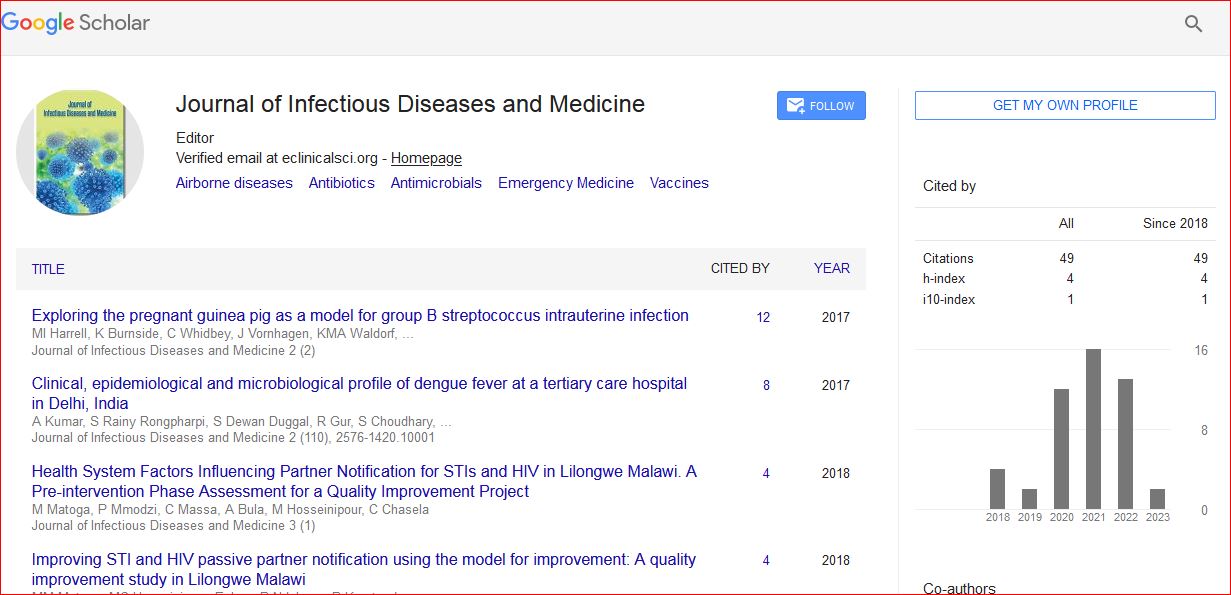
Journal of Infectious Diseases and Medicine received 1059 citations as per Google Scholar report