Opinion - (2025) Volume 16, Issue 2
Received: 01-Apr-2025, Manuscript No. jar-25-176279;
Editor assigned: 03-Apr-2025, Pre QC No. P-176279;
Reviewed: 17-Apr-2025, QC No. Q-176279;
Revised: 22-Apr-2025, Manuscript No. R-176279;
Published:
29-Apr-2025
, DOI: 10.37421/2155-6113.2025.16.1056
Citation: Ivanova, Yulia. "Global Infectious Diseases: Burden,
Innovations, Equity." J AIDS Clin Res 16 (2025):1056.
Copyright: © 2025 Ivanova Y. This is an open-access article distributed under the terms of the Creative Commons Attribution License, which permits unrestricted use,
distribution and reproduction in any medium, provided the original author and source are credited.
Understanding infectious diseases requires a multifaceted approach, from clinical presentation and immune responses to global public health strategies. For example, a detailed examination into how COVID-19 presents clinically and the immune system's response across different disease severities has revealed crucial insights. What this really means is that grasping these varied immune reactions helps us understand why some individuals experience mild sickness while others face life-threatening illness, also pointing towards potential targets for treatments [1].
A systematic analysis delivers a stark picture of the global burden of bacterial antimicrobial resistance (AMR) in 2019. Here's the thing, it highlights the sheer scale of deaths directly attributable to AMR, making it a leading cause of mortality worldwide. What this really means is that AMR isn't just a future threat; it's a current, devastating crisis demanding immediate, coordinated global action [2].
A critical gap in medical education across Sub-Saharan Africa concerning emerging and re-emerging infectious diseases has been identified. What this really means is that if future healthcare professionals aren't adequately trained on these evolving threats, countries in this region, often at the forefront of such outbreaks, will struggle to respond effectively. This highlights the urgent need to integrate more comprehensive education on these topics [3].
The exciting frontier of next-generation vaccines is pushing past conventional methods. Let's break it down: innovations like mRNA, viral vectors, and Artificial Intelligence (AI) are revolutionizing how we design and deploy vaccines. What this really means is a future where vaccines could be developed faster, be more effective against a wider range of pathogens, and even target diseases that have historically been difficult to prevent [4].
Significant progress has been made in developing diagnostic tools for infectious diseases. What this really means is that the ability to quickly and accurately identify pathogens is crucial for effective treatment and controlling outbreaks. We're seeing innovations from rapid point-of-care tests to advanced molecular techniques that promise to transform how we detect and manage infections, especially in resource-limited settings [5].
Research has also delved into the complex world of modeling public health interventions and their effect on how infectious diseases spread. The key insight here is that accurate modeling helps policymakers make informed decisions, but it's not without its challenges. What this really means is that as infectious diseases evolve, so too must our modeling approaches, incorporating more data and sophisticated techniques to better predict outcomes and guide effective control strategies [6].
A comprehensive review offers a thorough examination of how climate change is influencing vector-borne diseases. Let's break it down: rising temperatures and altered weather patterns are directly impacting the geographic spread, seasonality, and intensity of diseases carried by vectors like mosquitoes and ticks. What this really means is that climate change isn't just an environmental issue; it's a profound public health challenge that requires integrated strategies to predict and mitigate the spread of these illnesses [7].
Further work delves into the intricate dance between hosts and pathogens, revealing how these interactions shape the course of infectious diseases. The key insight is that understanding these molecular and cellular dialogues is crucial for developing new therapies. What this really means is by unraveling how pathogens evade host defenses or exploit host machinery, we can identify vulnerabilities and design targeted interventions that are more effective and specific [8].
A scoping review explores the profound influence of social determinants on infectious diseases. Here's the thing: factors like socioeconomic status, education, housing, and access to healthcare don't just correlate with disease; they fundamentally shape vulnerability and health outcomes. What this really means is that tackling infectious diseases effectively requires moving beyond purely medical interventions to address these underlying societal inequities [9].
Finally, the critical area of global health security, particularly how we prepare for and respond to emerging infectious diseases, has been addressed. The main takeaway is that pandemics underscore the interconnectedness of global health, showing that a threat anywhere can quickly become a threat everywhere. What this really means is that robust international cooperation, strong surveillance systems, and equitable access to resources are absolutely essential to build resilience against future outbreaks [10].
The landscape of infectious diseases is complex, demanding ongoing research and adaptive strategies across multiple domains. One key area involves understanding specific pathogens, such as the detailed clinical presentations and the immune system's varied responses to COVID-19 across different disease severities [1]. Gaining these insights helps clarify why some individuals experience mild symptoms while others face life-threatening illness, which in turn guides the identification of potential treatment targets. Concurrently, the global burden of bacterial antimicrobial resistance (AMR) presents an equally pressing challenge. A systematic analysis revealed the immense scale of deaths directly attributable to AMR, establishing it as a leading cause of mortality worldwide. This isn't merely a future threat; it is a devastating crisis that requires immediate and coordinated global action to mitigate its widespread impact [2]. Furthermore, a critical gap exists in medical education concerning emerging and re-emerging infectious diseases within Sub-Saharan Africa. The implication is clear: without adequate training for future healthcare professionals, countries in this region, frequently at the epicenter of such outbreaks, will struggle to mount effective responses. This underscores an urgent need for more comprehensive educational integration on these vital topics [3].
In response to these challenges, significant advancements in medical technology offer promising avenues. The frontier of next-generation vaccines is rapidly evolving beyond conventional methods, leveraging innovations like mRNA technology, viral vectors, and Artificial Intelligence (AI). This revolutionizes vaccine design and deployment, suggesting a future where vaccines could be developed more rapidly, prove more effective against a broader spectrum of pathogens, and even target historically difficult-to-prevent diseases [4]. Complementing these developments are the substantial improvements in diagnostic tools for infectious diseases. The capacity to quickly and accurately identify pathogens is fundamentally crucial for effective treatment and the control of outbreaks. From rapid point-of-care tests to sophisticated molecular techniques, these innovations are poised to transform how infections are detected and managed, particularly benefiting resource-limited settings [5].
Beyond direct interventions, strategic tools and environmental considerations play a crucial role in managing disease spread. The complex field of modeling public health interventions aims to predict their effects on infectious disease dissemination. The key insight here is that accurate modeling empowers policymakers to make informed decisions, though it consistently faces challenges. As infectious diseases evolve, so too must these modeling approaches, incorporating richer data and more sophisticated techniques to better predict outcomes and guide effective control strategies [6].
Environmental factors are also profoundly impactful; a comprehensive review highlights how climate change influences vector-borne diseases. Rising temperatures and altered weather patterns directly affect the geographic spread, seasonality, and intensity of illnesses carried by vectors like mosquitoes and ticks. This confirms that climate change is not solely an environmental concern but a significant public health challenge demanding integrated strategies for prediction and mitigation [7]. Additionally, understanding the intricate molecular and cellular interactions between hosts and pathogens is vital for developing novel therapies. By unraveling how pathogens evade host defenses or exploit host machinery, we can identify vulnerabilities and design targeted, more effective, and specific interventions [8].
Finally, the broader societal and global frameworks are indispensable for effective infectious disease management. A scoping review emphasizes the profound influence of social determinants on infectious diseases. Factors such as socioeconomic status, education, housing, and access to healthcare do more than just correlate with disease; they fundamentally shape an individual's vulnerability and health outcomes. This means that effectively tackling infectious diseases requires moving beyond purely medical interventions to address these deeply rooted societal inequities [9]. The critical area of global health security, focusing on preparedness and response to emerging infectious diseases, remains paramount. Pandemics consistently underscore the interconnectedness of global health, demonstrating that a threat in one region can rapidly escalate into a global concern. What this really means is that robust international cooperation, strong surveillance systems, and equitable access to resources are absolutely essential to build resilience against future outbreaks and safeguard global well-being [10].
Recent studies highlight critical aspects of infectious diseases, from understanding COVID-19's varied clinical presentations and immune responses, which helps in identifying treatment targets, to recognizing the devastating global burden of bacterial antimicrobial resistance (AMR), a leading cause of mortality demanding urgent global action. There's a notable gap in medical education in Sub-Saharan Africa regarding emerging and re-emerging infectious diseases, emphasizing the need for better training to effectively respond to outbreaks. The field of vaccinology is experiencing a revolution with next-generation vaccines utilizing mRNA, viral vectors, and Artificial Intelligence (AI) to develop faster and more effective preventatives against a broader range of pathogens. Significant progress has been made in diagnostic tools, from rapid point-of-care tests to advanced molecular techniques, which are vital for quick and accurate pathogen identification, improving treatment and outbreak control, especially in resource-limited settings. Effective public health interventions rely on accurate modeling to predict disease spread and guide strategies, a challenging but evolving area requiring sophisticated data integration. Climate change poses a profound public health challenge by influencing the geographic spread and intensity of vector-borne diseases, necessitating integrated mitigation strategies. Understanding the intricate host-pathogen interactions at molecular and cellular levels is crucial for developing new, targeted therapies by identifying vulnerabilities and designing specific interventions. Moreover, social determinants like socioeconomic status and access to healthcare profoundly shape vulnerability and outcomes related to infectious diseases, underscoring the need to address underlying societal inequities. Lastly, global health security demands robust international cooperation, strong surveillance, and equitable access to resources for preparedness and response to emerging infectious diseases, recognizing that global threats are interconnected.
Indexed at, Google Scholar, Crossref
Indexed at, Google Scholar, Crossref
Indexed at, Google Scholar, Crossref
Indexed at, Google Scholar, Crossref
Indexed at, Google Scholar, Crossref
Indexed at, Google Scholar, Crossref
Indexed at, Google Scholar, Crossref
Indexed at, Google Scholar, Crossref
Indexed at, Google Scholar, Crossref
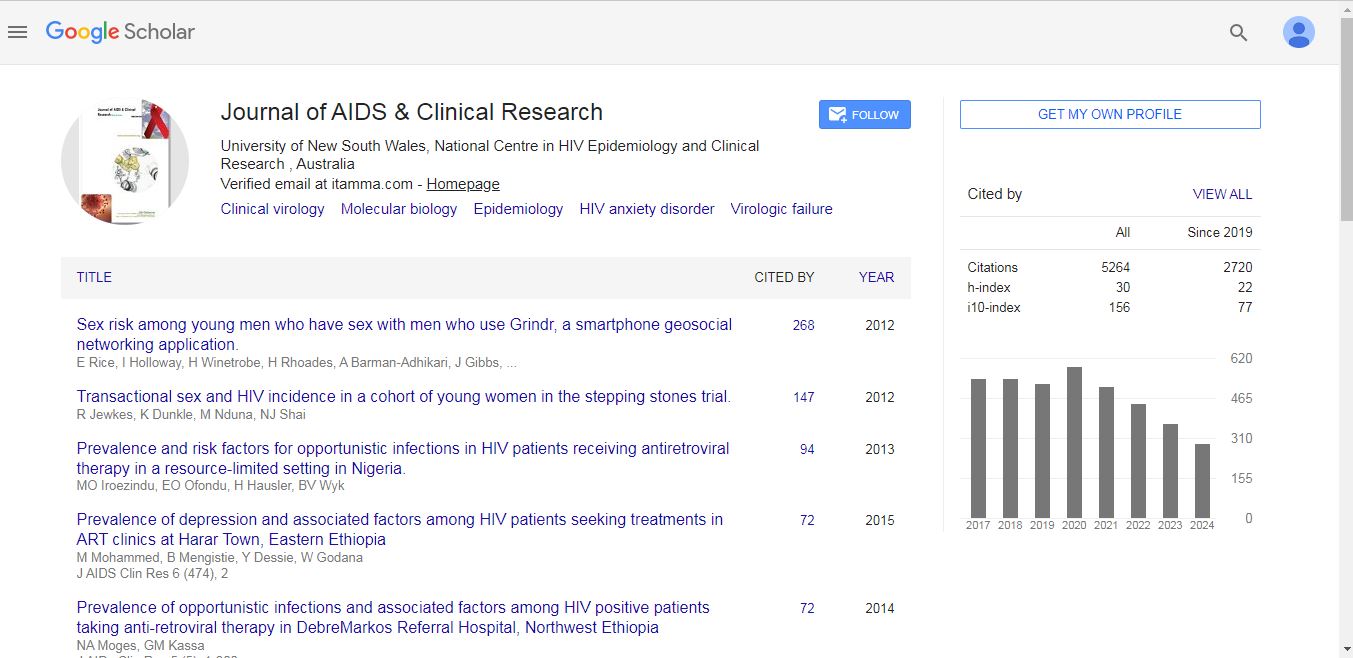
Journal of AIDS & Clinical Research received 5264 citations as per Google Scholar report