Perspective - (2025) Volume 16, Issue 4
Received: 04-Aug-2025, Manuscript No. jar-25-177608;
Editor assigned: 06-Aug-2025, Pre QC No. P-177608;
Reviewed: 20-Aug-2025, QC No. Q-177608;
Revised: 25-Aug-2025, Manuscript No. R-177608;
Published:
01-Sep-2025
, DOI: 10.37421/2155-6113.2025.16.1078
Citation: López, Juan Carlos. ”Global HIV Transmission: Risks
and Prevention Strategies.” J AIDS Clin Res 16 (2025):1078.
Copyright: © 2025 López C. Juan This is an open-access article distributed under the terms of the Creative Commons Attribution License, which permits unrestricted use,
distribution and reproduction in any medium, provided the original author and source are credited.
HIV transmission dynamics among men who have sex with men (MSM) in East Asia show high rates, emphasizing the need for targeted prevention efforts. A meta-analysis highlights specific risk factors and geographic variations, informing localized public health interventions to curb the epidemic within this key population [1].
This systematic review uncovers the significant prevalence of HIV, hepatitis B, and hepatitis C among people who inject drugs in Brazil. The findings stress the urgency of integrated harm reduction programs and expanded access to prevention and treatment services for this vulnerable group [2].
Perinatal HIV transmission continues to be a critical public health concern, though significant progress has been made in prevention and management. This review offers an updated perspective on strategies, including antiretroviral therapy for pregnant individuals and infants, emphasizing ongoing efforts to eliminate mother-to-child transmission [3].
The epidemiology of HIV in adolescents and young adults across Europe and North America is constantly shifting. This systematic review identifies emerging trends and unique risk factors within this demographic, highlighting the need for tailored prevention programs and accessible testing services that resonate with younger populations [4].
Understanding HIV transmission dynamics and risk factors among women living with HIV in sub-Saharan Africa is crucial for effective public health interventions. This systematic review points to a complex interplay of biological, behavioral, and socio-economic factors influencing transmission, guiding efforts to reduce new infections [5].
Sexual transmission remains a primary route for HIV. This article provides an update on the biological mechanisms underlying sexual transmission and outlines the effectiveness of current prevention strategies, including PrEP, Antiretroviral Therapy (ART) for treatment as prevention, and condoms, underscoring ongoing efforts to minimize risk [6].
Preventing mother-to-child transmission (MTCT) of HIV has seen remarkable global progress, moving towards elimination in many regions. This review offers a global perspective on successful prevention strategies, highlighting the critical role of antenatal care, antiretroviral regimens, and safe infant feeding practices in achieving these goals [7].
Injection drug use continues to be a significant route for HIV transmission. This review examines current trends in injection drug use-associated HIV epidemics and provides insights into effective intervention strategies, including needle exchange programs, opioid agonist therapy, and integrated care models to reduce harm [8].
Anal sex is a high-risk route for HIV transmission, particularly among specific populations. This systematic review identifies key risk factors associated with anal sex and HIV acquisition, alongside evaluating the effectiveness of various prevention strategies, including PrEP and condom use, to reduce risk [9].
While rare, blood transfusion remains a potential route for HIV transmission, necessitating stringent screening and safety measures. This contemporary review examines the current risks associated with transfusion and highlights the advanced safeguards in place globally to ensure the safety of blood products and minimize residual transmission risk [10].
HIV transmission dynamics vary significantly across different populations and geographic regions, necessitating tailored public health responses. In East Asia, for example, high rates of HIV transmission among men who have sex with men (MSM) demand specific prevention efforts. A meta-analysis of the region highlights unique risk factors and geographic variations, crucial for developing localized interventions to control the epidemic within this key population [1]. Similarly, in Brazil, a systematic review reveals a substantial prevalence of HIV, alongside hepatitis B and C, among people who inject drugs (PWID). These findings underscore the urgent need for integrated harm reduction programs and expanded access to prevention and treatment services for this particularly vulnerable group [2]. Addressing these diverse epidemiological landscapes is vital for global HIV control.
The evolving nature of the epidemic among specific age groups and regions also requires close attention. In Europe and North America, the epidemiology of HIV in adolescents and young adults is constantly shifting. A systematic review identifies emerging trends and unique risk factors pertinent to this demographic, emphasizing the necessity for prevention programs that are specifically designed for and accessible to younger populations [4]. Furthermore, understanding HIV transmission dynamics and associated risk factors among women living with HIV in sub-Saharan Africa is paramount for effective public health interventions. A systematic review from this region points to a complex interplay of biological, behavioral, and socio-economic factors that influence transmission, providing guidance for efforts aimed at reducing new infections [5]. These analyses demonstrate the importance of disaggregated data to inform targeted strategies.
Sexual transmission remains a predominant route for HIV acquisition, and significant efforts are focused on understanding its mechanisms and effective prevention. Updates on the biological mechanisms underlying sexual transmission clarify how the virus spreads, while outlining the effectiveness of current prevention strategies. These include pre-exposure prophylaxis (PrEP), antiretroviral therapy (ART) used for treatment as prevention, and consistent condom use, all of which are essential for minimizing risk [6]. Specifically, anal sex is recognized as a high-risk route for HIV transmission, especially within certain populations. A systematic review and meta-analysis identifies key risk factors associated with anal sex and HIV acquisition, and evaluates the efficacy of various prevention strategies like PrEP and condom use in reducing this specific risk [9]. Continuous education and access to these tools are critical.
Beyond sexual contact, other transmission routes demand robust public health interventions. Injection drug use continues to be a major factor in HIV transmission globally. A review of current trends in injection drug use-associated HIV epidemics offers insights into effective intervention strategies. These include vital needle exchange programs, opioid agonist therapy, and integrated care models, all designed to reduce associated harms [8]. Another critical area is perinatal HIV transmission, which, despite significant progress, remains a public health concern. Reviews offer updated perspectives on prevention and management strategies, including the crucial role of antiretroviral therapy for both pregnant individuals and infants, underscoring ongoing efforts to eliminate mother-to-child transmission [3]. Reinforcing this, global efforts to prevent mother-to-child transmission (MTCT) of HIV have achieved remarkable success, with many regions moving towards elimination. A review offers a global perspective on successful prevention strategies, emphasizing the critical importance of antenatal care, effective antiretroviral regimens, and safe infant feeding practices in achieving these vital goals [7]. Lastly, while exceedingly rare due to stringent safety measures, blood transfusion remains a potential route for HIV transmission. Contemporary reviews examine the current minimal risks associated with transfusion, highlighting the advanced safeguards implemented globally to ensure the safety of blood products and effectively minimize any residual transmission risk [10]. These varied approaches showcase a holistic effort to control HIV across all potential pathways.
The provided data offers a comprehensive overview of Human Immunodeficiency Virus (HIV) transmission dynamics, associated risk factors, and ongoing prevention and management strategies across diverse populations and global regions. It begins by shedding light on high HIV transmission rates among men who have sex with men (MSM) in East Asia, underscoring the necessity for targeted public health interventions tailored to specific risk factors and geographic variations. In Brazil, the significant prevalence of HIV, alongside hepatitis B and C, among people who inject drugs (PWID) mandates integrated harm reduction programs and expanded access to vital services for this vulnerable group. Perinatal HIV transmission remains a critical concern, though advancements in antiretroviral therapy for pregnant individuals and infants show significant progress towards eliminating mother-to-child transmission. The evolving epidemiology of HIV in adolescents and young adults in Europe and North America calls for bespoke prevention programs and accessible testing services that resonate with younger demographics. For women living with HIV in sub-Saharan Africa, understanding the complex interplay of biological, behavioral, and socio-economic factors is crucial for designing effective public health interventions and reducing new infections. Sexual transmission is highlighted as a primary route, with detailed updates on biological mechanisms and the effectiveness of prevention strategies like PrEP, Antiretroviral Therapy (ART) as prevention, and condoms. Specifically, anal sex is identified as a high-risk route, requiring focused prevention efforts that include PrEP and condom use. Injection drug use continues to drive HIV epidemics, necessitating interventions such as needle exchange programs, opioid agonist therapy, and integrated care models. Finally, the data acknowledges blood transfusion as a rare but potential route, stressing the importance of stringent screening and advanced global safeguards to ensure blood product safety and minimize residual risks. This collection collectively emphasizes the multifaceted nature of HIV transmission and the continuous global efforts required for effective prevention and control.
Indexed at, Google Scholar, Crossref
Indexed at, Google Scholar, Crossref
Indexed at, Google Scholar, Crossref
Indexed at, Google Scholar, Crossref
Indexed at, Google Scholar, Crossref
Indexed at, Google Scholar, Crossref
Indexed at, Google Scholar, Crossref
Indexed at, Google Scholar, Crossref
Indexed at, Google Scholar, Crossref
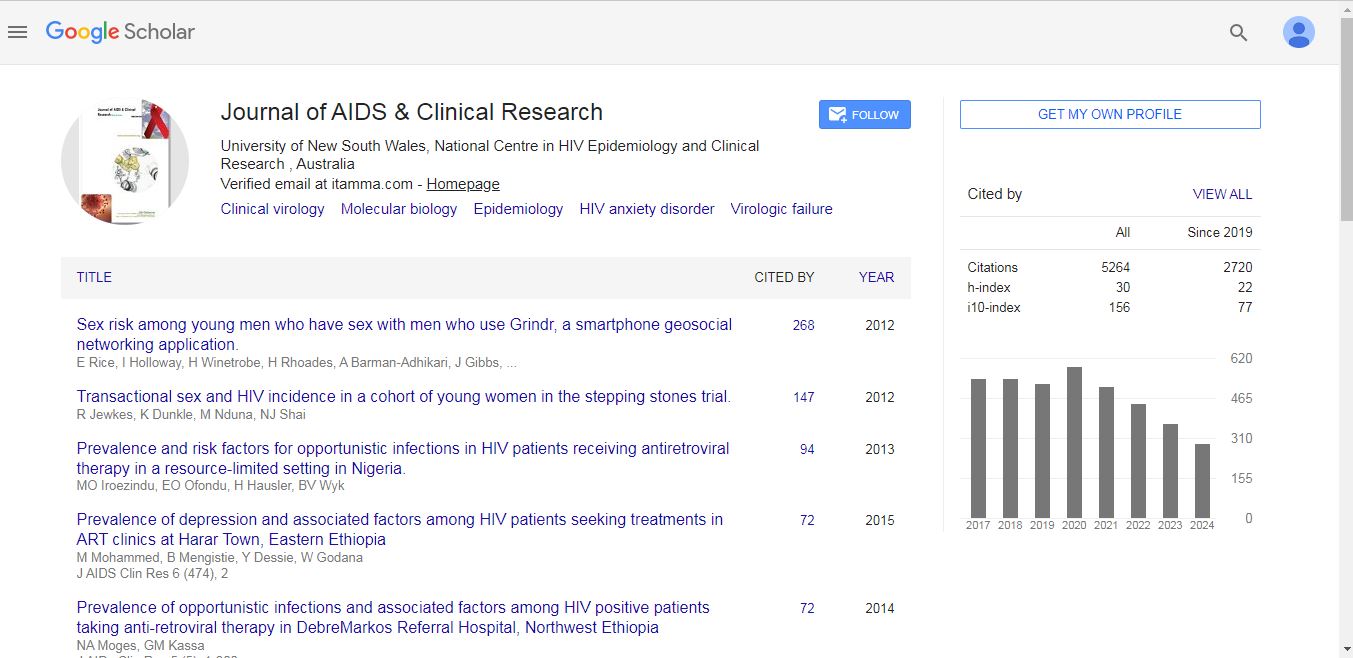
Journal of AIDS & Clinical Research received 5264 citations as per Google Scholar report