Short Communication - (2025) Volume 16, Issue 4
Received: 01-Jul-2025, Manuscript No. hycr-25-174948;
Editor assigned: 03-Jul-2025, Pre QC No. P-174948;
Reviewed: 17-Jul-2025, QC No. Q-174948;
Revised: 22-Jul-2025, Manuscript No. R-174948;
Published:
29-Jul-2025
, DOI: 10.37421/2157-7587.2025.16.613
Citation: Ndlovu, Amara. ”Global Groundwater: Threats, Innovation, Sustainability.” Hydrol Current Res 16 (2025):613.
Copyright: © 2025 Ndlovu A. This is an open-access article distributed under the terms of the Creative Commons Attribution License, which permits unrestricted use,
distribution and reproduction in any medium, provided the original author and source are credited.
Groundwater, a vital global resource, faces multifaceted challenges ranging from contamination to the impacts of climate change and complex governance issues. Understanding these challenges is crucial for sustainable water management. Research has extensively covered the prevailing groundwater contamination issues in the karst regions of Southwest China, identifying major pollutants such as nitrates, heavy metals, and organic compounds, and exploring unique hydrogeological vulnerabilities, along with discussing various remediation technologies and integrated strategies for effective protection and restoration [1].
Further analysis provides a global meta-analysis investigating the intricate relationship between climate change and groundwater storage variations across diverse regions. This work synthesizes observations and models, revealing critical trends in groundwater depletion and shifts in recharge, thereby underscoring groundwater's essential role in climate adaptation strategies and broader water security planning [2].
Advanced computational methods are increasingly being applied to address groundwater challenges. A review highlights the growing applications of machine learning techniques in groundwater quality modeling and assessment, demonstrating how these methods can effectively predict pollutant distribution, identify contamination sources, and support robust decision-making for sustainable resource management, often presenting a powerful alternative to traditional numerical models [3].
In urban environments, innovative solutions are explored for water management. One study examines the increasing role of Managed Aquifer Recharge (MAR) as a crucial strategy for sustainable urban water management. It evaluates the opportunities MAR offers for replenishing groundwater, mitigating subsidence, and improving water quality, while also addressing associated challenges in implementation, site selection, and potential contamination within city landscapes [4].
Understanding natural hydrological processes is equally important. An integrated ecohydrology and hydrogeochemistry approach has been applied to analyze groundwater-surface water interactions within a lowland river catchment. This demonstrates how these complex connections significantly influence water quality and overall ecosystem health, offering valuable insights for managing water resources in areas where surface and subsurface waters are tightly linked [5].
Specific contaminants demand focused attention. A global review offers a comprehensive overview of the occurrence and distribution of per- and polyfluoroalkyl substances (PFAS) in groundwater. This research identifies major sources and transport mechanisms, highlighting the widespread nature of these persistent contaminants and emphasizing the urgent need for enhanced monitoring, regulatory frameworks, and effective remediation strategies globally [6].
Another critical global contaminant, arsenic, is also thoroughly examined. A paper provides a global perspective on arsenic contamination in groundwater, detailing its natural and anthropogenic sources, hydrogeological controls, and the devastating health effects on human populations. It highlights the most affected regions and discusses various mitigation strategies, stressing the need for safe drinking water alternatives and robust public health interventions [7].
Beyond technical and environmental aspects, governance plays a crucial role. One review addresses the complex landscape of transboundary groundwater governance, emphasizing the challenges of managing shared aquifers across international borders. It discusses legal, institutional, and political hurdles, alongside opportunities for cooperative frameworks and sustainable management strategies that promote equitable access and prevent conflicts over these vital groundwater resources [8].
Detailed understanding of groundwater dynamics in specific regions is also essential. Research utilizing stable isotopes and hydrochemistry as powerful tracers investigates groundwater recharge processes and circulation patterns in semiarid regions. This provides detailed insights into water sources, residence times, and flow paths, which are critical for understanding water availability and informing sustainable groundwater management in water-stressed environments [9].
Finally, the integration of groundwater into sustainable energy solutions is also a growing area of study. A review provides an in-depth analysis of recent advances and persistent challenges in urban groundwater heat pump systems. It explores their potential as a sustainable energy solution for heating and cooling buildings, discussing technological innovations, environmental impacts, and the hydrogeological considerations essential for efficient and environmentally sound implementation in urban settings [10].
Groundwater contamination is a pressing global issue, with various studies detailing its prevalence and impact. In the karst regions of Southwest China, for instance, major pollutants like nitrates, heavy metals, and organic compounds pose significant threats to critical water sources. These unique hydrogeological systems are particularly vulnerable, necessitating integrated strategies for effective protection and restoration. Understanding the sources and transport mechanisms of such contaminants is vital for developing appropriate remediation technologies [1]. Similarly, the global presence of per- and polyfluoroalkyl substances (PFAS) in groundwater is a significant concern. A comprehensive review highlights the widespread nature of these persistent contaminants, underscoring the urgent need for enhanced monitoring and regulatory frameworks worldwide. Identifying their sources and transport pathways is a key step in protecting these vital resources [6]. Another pervasive contaminant, arsenic, affects human populations globally, with its presence attributed to both natural and anthropogenic sources. Its hydrogeological controls and devastating health effects demand robust public health interventions and the provision of safe drinking water alternatives [7].
Addressing groundwater resource challenges often requires innovative management strategies and a deep understanding of hydrological processes. Managed Aquifer Recharge (MAR) offers a promising approach for sustainable urban water management, helping to replenish groundwater, mitigate subsidence, and improve water quality. However, successful implementation requires careful consideration of site selection and potential contamination risks in urban environments [4]. Beyond direct management, understanding the complex interactions between groundwater and surface water is crucial for holistic water resource management, especially in lowland river catchments where these connections significantly influence water quality and ecosystem health. This integrated ecohydrology and hydrogeochemistry approach provides valuable insights into how intertwined surface and subsurface waters should be managed for optimal health outcomes [5].
Technological advancements are revolutionizing how we model and assess groundwater quality and dynamics. Machine learning techniques are increasingly applied in this domain, providing powerful tools to predict pollutant distribution, identify contamination sources, and inform decision-making for sustainable groundwater resource management. These advanced computational methods offer robust alternatives to traditional numerical models, enhancing our predictive capabilities [3]. Furthermore, stable isotopes and hydrochemistry serve as invaluable tracers for investigating groundwater recharge processes and circulation patterns, particularly in water-stressed semiarid regions. Insights into water sources, residence times, and flow paths derived from these methods are fundamental for ensuring sustainable groundwater availability [9].
The broader context of climate change also significantly impacts groundwater management. A global meta-analysis reveals critical trends in groundwater depletion and shifts in recharge due to climate change. Recognizing groundwater's crucial role in climate adaptation strategies and water security planning is paramount for future resilience [2]. This highlights the necessity of incorporating climate projections into all aspects of water resource planning to safeguard future supplies.
Finally, the institutional and engineering aspects of groundwater management are vital. The complex landscape of transboundary groundwater governance, for instance, highlights the necessity for international cooperation to manage shared aquifers effectively. Legal, institutional, and political hurdles must be overcome to establish cooperative frameworks that promote equitable access and prevent conflicts over these shared vital resources [8]. In terms of energy, urban groundwater heat pump systems represent a sustainable energy solution for heating and cooling buildings. Recent advances and persistent challenges in their implementation require careful consideration of technological innovations, environmental impacts, and hydrogeological factors to ensure efficient and environmentally sound operation in urban settings [10].
This collection of research underscores the critical importance and multifaceted challenges surrounding global groundwater resources. It provides a comprehensive look at contamination issues, particularly in vulnerable karst regions, identifying pollutants like nitrates, heavy metals, and organic compounds, and discusses remediation strategies [1]. The pervasive presence of emerging contaminants like PFAS and long-standing threats such as arsenic are also highlighted, emphasizing their sources, distribution, and significant health impacts globally [6, 7]. Beyond contamination, the influence of climate change on groundwater storage variations, including depletion and recharge shifts, is analyzed, stressing groundwater's role in climate adaptation and water security [2]. Innovative management techniques such as Managed Aquifer Recharge (MAR) are explored for sustainable urban water solutions, alongside an ecohydrology and hydrogeochemistry approach for understanding groundwater-surface water interactions [4, 5]. The growing application of machine learning in groundwater quality modeling and assessment offers advanced tools for predicting pollution and informing management decisions [3]. Geochemical tracers like stable isotopes are shown to be essential for deciphering recharge processes in arid environments [9]. Furthermore, the studies address the complexities of transboundary groundwater governance, highlighting the need for cooperative frameworks [8], and explore urban groundwater heat pump systems as a sustainable energy solution, noting technological advancements and challenges [10]. Collectively, these papers advocate for integrated, technologically informed, and collaboratively governed approaches to protect and sustain groundwater worldwide.
None
None
Indexed at, Google Scholar, Crossref
Indexed at, Google Scholar, Crossref
Indexed at, Google Scholar, Crossref
Indexed at, Google Scholar, Crossref
Indexed at, Google Scholar, Crossref
Indexed at, Google Scholar, Crossref
Indexed at, Google Scholar, Crossref
Indexed at, Google Scholar, Crossref
Indexed at, Google Scholar, Crossref
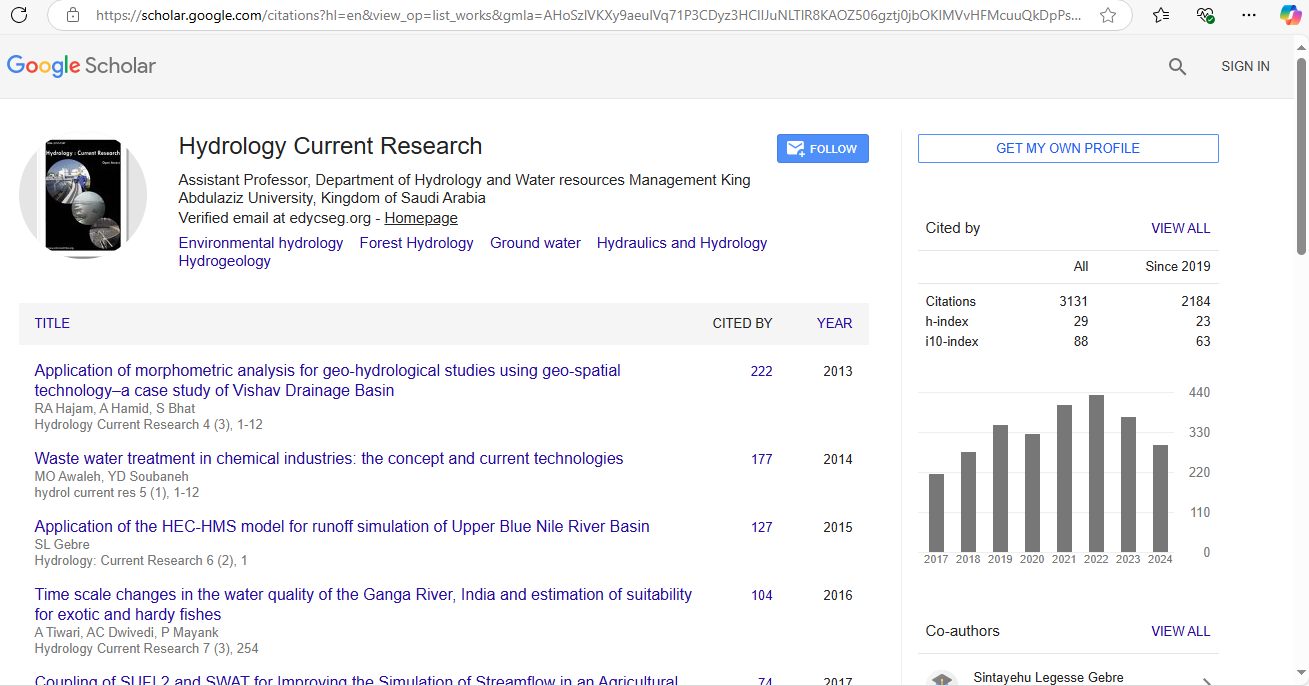
Hydrology: Current Research received 2843 citations as per Google Scholar report