Brief Report - (2025) Volume 10, Issue 5
Received: 01-Oct-2025, Manuscript No. jidm-26-188093;
Editor assigned: 04-Oct-2025, Pre QC No. P-188093;
Reviewed: 18-Oct-2025, QC No. Q-188093;
Revised: 22-Oct-2025, Manuscript No. R-188093;
Published:
29-Oct-2025
, DOI: 10.37421/2576-1420.2025.10.423
Citation: Ivanov, Ivan. "Global Gastrointestinal Infections: Challenges and Solutions."â J Infect Dis Med 10 (2025):423.
Copyright: © 2025 Ivanov I. This is an open-access article distributed under the terms of the Creative Commons Attribution License, which permits unrestricted use, distribution
and reproduction in any medium, provided the original author and source are credited.
Gastrointestinal infections represent a persistent and substantial global health concern, with their epidemiological patterns being intricately shaped by a confluence of factors including the specific types of pathogens involved, their various transmission routes, and the susceptibility of the host populations [1].
The effective management of these infections is critically dependent on several pillars: accurate and timely diagnosis, the judicious application of appropriate antimicrobial therapy when clinically indicated, the provision of robust supportive care, and, crucially, the implementation of comprehensive public health interventions. These interventions primarily focus on prevention through improvements in sanitation, promotion of hygiene practices, and the strategic use of vaccination [1].
A deep understanding of the epidemiology of prevalent pathogens such as norovirus, rotavirus, Salmonella, and E. coli is therefore indispensable for the development and execution of targeted control strategies [1].
Antimicrobial resistance among bacterial gastrointestinal pathogens, notably Salmonella and E. coli, has emerged as an increasingly alarming global threat, posing significant challenges to conventional treatment approaches [2].
This escalating resistance necessitates a highly judicious and informed strategy for antibiotic utilization. Emphasis must be placed on the use of diagnostic tools to precisely guide therapeutic decisions. Furthermore, the exploration and development of alternative therapeutic modalities, including the promising avenues of phage therapy and microbiome modulation, are essential to effectively combat the growing challenge posed by resistant bacterial strains [2].
Rotavirus continues to stand out as a primary etiological agent responsible for severe diarrheal disease, particularly impacting infants and young children worldwide [3].
While the widespread implementation of rotavirus vaccination programs has led to a dramatic reduction in disease burden in many high-income countries, significant challenges persist in ensuring equitable access to and adequate uptake of these life-saving vaccines in resource-limited settings [3].
Addressing these disparities is critical for further advancing the global control of rotavirus epidemiology. Norovirus, recognized as the most frequent cause of acute gastroenteritis in adult populations, presents formidable public health challenges owing to its highly infectious nature, the existence of diverse and evolving genotypes, and its rapid capacity for genetic change [4].
Outbreaks are particularly common and disruptive in communal settings such as healthcare facilities, schools, and cruise ships, underscoring the paramount importance of implementing and maintaining strict hygiene protocols and rigorous infection control measures to curb transmission [4].
Clostridioides difficile infection (CDI) has become a major and pervasive healthcare-associated infection, with a strong and well-established link to prior antibiotic exposure [5].
CDI significantly contributes to patient morbidity and mortality, imposing a substantial burden on healthcare systems. The management strategies for CDI are continuously evolving, with promising new approaches including fecal microbiota transplantation and novel targeted therapies that extend beyond the scope of traditional antibiotic treatments [5].
Foodborne outbreaks of bacterial gastroenteritis, with Salmonella, Campylobacter, and E. coli frequently implicated as causative agents, serve as stark reminders of the critical imperative for robust food safety regulations and comprehensive public education initiatives [6].
These educational efforts must focus on promoting safe food handling practices throughout the entire food supply chain, from production to consumption. Effective surveillance systems are also vital for enabling the rapid detection of outbreaks and facilitating timely and appropriate response mechanisms [6].
The intricate role of the gut microbiome in the pathogenesis and progression of gastrointestinal infections is gaining increasing scientific recognition [7].
Disruptions in the delicate balance of the gut microbial ecosystem, a condition known as dysbiosis, can significantly increase an individual's susceptibility to pathogenic infections and profoundly influence the severity and duration of the resulting illness [7].
Therapeutic interventions specifically designed to restore a healthy and balanced gut microbiome are demonstrating considerable promise in the management of certain types of gastrointestinal infections. Travelers' diarrhea, a common gastrointestinal ailment encountered by international travelers, is predominantly caused by enterotoxigenic E. coli (ETEC) and a variety of other bacterial species [8].
Prevention strategies primarily revolve around advising travelers on careful food and water selection during their journeys. While management is often focused on symptomatic relief, the use of antibiotics is typically reserved for specific clinical situations and in cases of moderate to severe illness [8].
The continuous advancement and widespread adoption of novel diagnostic tools have dramatically enhanced our capability to swiftly and accurately identify the causative agents responsible for gastroenteritis [9].
The development of rapid molecular assays, in particular, has been a significant breakthrough, enabling more targeted and effective patient management strategies and facilitating more efficient and precise outbreak investigations, thereby improving public health responses [9].
Achieving a substantial and sustainable reduction in the global burden of gastrointestinal infections necessitates the implementation of integrated and multi-faceted approaches [10].
These comprehensive strategies must effectively combine robust surveillance systems, widespread public health education campaigns, significant improvements in sanitation infrastructure, and the consistent application of evidence-based clinical management practices [10].
Fundamental to achieving long-term control are efforts to address underlying socioeconomic determinants of health and to ensure equitable access to quality healthcare for all populations worldwide [10].
Global health challenges are multifaceted and require comprehensive strategies. Gastrointestinal infections, a significant burden worldwide, are influenced by pathogen type, transmission, and host factors [1].
Effective management relies on accurate diagnosis, appropriate treatment, supportive care, and public health interventions like sanitation and vaccination [1].
Understanding specific pathogen epidemiology is key for targeted control [1].
Antimicrobial resistance in bacterial gastrointestinal pathogens like Salmonella and E. coli is a growing concern, demanding judicious antibiotic use and exploration of alternative therapies such as phage therapy and microbiome modulation [2].
This approach is crucial to combatting resistant strains and preserving the efficacy of available treatments [2].
Rotavirus remains a leading cause of severe diarrheal disease in young children globally [3].
While vaccination has significantly reduced its impact in high-income countries, vaccine access and uptake in resource-limited settings are critical challenges for further epidemiological control [3].
Norovirus, the most common cause of acute gastroenteritis in adults, presents challenges due to its high infectivity, diverse genotypes, and rapid evolution [4].
Frequent outbreaks in communal settings highlight the importance of strict hygiene and infection control measures [4].
Clostridioides difficile infection (CDI) is a major healthcare-associated infection linked to antibiotic exposure [5].
Evolving management strategies include fecal microbiota transplantation and novel targeted therapies beyond traditional antibiotics to improve patient outcomes [5].
Foodborne outbreaks caused by Salmonella, Campylobacter, and E. coli underscore the need for robust food safety regulations and public education on safe food handling [6].
Effective surveillance systems are vital for rapid outbreak detection and response [6].
The gut microbiome plays a recognized role in gastrointestinal infections [7].
Dysbiosis can increase susceptibility to pathogens and influence disease severity. Therapeutic interventions to restore a healthy microbiome show promise in managing certain infections [7].
Travelers' diarrhea, common among international travelers, is primarily caused by enterotoxigenic E. coli (ETEC) and other bacteria [8].
Prevention involves careful food and water selection, with antibiotics reserved for specific cases [8].
Novel diagnostic tools, including rapid molecular assays, have significantly improved the identification of gastroenteritis agents [9].
This enables more targeted management strategies and effective outbreak investigations [9].
Integrated approaches combining surveillance, public health education, improved sanitation, and evidence-based clinical management are crucial for reducing the burden of gastrointestinal infections globally [10].
Addressing socioeconomic determinants and ensuring equitable healthcare access are fundamental to long-term control [10].
Gastrointestinal infections present a significant global health challenge, with their epidemiological dynamics influenced by pathogen type, transmission routes, and host susceptibility. The effective management of these infections relies on accurate diagnosis, appropriate antimicrobial therapy when indicated, supportive care, and crucial public health interventions focused on prevention through sanitation, hygiene, and vaccination. Understanding the epidemiology of common pathogens like norovirus, rotavirus, Salmonella, and E. coli is essential for targeted control strategies [1].
Antimicrobial resistance in bacterial gastrointestinal pathogens such as Salmonella and E. coli is a growing concern, necessitating a judicious approach to antibiotic use. This approach emphasizes diagnostics to guide treatment and encourages the exploration of alternative therapeutic strategies, including phage therapy and microbiome modulation, to combat resistant strains [2].
Rotavirus remains a leading cause of severe diarrheal disease in infants and young children globally. While vaccination has dramatically reduced its burden in many high-income countries, access to and uptake of rotavirus vaccines remain critical challenges in resource-limited settings to further control its epidemiology [3].
Norovirus, the most common cause of acute gastroenteritis in adults, poses significant challenges due to its high infectivity, diverse genotypes, and rapid evolution. Outbreaks are frequent in communal settings, highlighting the importance of strict hygiene and infection control measures [4].
Clostridioides difficile infection (CDI) is a major healthcare-associated infection, strongly linked to antibiotic exposure and impacting patient morbidity and mortality. Management strategies are evolving to include fecal microbiota transplantation and novel targeted therapies beyond traditional antibiotics [5].
Foodborne outbreaks of bacterial gastroenteritis, particularly those caused by Salmonella, Campylobacter, and E. coli, underscore the critical need for robust food safety regulations and public education on safe food handling practices. Surveillance systems are vital for rapid outbreak detection and response [6].
The role of the gut microbiome in gastrointestinal infections is increasingly recognized. Dysbiosis can increase susceptibility to pathogens and influence disease severity and duration. Therapeutic interventions aimed at restoring a healthy microbiome show promise in managing certain infections [7].
Travelers' diarrhea, a common gastrointestinal infection among international travelers, is primarily caused by enterotoxigenic E. coli (ETEC) and other bacteria. Prevention involves careful food and water selection, while management is often symptomatic, with antibiotics reserved for specific cases [8].
The development of novel diagnostic tools, including rapid molecular assays, has significantly improved the ability to quickly identify causative agents of gastroenteritis, enabling more targeted and effective management strategies and outbreak investigations [9].
Integrated approaches combining surveillance, public health education, improved sanitation, and evidence-based clinical management are crucial for reducing the burden of gastrointestinal infections globally. Addressing socioeconomic determinants and ensuring equitable access to healthcare are fundamental to achieving long-term control [10].
Gastrointestinal infections are a significant global health issue influenced by pathogen type, transmission, and host susceptibility. Management involves accurate diagnosis, appropriate treatment, supportive care, and public health interventions focused on prevention through sanitation, hygiene, and vaccination. Antimicrobial resistance in pathogens like Salmonella and E. coli is a growing concern, necessitating judicious antibiotic use and exploration of alternative therapies. Rotavirus and norovirus remain major causes of diarrheal disease globally, with vaccination and infection control measures being crucial. Clostridioides difficile infection is a significant healthcare-associated problem, prompting evolving management strategies. Foodborne outbreaks highlight the need for food safety regulations and public education. The gut microbiome's role in these infections is increasingly recognized, with interventions to restore microbial balance showing promise. Travelers' diarrhea is common, managed through prevention and symptomatic treatment. Advances in diagnostics improve identification and management. Integrated approaches combining surveillance, education, sanitation, and clinical management are essential for global control, alongside addressing socioeconomic factors and ensuring healthcare equity.
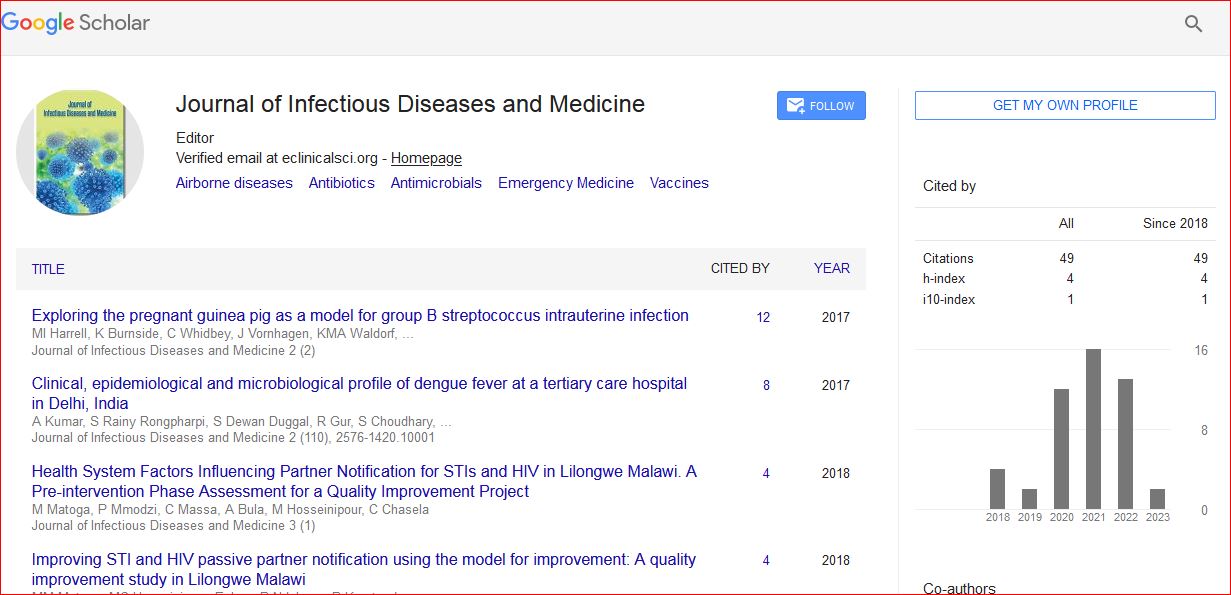
Journal of Infectious Diseases and Medicine received 1059 citations as per Google Scholar report