Commentary - (2025) Volume 17, Issue 6
Received: 03-Nov-2025, Manuscript No. jcst-25-176309;
Editor assigned: 05-Nov-2025, Pre QC No. P-176309;
Reviewed: 19-Nov-2025, QC No. Q-176309;
Revised: 24-Nov-2025, Manuscript No. R-176309;
Published:
01-Dec-2025
, DOI: 10.37421/1948-5956.2025.17.733
Citation: Khalid, Mohammed. "Global Cancer Burden: Multifaceted
Risks, Prevention." J Cancer Sci Ther 17 (2025):733.
Copyright: © 2025 Khalid M. This is an open-access article distributed under the terms of the Creative Commons Attribution License, which permits unrestricted use, distribution
and reproduction in any medium, provided the original author and source are credited.
This article provides the latest global cancer statistics from GLOBOCAN 2020, estimating the incidence and mortality rates for 36 cancers across 185 countries. It highlights the significant burden of cancer globally and identifies key trends, essential for understanding the scope of the disease and guiding prevention strategies [1].
This systematic review and meta-analysis quantifies the global cancer burden attributed to modifiable lifestyle factors like smoking, alcohol, excess body weight, and insufficient physical activity. It emphasizes the substantial role of these factors in cancer development and highlights the potential for prevention through lifestyle interventions [2].
This article presents updated clinical practice guidelines for germline genetic testing in cancer susceptibility. It provides crucial recommendations for identifying individuals at higher genetic risk, guiding appropriate testing strategies, and informing personalized management and prevention plans for those with inherited cancer predispositions [3].
This review examines the current evidence linking environmental chemical exposures to various cancers. It highlights the complex interplay between chemical agents and cancer development, underscoring the importance of understanding these exposures for public health interventions and primary prevention strategies [4].
This article explores the established link between chronic inflammation and increased cancer risk. It delves into the molecular mechanisms by which inflammatory processes can promote tumor initiation, progression, and metastasis, identifying potential therapeutic targets and preventive strategies [5].
This comprehensive review explores the intricate relationship between the human microbiome, particularly the gut microbiome, and cancer risk. It details the mechanisms by which microbial communities can influence various stages of carcinogenesis, immune modulation, and therapeutic outcomes, highlighting their potential as targets for prevention [6].
This systematic review synthesizes findings from Mendelian randomization studies, providing robust evidence for the causal role of obesity in increasing the risk of various cancers. It elucidates specific cancer types impacted by higher BMI, strengthening the rationale for obesity prevention as a cancer prevention strategy [7].
This review explores the complex and bidirectional relationship between aging and cancer risk. It discusses how age-related biological changes, such as cellular senescence, genomic instability, and altered immune function, contribute to increased cancer incidence and affect treatment responses in older adults [8].
This updated review synthesizes evidence on occupational exposure to carcinogens and their associated cancer risks. It highlights common workplace hazards and the types of cancers they induce, emphasizing the ongoing need for robust occupational health policies and preventive measures to protect workers [9].
This global perspective article reviews the significant contribution of infectious agents to the worldwide cancer burden. It details specific pathogens, such as HPV, HBV, HCV, and H. pylori, explaining their mechanisms of carcinogenesis and underscoring the importance of vaccination and infection control in cancer prevention [10].
Global cancer statistics from GLOBOCAN 2020 provide a critical perspective on the worldwide burden of cancer [1]. This dataset offers estimates of incidence and mortality rates across 36 cancer types in 185 countries, essential for understanding the disease's scope and guiding prevention strategies. A significant portion of this global burden is attributable to modifiable lifestyle factors [2]. A systematic review quantified the impact of elements like smoking, alcohol consumption, excess body weight, and insufficient physical activity, underscoring their substantial role in cancer development and highlighting potential for prevention through targeted lifestyle interventions.
Beyond lifestyle, genetic predispositions are fundamental to cancer susceptibility. Updated clinical practice guidelines for germline genetic testing provide recommendations for identifying high-risk individuals and informing personalized management and prevention plans for inherited cancer predispositions [3]. Concurrently, environmental factors, particularly exposure to various chemical agents, contribute significantly to cancer development [4]. Reviews highlight the intricate interplay between specific chemical agents and carcinogenesis, making a deeper understanding of these exposures indispensable for designing effective public health interventions and implementing primary prevention strategies.
The internal biological landscape also holds profound implications for cancer risk. Chronic inflammation is an established link to elevated cancer risk [5]. Research delves into molecular mechanisms through which persistent inflammatory processes promote tumor initiation, progression, and metastasis, uncovering potential therapeutic targets and preventive strategies. The human microbiome, especially the gut microbiome, presents another crucial relationship with cancer risk [6]. Comprehensive reviews explore how microbial communities influence carcinogenesis, immune modulation, and outcomes of cancer therapies, positioning the microbiome as a promising target for prevention.
Further reinforcing intrinsic biological risks, systematic reviews of Mendelian randomization studies offer compelling evidence for the causal role of obesity in increasing the risk of multiple cancer types [7]. This strong evidence clarifies specific cancer types impacted by higher Body Mass Index (BMI), strengthening the rationale for obesity prevention as a fundamental cancer prevention strategy. The aging process itself is intricately linked with cancer risk [8]. Research explores how age-related biological changesâ??such as cellular senescence and altered immune functionâ??contribute to increased cancer incidence and affect treatment responses in older adults. Separately, occupational exposures continue to pose a significant cancer risk [9]. Reviews synthesize evidence on workplace carcinogens, detailing common hazards and induced cancer types, underscoring the persistent need for robust occupational health policies and proactive preventive measures to safeguard worker health.
Finally, infectious agents constitute a major, often preventable, component of the global cancer burden [10]. This perspective outlines the substantial contribution of specific pathogens, including Human Papillomavirus (HPV), Hepatitis B Virus (HBV), Hepatitis C Virus (HCV), and H. pylori. It explains their mechanisms of carcinogenesis and highlights the importance of vaccination programs and comprehensive infection control measures as vital components of worldwide cancer prevention efforts. These diverse lines of inquiry illuminate the complex etiology of cancer, advocating for a holistic, multi-pronged prevention approach addressing genetic, environmental, lifestyle, and biological factors to reduce cancer incidence globally.
Global cancer statistics from GLOBOCAN 2020 reveal a significant worldwide burden, detailing incidence and mortality rates across numerous cancers and countries. This understanding is crucial for guiding prevention strategies. A substantial portion of the global cancer burden is linked to modifiable lifestyle factors such as smoking, alcohol consumption, excess body weight, and insufficient physical activity, emphasizing the potential for prevention through targeted interventions. Beyond lifestyle, genetic predispositions play a key role, with clinical practice guidelines now available for germline genetic testing to identify high-risk individuals and inform personalized management. Environmental factors, including chemical exposures, also contribute significantly to cancer development. Chronic inflammation is an established driver of cancer, influencing tumor initiation and progression. The human microbiome, particularly the gut microbiome, impacts cancer risk, immune modulation, and therapeutic outcomes. Robust evidence confirms obesity's causal role in increasing cancer risk, reinforcing obesity prevention. The complex relationship between aging and cancer is evident, as age-related biological changes heighten cancer incidence. Occupational exposures to carcinogens remain a concern, necessitating strong occupational health policies. Finally, infectious agents like HPV, HBV, HCV, and H. pylori contribute significantly to the global cancer burden, making vaccination and infection control vital prevention measures. Collectively, these studies underscore a multifaceted approach to cancer prevention, addressing lifestyle, genetic, environmental, and biological factors.
Indexed at, Google Scholar, Crossref
Indexed at, Google Scholar, Crossref
Indexed at, Google Scholar, Crossref
Indexed at, Google Scholar, Crossref
Indexed at, Google Scholar, Crossref
Indexed at, Google Scholar, Crossref
Indexed at, Google Scholar, Crossref
Indexed at, Google Scholar, Crossref
Indexed at, Google Scholar, Crossref
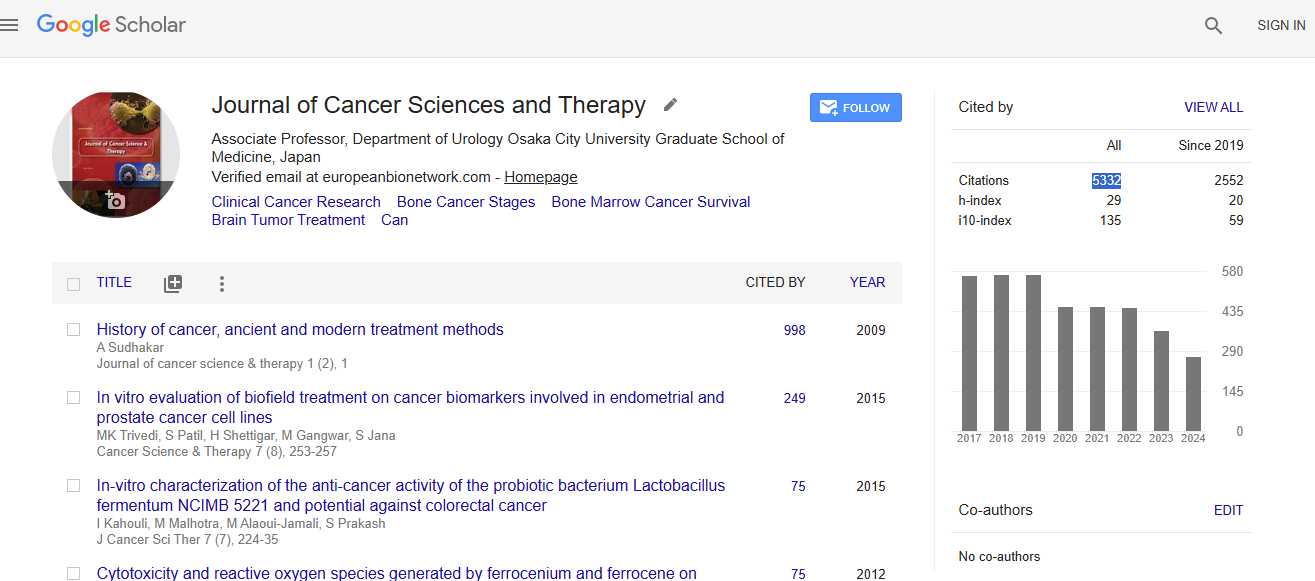
Cancer Science & Therapy received 5332 citations as per Google Scholar report