Short Communication - (2025) Volume 16, Issue 2
Received: 03-Mar-2025, Manuscript No. jch-26-178753;
Editor assigned: 05-Mar-2025, Pre QC No. P-178753;
Reviewed: 19-Mar-2025, QC No. Q-178753;
Revised: 24-Mar-2025, Manuscript No. R-178753;
Published:
31-Mar-2025
, DOI: 10.37421/2157-7099.2025.16.791
Citation: Hernández, Rafael G.. ”Genomics and Cytomorphology: Unlocking Biological Insights.” J Cytol Histol 16 (2025):791.
Copyright: © 2025 Hernández G. Rafael This is an open-access article distributed under the terms of the Creative Commons Attribution License, which permits unrestricted use, distribution and reproduction in any medium, provided the original author and source are credited.
The synergistic integration of genomic data with traditional cytomorphology represents a significant advancement in our understanding of biological processes and disease mechanisms. This interdisciplinary approach combines high-throughput genomic techniques, such as next-generation sequencing and array comparative genomic hybridization, with detailed microscopic examination of cell and tissue structure, offering a more comprehensive perspective. This fusion enables the precise identification of genetic alterations that underlie observed morphological changes, thereby enhancing diagnostic accuracy and facilitating the discovery of novel therapeutic targets in various fields of study [1].
The application of advanced cytomorphological techniques alongside genomic analysis is revolutionizing cancer research by providing deeper insights into tumor classification and treatment response. Correlating chromosomal aberrations, gene copy number variations, and single nucleotide polymorphisms with distinct cellular phenotypes aids in more accurate tumor classification, prediction of treatment efficacy, and identification of biomarkers for early detection. This integration serves as a powerful tool for dissecting tumor heterogeneity and understanding its evolutionary trajectory [2].
Developmental biology is also being profoundly investigated through the lens of integrated molecular cytology, demonstrating how combining epigenetic profiling and cell lineage tracing with detailed morphological analysis of developing tissues and organs can unravel complex regulatory networks. Understanding the intricate interplay between genetic regulation and cellular differentiation is paramount for addressing developmental disorders and devising effective regenerative medicine strategies [3].
The diagnostic utility of integrating genomic and cytomorphological data is making a profound impact on neuropathology, offering more precise diagnoses for neurodegenerative diseases and brain tumors. Correlating genetic mutations and chromosomal abnormalities in neurological tissues with observed cellular and structural changes via microscopy provides enhanced diagnostic precision and paves the way for targeted therapies based on a molecularly defined understanding of the pathology [4].
Molecular cytology plays a crucial role in the study of infectious diseases, where the combination of genomic sequencing of pathogens with detailed analysis of host cell responses and pathogen-host interactions at the cellular level is proving invaluable. This integrated approach allows for a better understanding of disease pathogenesis, the identification of virulence factors, and the development of novel antimicrobial strategies, offering deeper insights into the molecular mechanisms of infection and host defense [5].
The integration of single-cell genomics with high-resolution imaging techniques is fundamentally transforming our perception of cellular heterogeneity. Analyzing the genomic landscape of individual cells concurrently with observing their morphology and spatial organization reveals intricate cellular states and their functional implications within complex tissues, particularly in dynamic environments such as tumors and developing embryos [6].
In the realm of toxicology and environmental health, molecular cytology offers a powerful framework for investigation. By integrating omics data, including genomics and transcriptomics, with cellular and tissue-level observations, researchers can identify the molecular mechanisms underlying toxicity and assess the impact of environmental agents on cellular function and morphology. This allows for a more sensitive and predictive approach to risk assessment [7].
The capabilities of molecular cytology are significantly amplified by the development of advanced imaging technologies, such as super-resolution microscopy and light-sheet microscopy. These techniques, when coupled with genomic and proteomic data, permit the visualization of molecular events within cells and tissues at unprecedented levels of detail, thereby elucidating the spatial organization of genetic material and its functional context [8].
Bioinformatics and computational approaches are pivotal in the integration of large-scale genomic datasets with cytomorphological information. The application of machine learning algorithms and statistical modeling allows for the identification of patterns, correlations, and predictive signatures that are otherwise imperceptible through manual analysis alone, thereby accelerating the pace of discovery in the field of molecular cytology [9].
The field of epigenetics is experiencing substantial advancement through the integration of genomic mapping techniques with cellular imaging. Visualizing epigenetic modifications, such as DNA methylation and histone modifications, within the structural context of cells and nuclear organization reveals their profound impact on gene expression and cellular function, which is critical for understanding cellular differentiation, development, and disease [10].
The synergistic integration of genomic data with traditional cytomorphology is a cornerstone for enhancing our understanding of biological processes and disease mechanisms. This approach leverages high-throughput genomic techniques, including next-generation sequencing and array comparative genomic hybridization, alongside meticulous microscopic examination of cellular and tissue structures. This fusion allows for the precise identification of genetic alterations that manifest as morphological changes, leading to improved diagnostic accuracy and the discovery of novel therapeutic targets across various biological disciplines [1].
In cancer research, the integration of advanced cytomorphological techniques with genomic analysis is proving revolutionary. The correlation of chromosomal aberrations, gene copy number variations, and single nucleotide polymorphisms with distinct cellular phenotypes enables more accurate tumor classification, prediction of treatment responses, and the identification of critical biomarkers for early detection. This unified approach provides a potent tool for deciphering tumor heterogeneity and understanding its evolutionary dynamics [2].
The study of developmental biology is significantly advanced by integrated molecular cytology. This methodology combines epigenetic profiling and cell lineage tracing with detailed morphological analysis of developing tissues and organs, facilitating the unraveling of complex regulatory networks. A thorough comprehension of the interplay between genetic regulation and cellular differentiation is essential for addressing developmental disorders and formulating effective regenerative medicine strategies [3].
Neuropathology is witnessing a profound transformation due to the integration of genomic and cytomorphological data. This approach enables more precise diagnoses for neurodegenerative diseases and brain tumors by correlating genetic mutations and chromosomal abnormalities in neurological tissues with observed cellular and structural changes discernible through microscopy. Furthermore, it lays the groundwork for developing targeted therapies informed by a molecularly defined understanding of pathological conditions [4].
Molecular cytology offers critical insights into infectious diseases through the combined analysis of pathogen genomics and host cell responses at the cellular level. This integration allows for a deeper understanding of disease pathogenesis, the identification of virulence factors, and the development of innovative antimicrobial strategies, illuminating the intricate molecular mechanisms governing infection and host defense [5].
Single-cell genomics, when coupled with high-resolution imaging, is revolutionizing the study of cellular heterogeneity. This powerful combination enables the analysis of the genomic landscape of individual cells while simultaneously observing their morphology and spatial organization. This reveals complex cellular states and their functional implications, particularly within dynamic environments like tumors and developing embryos [6].
In toxicology and environmental health, molecular cytology provides a robust framework for investigation. By integrating omics data (genomics, transcriptomics) with cellular and tissue-level observations, researchers can elucidate the molecular mechanisms of toxicity and evaluate the impact of environmental agents on cellular function and morphology, thereby facilitating more sensitive and predictive risk assessments [7].
Advanced imaging technologies, such as super-resolution and light-sheet microscopy, are significantly enhancing the capabilities of molecular cytology. When integrated with genomic and proteomic data, these techniques allow for the visualization of molecular events within cells and tissues at unparalleled detail, offering insights into the spatial organization of genetic material and its functional significance [8].
Bioinformatics and computational approaches play a pivotal role in integrating vast genomic datasets with cytomorphological information. Machine learning algorithms and statistical modeling are instrumental in identifying patterns, correlations, and predictive signatures that manual analysis would likely miss, thereby accelerating the pace of discovery in molecular cytology [9].
The field of epigenetics is substantially propelled by the integration of genomic mapping techniques with cellular imaging. This synergy enables the visualization of epigenetic modifications, such as DNA methylation and histone modifications, within the context of cellular structure and nuclear organization, revealing their impact on gene expression and cellular function. This understanding is vital for comprehending cellular differentiation, development, and disease processes [10].
This collection of research highlights the transformative power of integrating genomic data with cytomorphological analysis across various scientific disciplines. By combining high-throughput genomic techniques with detailed microscopic examination, researchers are achieving deeper insights into complex biological processes and diseases. Applications range from enhanced diagnostic accuracy in oncology and neuropathology to unraveling developmental pathways, understanding infectious diseases, and studying cellular heterogeneity. Advanced imaging and computational approaches further bolster this integrative methodology, enabling precise visualization of molecular events and identification of complex patterns. The synergy between genomics and cytomorphology is crucial for advancing fields like epigenetics, toxicology, and ultimately, for developing more effective diagnostics and therapeutics.
None
None
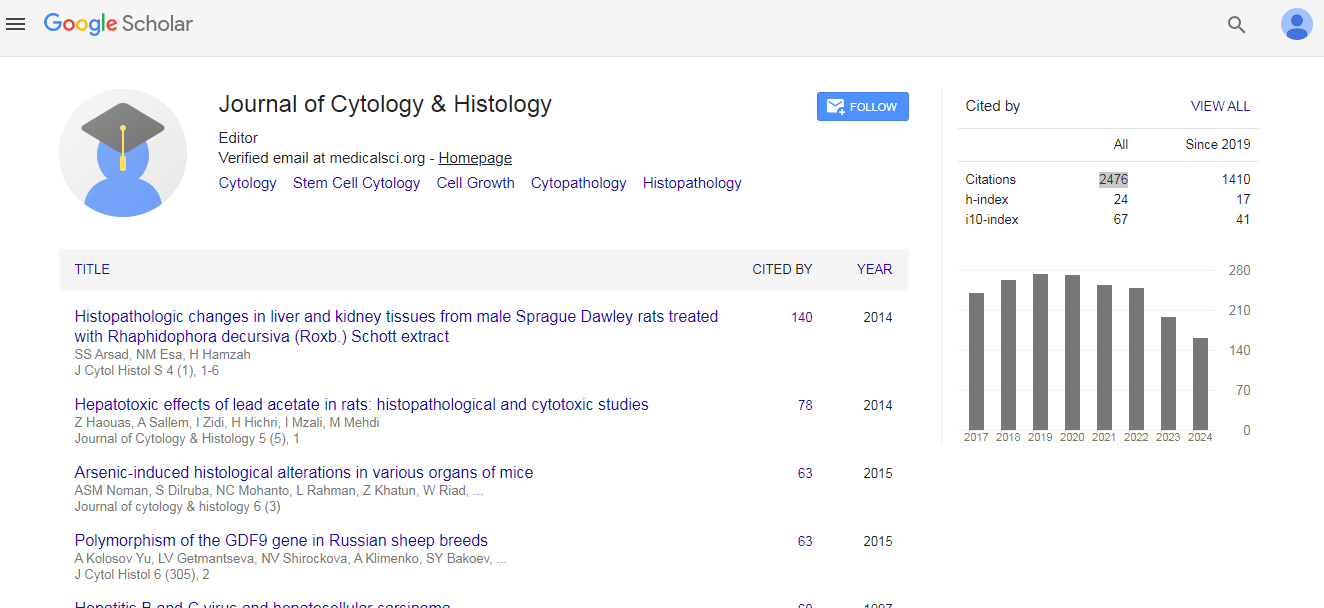
Journal of Cytology & Histology received 2476 citations as per Google Scholar report