Short Communication - (2025) Volume 9, Issue 5
Received: 02-Oct-2025, Manuscript No. jgge-25-174651;
Editor assigned: 06-Oct-2025, Pre QC No. P-174651;
Reviewed: 20-Oct-2025, QC No. Q-174651;
Revised: 23-Oct-2025, Manuscript No. R-174651;
Published:
30-Oct-2025
, DOI: 10.37421/2684-4567.2025.9.197
Citation: Lebedev, Viktor S.. ”Genomic Sequencing: Transforming Healthcare, Research, Ethics.” J Genet Genom 09 (2025):197.
Copyright: © 2025 Lebedev S. Viktor This is an open-access article distributed under the terms of the Creative Commons Attribution License, which permits unrestricted use,
distribution and reproduction in any medium, provided the original author and source are credited.
This paper highlights how whole-genome sequencing (WGS) is becoming a game-changer in diagnosing rare genetic diseases in children, particularly when standard tests don't provide answers. It shows that WGS can identify genetic causes more frequently than other methods, leading to more precise patient management and often avoiding a diagnostic odyssey.[1] Here's the thing: implementing comprehensive germline genetic testing programs is crucial for delivering personalized cancer care. This article lays out the practical steps and considerations for integrating such programs into clinical practice, emphasizing their role in identifying inherited cancer risks and guiding treatment decisions for patients and their families.[2] This study shows how whole-genome sequencing applied to large population cohorts, like the Framingham Heart Study, can uncover novel genetic associations with various diseases and biomarkers. What this really means is that population-scale sequencing provides a powerful tool for understanding the genetic architecture of common complex diseases, potentially leading to new diagnostic and therapeutic strategies.[3] Let's break it down: whole-genome sequencing (WGS) is invaluable for tracking and understanding the spread of infectious diseases, especially in hospital settings. This work demonstrates how WGS precisely mapped the transmission routes of a Klebsiella pneumoniae outbreak in an ICU, showing its power in informing infection control measures and preventing further spread.[4] Here's the deal with single-cell multi-omics sequencing: it's revolutionizing our ability to explore biological systems at unprecedented resolution. This review details the latest advancements in these technologies, which allow researchers to simultaneously analyze DNA, RNA, and proteins from individual cells, providing profound insights into cellular heterogeneity and complex biological processes.[5] Whole-genome sequencing (WGS) isn't just for rare pediatric conditions; it's also making a difference for adults with previously undiagnosed cardiovascular genetic diseases. This study demonstrates that WGS significantly boosts the diagnostic yield in these complex cases, leading to clearer diagnoses, better risk stratification, and more informed treatment plans for patients and their families, highlighting its broad utility in adult medicine.[6] When we talk about precision medicine, understanding the economic impact is vital. This systematic review tackles the cost-effectiveness of whole-genome sequencing for rare disease diagnosis. It suggests that while initial costs can be high, WGS can ultimately reduce overall healthcare expenditures by shortening diagnostic odysseys and enabling earlier, more effective treatments, making it a valuable tool for healthcare systems.[7] Here's the lowdown on long-read sequencing: it's making significant waves in cancer research by providing a more complete view of genomic structural variations that short-read methods often miss. This review highlights how these technologies are being used to better characterize complex genomic rearrangements, identify fusion genes, and understand epigenetic modifications in cancer, opening new avenues for diagnosis and treatment.[8] Let's face it, while genomic sequencing offers immense potential, it also brings significant ethical considerations, especially around data sharing. This review meticulously examines the challenges associated with sharing genetic data, such as privacy concerns, informed consent, and potential discrimination, while also proposing practical solutions to ensure responsible and equitable access to this invaluable information.[9] Non-invasive prenatal testing (NIPT) has been transformed by genomic sequencing. This paper introduces an advanced approach that combines cfDNA NIPT with whole-exome sequencing to significantly improve the diagnosis of fetal genetic disorders. What this means for expectant parents is a more accurate, safer way to detect conditions prenatally, providing crucial information for clinical management without the risks associated with invasive procedures.[10]
Genomic sequencing technologies are fundamentally changing how we approach diagnosis and treatment across a spectrum of medical fields. Whole-genome sequencing (WGS) stands out as a powerful tool for unraveling the mysteries of rare genetic diseases, particularly in children where conventional tests often fail to yield answers. It significantly increases the diagnostic yield, paving the way for more precise patient management and effectively shortening prolonged diagnostic odysseys [1]. This diagnostic power extends to adult medicine as well; WGS notably improves the diagnosis of previously undiagnosed cardiovascular genetic diseases, leading to clearer diagnoses, better risk stratification, and more informed treatment decisions for affected individuals and their families [6]. What this really means is that a comprehensive genetic profile can guide care from early life into adulthood, addressing complex conditions.
Beyond individual diagnostics, the utility of genomic sequencing stretches into population health and cancer care. Applying whole-genome sequencing to large population cohorts, like the Framingham Heart Study, reveals novel genetic associations with various diseases and biomarkers. This population-scale sequencing offers a robust framework for understanding the genetic architecture of common complex diseases, potentially leading to innovative diagnostic and therapeutic strategies [3]. In the realm of cancer, implementing comprehensive germline genetic testing programs is vital for delivering personalized cancer care. These programs play a critical role in identifying inherited cancer risks and guiding treatment decisions for patients, demonstrating the proactive and tailored nature of modern oncology [2].
Genomic sequencing also provides invaluable insights into managing infectious diseases and enhancing prenatal care. WGS, for example, proves essential for tracking and understanding the spread of infectious pathogens, especially in hospital environments. Its ability to precisely map transmission routes, as demonstrated in a Klebsiella pneumoniae outbreak in an ICU, underscores its power in informing infection control measures and preventing further dissemination [4]. Furthermore, the field of non-invasive prenatal testing (NIPT) has seen remarkable advancements. A novel approach combining cell-free DNA (cfDNA) NIPT with whole-exome sequencing significantly improves the diagnosis of fetal genetic disorders, offering a more accurate and safer prenatal detection method without the risks associated with invasive procedures, providing crucial information for clinical management [10].
Emerging sequencing technologies are pushing the boundaries of biological discovery, offering unprecedented resolution. Single-cell multi-omics sequencing, for instance, is revolutionizing our capacity to explore biological systems by allowing simultaneous analysis of DNA, RNA, and proteins from individual cells. This provides profound insights into cellular heterogeneity and complex biological processes, opening new avenues for research [5]. In cancer research, long-read sequencing is making significant waves by offering a more complete view of genomic structural variations often missed by short-read methods. These technologies are crucial for better characterizing complex genomic rearrangements, identifying fusion genes, and understanding epigenetic modifications in cancer, paving the way for new diagnostic and treatment strategies [8].
However, the widespread adoption and utilization of genomic sequencing are not without crucial considerations. Economically, while initial costs can appear substantial, a systematic review suggests that whole-genome sequencing for rare disease diagnosis can ultimately reduce overall healthcare expenditures. This happens by shortening diagnostic odysseys and enabling earlier, more effective treatments, making it a valuable investment for healthcare systems [7]. Let's face it, while genomic sequencing offers immense potential, it also brings significant ethical challenges, particularly concerning data sharing. A meticulous review highlights critical issues like privacy concerns, informed consent, and potential discrimination, emphasizing the urgent need for practical solutions to ensure responsible and equitable access to this invaluable genetic information [9].
Genomic sequencing technologies are revolutionizing healthcare, providing unprecedented diagnostic capabilities and insights into complex biological processes. Whole-genome sequencing (WGS) is transforming the diagnosis of rare genetic diseases in both children and adults with undiagnosed cardiovascular conditions, significantly increasing diagnostic yield and shortening arduous diagnostic odysseys [1, 6]. This approach is proving cost-effective in the long run by enabling earlier and more effective treatments [7]. Beyond individual patient care, WGS is instrumental in public health initiatives, like tracking infectious disease outbreaks and informing infection control measures [4], and in population-scale studies to uncover new genetic associations for common complex diseases [3]. In cancer care, germline genetic testing programs are crucial for personalized treatment and risk assessment [2], complemented by long-read sequencing which offers a more complete view of genomic structural variations, opening new avenues for diagnosis and treatment [8]. Advances also extend to non-invasive prenatal testing, combining cfDNA NIPT with whole-exome sequencing for safer and more accurate fetal genetic disorder diagnoses [10]. Furthermore, single-cell multi-omics sequencing is pushing the boundaries of research, allowing simultaneous analysis of DNA, RNA, and proteins from individual cells for deep insights into cellular heterogeneity [5]. While these technologies offer immense potential, ethical considerations, especially around genetic data sharing, privacy, and informed consent, remain critical challenges that require thoughtful solutions for responsible and equitable access [9].
None
None
Chong, JX, Le, V, Smithers, CM. "Clinical utility of whole-genome sequencing in pediatric medicine".Genome Med 15 (2023):1.
Indexed at, Google Scholar, Crossref
Wyrick, DL, Kim, YC, Zhang, Y. "Implementing a Germline Genetic Testing Program for Precision Cancer Care".JCO Oncol Pract 18 (2022):e939-e946.
Indexed at, Google Scholar, Crossref
Fritsche, LG, Lee, S, Chu, Y. "Whole-genome sequencing reveals new associations with disease and protein biomarkers in the Framingham Heart Study".Sci Rep 11 (2021):14583.
Indexed at, Google Scholar, Crossref
Parcellier, A, Avenaud, V, Sacleux, M. "Contribution of Whole-Genome Sequencing to Understand the Dynamics of a Nosocomial Klebsiella pneumoniae Outbreak in the ICU".Front Microbiol 12 (2022):800100.
Indexed at, Google Scholar, Crossref
Guo, Q, Yan, X, Wang, J. "Recent advances in single-cell multi-omics sequencing technologies".Front Genet 14 (2023):1143891.
Indexed at, Google Scholar, Crossref
Schwartz, SM, Kim, S, Chung, D. "Whole genome sequencing improves diagnosis of adult patients with undiagnosed cardiovascular genetic disease".Eur Heart J 44 (2023):1979-1988.
Indexed at, Google Scholar, Crossref
Lee, K, Yoon, D, Jeon, S. "Cost-effectiveness analysis of whole-genome sequencing in patients with suspected rare diseases: a systematic review".J Med Econ 26 (2023):15-26.
Indexed at, Google Scholar, Crossref
Manickam, S, Kumar, K, Tan, XW. "Current Applications of Long-Read Sequencing in Cancer Research".Front Oncol 13 (2023):1120016.
Indexed at, Google Scholar, Crossref
Christen, M, Biller-Andorno, N, Casonato, S. "Genetic data sharing: a review of the ethical challenges and their solutions".J Community Genet 12 (2021):1-14.
Indexed at, Google Scholar, Crossref
Hu, X, Wang, W, Liu, Y. "A novel cfDNA non-invasive prenatal testing combined with whole-exome sequencing for diagnosis of fetal genetic disorders".BMC Med Genomics 15 (2022):210.
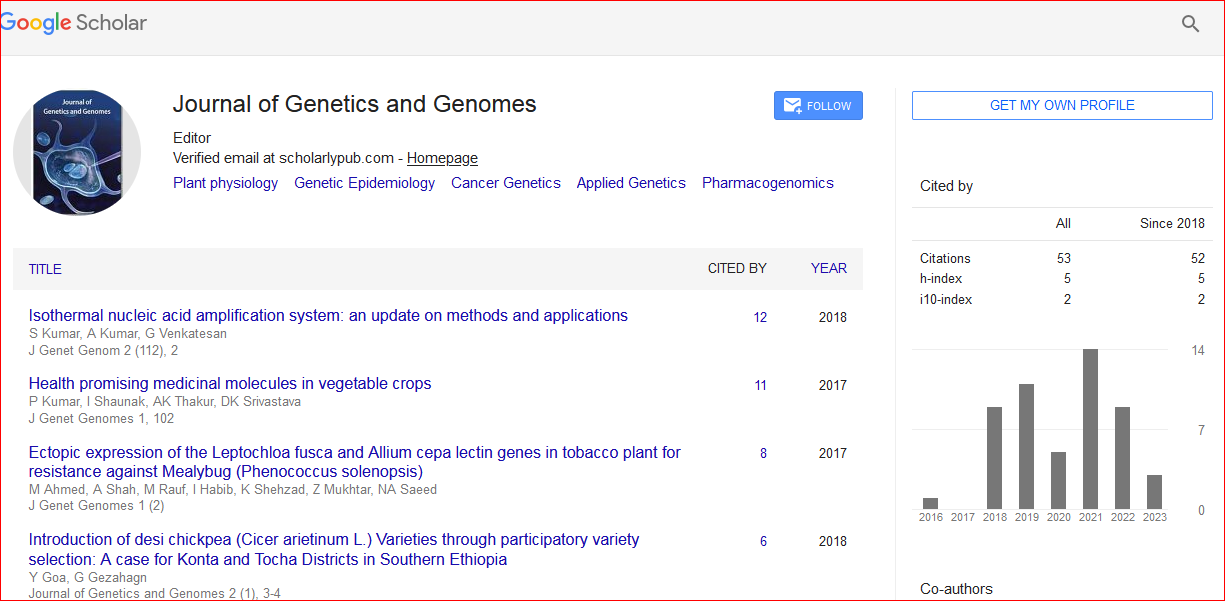
Journal of Genetics and Genomes received 65 citations as per Google Scholar report