Brief Report - (2025) Volume 9, Issue 5
Received: 02-Oct-2025, Manuscript No. jgge-25-174643;
Editor assigned: 06-Oct-2025, Pre QC No. P-174643;
Reviewed: 20-Oct-2025, QC No. Q-174643;
Revised: 23-Oct-2025, Manuscript No. R-174643;
Published:
30-Oct-2025
, DOI: 10.37421/2684-4567.2025.9.191
Citation: Hayes, Connor T.. ”Genetic Variations: Impact, Diagnosis, Therapy.” J Genet Genom 09 (2025):191.
Copyright: © 2025 Hayes T. Connor This is an open-access article distributed under the terms of the Creative Commons Attribution License, which permits unrestricted use,
distribution and reproduction in any medium, provided the original author and source are credited.
Advancements in genetics and genomics continue to revolutionize our understanding of human health and disease. Gene editing technologies, specifically CRISPR-Cas9, show significant promise in treating various human genetic diseases. This technology precisely corrects disease-causing mutations, with ongoing clinical trials exploring its mechanisms and future prospects, including addressing off-target effects and refining delivery methods [1].
Whole Genome Sequencing (WGS) has emerged as a transformative tool for diagnosing rare diseases. It effectively identifies pathogenic genetic variants often missed by conventional diagnostic approaches, thereby improving diagnostic yield and enabling personalized management strategies for patients. The integration of WGS into clinical practice presents both current challenges and exciting future directions [2].
Beyond inherited conditions, somatic mutations play a critical role in the development and progression of cancer. These acquired genetic changes drive oncogenesis and influence tumor heterogeneity. Consequently, they serve as crucial targets for personalized cancer therapies, with genomic profiling increasingly guiding treatment decisions and predicting patient responses in clinical oncology [3].
The diverse spectrum of human diseases also includes those caused by mutations in mitochondrial DNA (mtDNA). These genetic alterations impair mitochondrial function, leading to a wide range of clinical presentations affecting multiple organ systems. Diagnostic approaches and current therapeutic strategies for managing these complex mtDNA-related disorders continue to evolve, though significant challenges remain [4].
Germline mutations have a profound impact on human health, being central to inherited diseases. These genetic changes are present in every cell from birth and predispose individuals to a vast array of conditions, from Mendelian disorders to complex diseases. Understanding the mechanisms of germline mutation inheritance is essential for effective genetic counseling and early diagnosis [5].
Structural variants (SVs), which are large-scale genomic rearrangements like deletions, duplications, inversions, and translocations, are increasingly recognized for their significant role in human disease. These variants can profoundly disrupt gene function and contribute to various conditions, including neurodevelopmental disorders and cancer. Advanced methods for SV detection are thus gaining importance in clinical diagnostics [6].
The landscape of precision medicine is rapidly evolving, offering tailored medical treatments based on an individual's genetic makeup. This approach is revolutionizing patient care, especially for rare and complex disorders, by integrating advancements in genomic diagnostics with targeted therapies. While promising, the broad implementation of precision medicine faces ethical and economic considerations that need careful navigation [7].
Gene dosage, the concept that alterations in the number of copies of specific genes can disrupt cellular pathways, has profound implications for human disease. Whether through deletions or duplications, these changes lead to various genetic conditions, such as DiGeorge syndrome and Charcot-Marie-Tooth disease. Understanding the mechanisms underlying gene dosage sensitivity is crucial for comprehending these disorders [8].
Emerging research also highlights the contribution of mutations in long noncoding RNAs (lncRNAs) to various human diseases. While often overlooked, lncRNAs perform crucial regulatory roles in gene expression, and their disruption through mutations can lead to pathologies including cancer, neurological disorders, and cardiovascular diseases. This underscores their potential as diagnostic biomarkers and therapeutic targets [9].
The complex challenge of interpreting genetic variants identified through sequencing is a cornerstone of precision medicine for disease diagnosis and treatment. This process involves methodologies, computational tools, and expert consensus guidelines to classify variants as pathogenic, benign, or of uncertain significance. Accurate interpretation is critical for sound clinical decision-making [10].
Genetic mutations stand as a fundamental driving force behind a wide array of human diseases. These alterations can be broadly categorized into somatic and germline mutations, each with distinct implications for health and disease progression. Somatic mutations, acquired during an individual's lifetime, are critical in the development and progression of cancer. They initiate oncogenesis, influence the heterogeneity within tumors, and importantly, serve as direct targets for personalized cancer therapies. Genomic profiling has become an indispensable tool in clinical oncology, guiding treatment decisions and predicting how patients will respond to specific interventions [3]. In contrast, germline mutations are inherited, present in every cell from birth, and are the primary cause of inherited diseases. These genetic changes can predispose individuals to a vast spectrum of conditions, ranging from straightforward Mendelian disorders to more complex polygenic diseases. A deep understanding of germline mutation inheritance mechanisms is paramount for effective genetic counseling, allowing for early diagnosis and informed family planning [5].
Beyond single nucleotide variants, other forms of genetic alterations profoundly impact human health. Structural variants (SVs), which encompass large-scale genomic rearrangements like deletions, duplications, inversions, and translocations, can severely disrupt normal gene function. These SVs are increasingly implicated in various conditions, including neurodevelopmental disorders and different types of cancer. The ongoing development of advanced methodologies for SV detection highlights their growing importance in clinical diagnostics [6]. Another crucial area involves mutations in mitochondrial DNA (mtDNA), which lead to a diverse array of human diseases by impairing critical mitochondrial function. Such dysfunctions manifest as a wide range of clinical presentations, often affecting multiple organ systems simultaneously [4]. Similarly, alterations in gene dosageâ??meaning changes in the number of copies of specific genesâ??can disrupt delicate cellular pathways, resulting in various genetic conditions like DiGeorge syndrome and Charcot-Marie-Tooth disease. The sensitivity of cellular systems to gene copy numbers underscores its significant role in human disease [8]. Furthermore, research is increasingly revealing the underappreciated role of mutations in long noncoding RNAs (lncRNAs). These lncRNAs, though often overlooked, perform crucial regulatory functions in gene expression. Their disruption through mutation can contribute to pathologies such as cancer, neurological disorders, and cardiovascular diseases, suggesting their potential as valuable diagnostic biomarkers and therapeutic targets [9].
In the realm of diagnostics, Whole Genome Sequencing (WGS) represents a transformative advancement, particularly for rare diseases. WGS offers the capacity to identify pathogenic genetic variants that traditional diagnostic methods frequently miss, thereby significantly improving diagnostic yield and enabling more personalized management plans for patients. However, the successful integration of WGS into routine clinical practice still faces considerable challenges [2]. A critical aspect of applying genomic insights is the complex task of interpreting the vast number of genetic variants identified through sequencing. This process, central to precision medicine for accurate disease diagnosis and treatment, requires sophisticated methodologies, advanced computational tools, and adherence to expert consensus guidelines. Classifying variants as pathogenic, benign, or of uncertain significance is a meticulous undertaking, and accurate interpretation is absolutely essential for making sound clinical decisions and ensuring effective patient care [10].
The therapeutic landscape for genetic diseases is also undergoing rapid evolution, particularly with the advent of precision medicine. CRISPR-Cas9 gene editing technology stands out as a significant advancement, offering the potential to correct specific disease-causing mutations. Its mechanisms and applications are being rigorously explored, with ongoing clinical trials focused on translating this promise into tangible treatments while also addressing important considerations such as off-target effects and optimal delivery methods [1]. Precision medicine, at its core, involves tailoring medical treatment to an individual's unique genetic makeup, an approach that is fundamentally revolutionizing patient care, especially for those with rare and complex genetic disorders. This paradigm integrates cutting-edge genomic diagnostics with highly targeted therapies. Despite its immense potential, the widespread implementation of precision medicine is not without its hurdles, including significant ethical considerations, economic challenges, and the need for robust infrastructure to support its advanced requirements [7].
Genetic variations are fundamental to a vast spectrum of human diseases, driving conditions from cancer to inherited disorders. Somatic mutations fuel oncogenesis and tumor heterogeneity, serving as targets for personalized cancer therapies, while germline mutations, present from birth, predispose individuals to inherited diseases and require careful genetic counseling. Beyond single gene changes, large-scale structural variants, mitochondrial DNA mutations affecting multiple organ systems, and gene dosage alterations also play critical roles in pathology. Emerging research further highlights the regulatory importance of long noncoding RNA mutations in various diseases, including neurological and cardiovascular conditions. Advanced genomic technologies, notably Whole Genome Sequencing, have revolutionized the diagnosis of rare diseases by identifying previously missed pathogenic variants and guiding personalized patient management. The complex task of interpreting these genetic variants is central to precision medicine, demanding sophisticated tools and expert guidelines to classify their significance for clinical decision-making. Simultaneously, CRISPR-Cas9 gene editing technology offers a powerful therapeutic avenue for correcting specific disease-causing mutations, with ongoing trials exploring its application and addressing challenges like off-target effects. This shift towards precision medicine, which tailors treatments to an individualâ??s genetic profile, is transforming patient care for complex genetic disorders, though its broad implementation faces ethical and economic considerations.
None
None
Meng-Ting L, Ru-Qian Z, Shu-Hui C. "CRISPR-Cas9-mediated gene therapy for human genetic diseases".World J Clin Cases 9 (2021):7306-7319.
Indexed at, Google Scholar, Crossref
Andrew EF, Matthew RGT, Helen VF. "Whole genome sequencing for the diagnosis of rare diseases: an overview".Genome Med 13 (2021):138.
Indexed at, Google Scholar, Crossref
Nicholas JS, Joshua DB, Michael JP. "Somatic mutations in cancer: understanding the genomic landscape and clinical implications".J Oncol Pract 18 (2022):147-156.
Indexed at, Google Scholar, Crossref
Laura S, Andrea LG, Mary-Kay BG. "Mitochondrial DNA Mutations in Human Disease".J Clin Med 10 (2021):3267.
Indexed at, Google Scholar, Crossref
Laura AF, Anna ND, Gian LP. "Germline mutations and their role in human disease".Front Mol Biosci 7 (2020):172.
Indexed at, Google Scholar, Crossref
Matthew WS, Alexander EU, Benjamin DL. "Structural variants in human disease".Cell Genomics 1 (2021):100008.
Indexed at, Google Scholar, Crossref
Annapurna G, Sanjana R, Divya R. "Precision medicine for genetic diseases: current status and future perspectives".J Transl Med 21 (2023):593.
Indexed at, Google Scholar, Crossref
David HL, James RL, Charles L. "Gene Dosage and Human Disease".Annu Rev Genomics Hum Genet 21 (2020):119-140.
Indexed at, Google Scholar, Crossref
Jing Z, Xiao-Xia S, Li-Fen C. "Long noncoding RNA mutations in human diseases".Int J Biol Sci 17 (2021):1982-1994.
Indexed at, Google Scholar, Crossref
Stephanie AC, Steven MN, Michael RP. "Interpreting genetic variants in precision medicine".Genome Med 13 (2021):78.
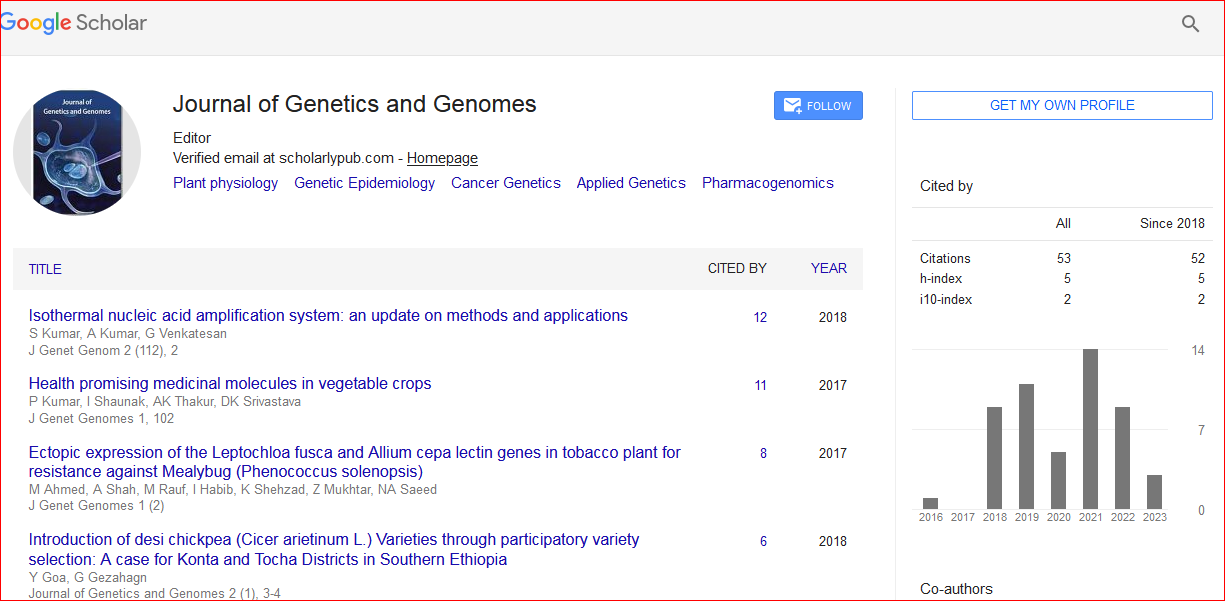
Journal of Genetics and Genomes received 65 citations as per Google Scholar report