Brief Report - (2025) Volume 15, Issue 4
Received: 03-Aug-2025, Manuscript No. jbbs-25-174239;
Editor assigned: 05-Aug-2025, Pre QC No. P-174239;
Reviewed: 19-Aug-2025, QC No. Q-174239;
Revised: 25-Aug-2025, Manuscript No. R-174239;
Published:
30-Aug-2025
, DOI: 10.37421/2155-9538.2025.15.487
Citation: Fernández, Laura. ”Gene Editing Revolution: Health, Agriculture, Ethics.” J Bioengineer & Biomedical Sci 15 (2025):487.
Copyright: © 2025 Fernández L. This is an open-access article distributed under the terms of the Creative Commons Attribution License, which permits unrestricted use, distribution and reproduction in any medium, provided the original author and source are credited.
This article delves into the ethical complexities and future potential of using CRISPR-Cas9 for gene editing in human embryos. It highlights the significant challenges we face, like unintended off-target edits and the implications for germline modifications, but it also acknowledges the promise this technology holds for preventing severe genetic diseases. The discussion emphasizes the need for robust regulatory frameworks and broad societal dialogue as we move forward[1].
Gene therapy is making incredible strides, especially for inherited retinal diseases. This review breaks down the recent advances, showcasing how gene therapies are moving from clinical trials to actual treatments, offering hope for conditions previously considered untreatable. It touches on various strategies, including viral vectors, and the impressive clinical outcomes that are really changing patient lives[2].
Synthetic biology and metabolic engineering are powerful tools for creating sustainable chemicals. This piece explores how we can engineer microorganisms to produce high-value chemicals and fuels from renewable resources, reducing our reliance on petrochemicals. It highlights the potential for greener industrial processes and a more circular economy[3].
This article discusses the use of CRISPR-Cas9 gene editing in cancer immunotherapy, which is a big deal. It explains how this technology can modify immune cells or tumor cells to enhance the body's natural ability to fight cancer. The piece covers both the exciting applications and the hurdles that researchers are working to overcome to make these treatments safer and more effective for patients[4].
Plant genetic engineering is hugely important for crop improvement, especially with global food security concerns. This article reviews how genetic modification techniques are being used to enhance traits like yield, nutritional content, and resistance to pests and diseases. It highlights the latest developments and how these biotechnological approaches contribute to more sustainable and productive agriculture[5].
A solid overview of precision genetic engineering in livestock. We're talking about using advanced tools like CRISPR to introduce specific genetic changes in animals. The goal is to improve traits like disease resistance, growth rates, and product quality, contributing to more efficient and sustainable animal agriculture. It covers the current state of the art and future directions in this field[6].
Gene drives are fascinating, particularly for vector control, and this article discusses their current status and the associated challenges. The idea is to spread specific genes quickly through a population, like those that make mosquitoes resistant to carrying malaria. It covers the promise of this technology for public health but also points out the ecological and ethical considerations that demand careful attention[7].
Focusing on the ethical considerations surrounding human germline gene editing. That means making heritable changes, which obviously raises profound questions. It covers the potential benefits for preventing genetic diseases but also the serious concerns about safety, equity, and societal impact. The authors emphasize the need for caution, public engagement, and international collaboration in setting norms for this powerful technology[8].
Getting CRISPR into cells effectively is half the battle. This article focuses on the advancements in non-viral delivery systems for CRISPR/Cas9. It explains how these methods, using things like nanoparticles or lipid-based carriers, offer safer and more flexible alternatives to traditional viral vectors for gene editing applications. It highlights how these innovations are crucial for moving gene editing therapies closer to clinical reality[9].
Epigenetic editing, which is a new frontier in manipulating gene expression without changing the underlying DNA sequence. This is important because it offers strategies to precisely control gene activity, potentially correcting disease-causing epigenetic marks. It discusses the mechanisms and tools used for targeted epigenetic modification, opening up new avenues for therapies in various diseases like cancer and neurological disorders[10].
Gene editing, especially with CRISPR-Cas9, presents significant potential and ethical complexities, particularly when considering human embryos. Challenges like unintended off-target edits and germline modifications are major concerns, yet the promise for preventing severe genetic diseases is clear. This demands robust regulatory frameworks and broad societal dialogue [1]. Focusing on the ethical considerations surrounding human germline gene editing, heritable changes raise profound questions about safety, equity, and societal impact. There's a strong emphasis on caution, public engagement, and international collaboration in setting norms for this powerful technology [8]. CRISPR-Cas9 gene editing also holds significant promise in cancer immunotherapy. The technology can modify immune cells or tumor cells, enhancing the body's natural ability to fight cancer, though researchers continue to work on making these treatments safer and more effective for patients [4].
Gene therapy is making incredible strides, particularly for inherited retinal diseases. Recent advances show gene therapies moving from clinical trials to actual treatments, offering hope for conditions previously considered untreatable. This work touches on various strategies, including viral vectors, and the impressive clinical outcomes are truly changing patient lives [2]. Getting CRISPR into cells effectively is a crucial step. Advancements in non-viral delivery systems for CRISPR/Cas9, using things like nanoparticles or lipid-based carriers, offer safer and more flexible alternatives to traditional viral vectors. These innovations are vital for bringing gene editing therapies closer to clinical reality [9].
Plant genetic engineering is hugely important for crop improvement, especially with global food security concerns. Genetic modification techniques are used to enhance traits like yield, nutritional content, and resistance to pests and diseases. These biotechnological approaches contribute to more sustainable and productive agriculture [5]. A solid overview of precision genetic engineering in livestock shows advanced tools like CRISPR introducing specific genetic changes in animals. The goal is to improve traits like disease resistance, growth rates, and product quality, contributing to more efficient and sustainable animal agriculture. This field covers its current state and future directions [6].
Synthetic biology and metabolic engineering are powerful tools for creating sustainable chemicals. This involves engineering microorganisms to produce high-value chemicals and fuels from renewable resources, reducing our reliance on petrochemicals. It highlights the potential for greener industrial processes and a more circular economy [3]. Gene drives are fascinating, especially for vector control. The idea is to spread specific genes quickly through a population, like those making mosquitoes resistant to carrying malaria. This technology holds promise for public health, but it also points out ecological and ethical considerations that demand careful attention [7]. Epigenetic editing is a new frontier in manipulating gene expression without changing the underlying DNA sequence. This offers strategies to precisely control gene activity, potentially correcting disease-causing epigenetic marks and opening new avenues for therapies in various diseases like cancer and neurological disorders [10].
Recent advancements across biotechnology highlight the profound impact of gene editing and genetic engineering on diverse fields. CRISPR-Cas9, a cornerstone of this revolution, is actively explored for ethical complexities in human embryo editing, addressing challenges like off-target edits and germline modifications while acknowledging its potential for preventing severe genetic diseases. Similarly, CRISPR applications in cancer immunotherapy aim to enhance the body's natural fight against cancer by modifying immune or tumor cells. Beyond human health, plant genetic engineering is crucial for crop improvement, boosting yield and disease resistance for global food security. Precision genetic engineering in livestock also improves traits like disease resistance and growth rates, leading to more efficient animal agriculture. Gene therapy, especially for inherited retinal diseases, is making remarkable strides, moving from trials to effective treatments. Innovations in non-viral delivery systems for CRISPR/Cas9, using nanoparticles and lipid-based carriers, are vital for safer and more flexible gene editing therapies, pushing them closer to clinical reality. Moreover, the field extends to synthetic biology and metabolic engineering, utilizing microorganisms for sustainable chemical production, and gene drives for vector control, which carries significant public health promise but necessitates careful ethical and ecological consideration. A new frontier is epigenetic editing, which precisely controls gene activity without altering DNA, offering novel therapeutic avenues for various diseases. These developments underscore the intricate balance between technological advancement, ethical responsibility, and societal dialogue in shaping the future of biotechnology.
None
None
1. Song T, Qi Z, Xin L. "CRISPR-Cas9-mediated gene editing in human embryos: ethical challenges and prospects".Precis Clin Med 4 (2021):1-7.
Indexed at, Google Scholar, Crossref
2. Manuel EC, Vicente AA, Samuel GJ. "Advances in gene therapy for inherited retinal diseases".Prog Retin Eye Res 74 (2020):100782.
Indexed at, Google Scholar, Crossref
3. Jay DK, Andrea ML, Jessica MSR. "Synthetic Biology and Metabolic Engineering for Sustainable Chemical Production".Trends Biotechnol 39 (2021):227-230.
Indexed at, Google Scholar, Crossref
4. Zili X, Yong Y, Hong W. "CRISPR-Cas9-based gene editing for cancer immunotherapy".Cancer Biol Med 19 (2022):512-526.
Indexed at, Google Scholar, Crossref
5. Braj NS, Harinder SD, Sudhakar SS. "Advances in plant genetic engineering for crop improvement".Crop J 11 (2023):31-41.
Indexed at, Google Scholar, Crossref
6. Wen-Hao D, Guang-Jun H, Ben-Tao W. "Precision genetic engineering in livestock: current status and future perspectives".Anim Genet 51 (2020):181-192.
Indexed at, Google Scholar, Crossref
7. Omar SA, Nicholas FGG, Ethan RB. "Gene drives for vector control: current status and challenges".Trends Parasitol 37 (2021):45-53.
Indexed at, Google Scholar, Crossref
8. Henry G, Bartha MK, Rosario I. "Ethical Considerations in Human Germline Gene Editing".CRISPR J 3 (2020):432-436.
Indexed at, Google Scholar, Crossref
9. Bonnie PPC, Sook RSNL, Hwee YHHSL. "Advances in non-viral delivery systems for CRISPR/Cas9-based gene editing".J Control Release 337 (2021):370-386.
Indexed at, Google Scholar, Crossref
10. Akash KR, Santosh KP, Satyendra SJ. "Epigenetic Editing: Strategies for Gene Expression Modulation".Cells 11 (2022):2262.
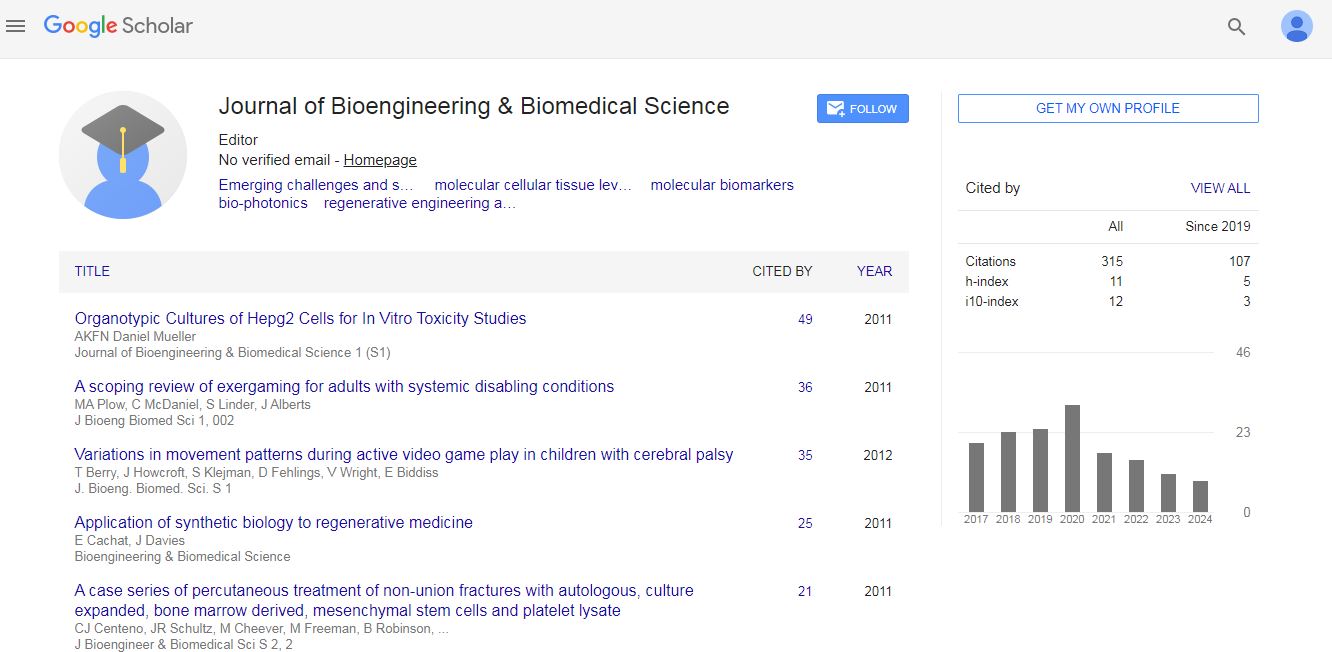
Journal of Bioengineering & Biomedical Science received 307 citations as per Google Scholar report