Short Communication - (2025) Volume 9, Issue 4
Received: 01-Jul-2025, Manuscript No. fsb-26-189961;
Editor assigned: 03-Jul-2025, Pre QC No. P-189961;
Reviewed: 17-Jul-2025, QC No. Q-189961;
Revised: 22-Jul-2025, Manuscript No. R-189961;
Published:
29-Jul-2025
, DOI: 10.37421/2577-0543.2025.9.247
Citation: Mendes, Carlos. ”Gastroretentive Systems: Prolonging Drug Action in Stomach.” J Formul Sci Bioavailab 09 (2025):247.
Copyright: © 2025 Mendes C. This is an open-access article distributed under the terms of the Creative Commons Attribution License, which permits unrestricted use, distribution and reproduction in any medium, provided the original author and source are credited.
Gastroretentive drug delivery systems represent a significant advancement in oral pharmaceutical formulations, aiming to improve drug efficacy and patient compliance by extending the time dosage forms remain in the stomach [1].
This strategy is particularly valuable for drugs with a limited absorption window in the upper gastrointestinal tract or those prone to degradation in lower regions of the GI tract. Innovations in this field focus on various retentive mechanisms, including high-density, mucoadhesive, expandable, and raft-forming systems, all designed to overcome the limitations of conventional oral delivery methods [1].
Among the various approaches, floating gastroretentive drug delivery systems have emerged as a prominent class of technologies. These systems are engineered to remain buoyant in gastric fluid, thereby prolonging gastric residence time. Their buoyancy is achieved by maintaining a density lower than that of gastric fluids, allowing them to float and resist premature emptying. Recent progress in this area involves optimizing buoyancy and drug release profiles through the judicious selection of excipients and formulation designs, which ultimately leads to improved bioavailability for challenging drugs [2].
Mucoadhesive gastroretentive systems utilize the natural adhesive properties of the gastric mucus layer to enhance drug contact time within the stomach. Formulations incorporating polymers with strong interactions with gastric mucus are designed to prevent rapid expulsion from the stomach. Ongoing research is dedicated to exploring novel bio-adhesive polymers and hybrid systems to bolster the effectiveness and durability of mucoadhesion in the dynamic environment of the stomach [3].
Expandable gastroretentive systems, which include devices like inflatable balloons or swellable matrices, are designed to increase in size once inside the stomach, thereby hindering their passage through the pyloric sphincter. This controlled expansion can be triggered by various mechanisms such as effervescence, osmosis, or the use of specific swellable polymers. A key challenge in developing these systems is ensuring predictable and safe expansion without causing patient discomfort or gastrointestinal obstruction [4].
Rafting systems create a viscous layer that floats on the stomach contents, effectively trapping the drug and preventing its rapid transit. These systems are particularly advantageous for drugs requiring extended contact with the gastric mucosa or those susceptible to degradation in the intestinal environment. Typical formulation strategies involve the use of effervescent agents and gelling polymers to establish a stable and effective raft [5].
The therapeutic success of gastroretentive drug delivery systems is directly correlated with their capacity to achieve consistent and predictable gastric residence times. Several physiological factors, including gastric pH, motility, and the presence of food, can significantly impact the performance of these systems. Consequently, sophisticated formulation design and thorough characterization are indispensable for ensuring optimal therapeutic outcomes [6].
Achieving controlled drug release from gastroretentive systems is a critical factor for enhancing therapeutic benefits. This necessitates the careful selection of polymers and excipients to meticulously modulate drug dissolution and diffusion rates over the extended gastric residence period. The ultimate objective is to maintain drug concentrations within the therapeutic window, thereby minimizing both sub-therapeutic levels and the risk of potential toxicity [7].
The applicability of gastroretentive drug delivery systems spans a broad spectrum of therapeutic areas. These include the management of gastric ulcers, inflammatory bowel disease, and systemic infections, where localized or sustained drug action within the stomach is deemed beneficial. Recent investigations have successfully demonstrated the incorporation of a wide array of therapeutic agents into these systems, leading to demonstrable improvements in efficacy and enhanced patient compliance [8].
Nanotechnology-based gastroretentive systems represent a pioneering frontier in this domain. The integration of nanoparticles, nanocapsules, or niosomes within gastroretentive formulations offers the potential to significantly improve drug solubility, enhance stability, and facilitate targeted delivery to the gastric mucosa. This advanced approach may ultimately yield superior therapeutic results and reduce the incidence of systemic side effects [9].
Navigating the regulatory pathway and addressing future challenges are crucial considerations for the successful clinical translation of gastroretentive drug delivery systems. Rigorous preclinical and clinical evaluations are essential to guarantee the safety, efficacy, and consistent performance of these systems across diverse patient populations. Overcoming hurdles related to manufacturing scalability, cost-effectiveness, and patient acceptance will ultimately pave the way for their broader adoption and contribute to improved patient care [10].
Gastroretentive drug delivery systems offer a compelling strategy to enhance drug absorption and prolong therapeutic effects by increasing the residence time of dosage forms in the stomach. This approach is particularly beneficial for drugs with a narrow absorption window in the upper gastrointestinal tract or those that undergo degradation in the lower intestinal regions. Key innovations include the development of various retentive mechanisms such as high-density formulations, mucoadhesive systems, expandable systems, and raft-forming systems, each designed to overcome limitations of conventional oral delivery [1].
Floating gastroretentive drug delivery systems are a prominent class of these technologies. They are designed to remain buoyant in the gastric fluid, thus prolonging gastric residence time. The principle relies on a density lower than gastric fluids, enabling them to float. Recent advancements focus on optimizing buoyancy and drug release characteristics through the use of specific excipients and formulation designs, leading to improved bioavailability and therapeutic efficacy for challenging drugs [2].
Mucoadhesive gastroretentive systems leverage the natural adhesion properties of mucus in the stomach lining to prolong drug contact time. These systems are formulated with polymers that exhibit strong interactions with the gastric mucus layer, thereby preventing premature emptying. Research is exploring novel bio-adhesive polymers and hybrid systems to enhance the robustness and efficacy of mucoadhesion in the dynamic gastric environment [3].
Expandable gastroretentive systems, such as inflatable balloons or swellable matrices, are designed to increase in size within the stomach, preventing their passage through the pyloric sphincter. This controlled expansion can be achieved through various mechanisms like effervescence, osmosis, or the use of specific swellable polymers. The challenge lies in ensuring predictable and safe expansion without causing discomfort or obstruction [4].
Rafting systems form a viscous layer that floats on the gastric contents, thereby trapping the drug and preventing its rapid emptying. These systems are particularly useful for delivering drugs that require prolonged contact with the gastric mucosa or are susceptible to degradation in the intestinal environment. Formulation strategies often involve effervescent agents and gelling polymers to create a stable raft [5].
The therapeutic outcomes of gastroretentive drug delivery systems are directly linked to their ability to achieve consistent and predictable gastric residence times. Factors such as gastric pH, motility, and the presence of food can significantly influence the performance of these systems. Therefore, advanced formulation design and characterization are crucial for ensuring therapeutic success [6].
Controlled release of drugs from gastroretentive systems is paramount for achieving improved therapeutic outcomes. This involves careful selection of polymers and excipients to modulate drug dissolution and diffusion profiles over the extended gastric residence time. The goal is to maintain drug concentration within the therapeutic window, minimizing both sub-therapeutic levels and potential toxicity [7].
The application of gastroretentive drug delivery systems extends to various therapeutic areas, including the treatment of gastric ulcers, inflammatory bowel disease, and systemic infections where localized or prolonged drug action in the stomach is beneficial. Recent studies highlight the successful incorporation of a wide range of therapeutic agents into these systems, demonstrating enhanced efficacy and patient compliance [8].
Nanotechnology-based gastroretentive systems represent a cutting-edge frontier in this field. The incorporation of nanoparticles, nanocapsules, or niosomes within gastroretentive formulations can further improve drug solubility, stability, and targeted delivery to the gastric mucosa, potentially leading to superior therapeutic outcomes and reduced systemic side effects [9].
The regulatory landscape and future challenges for gastroretentive drug delivery systems are critical considerations for their clinical translation. Ensuring safety, efficacy, and consistent performance across diverse patient populations requires rigorous preclinical and clinical evaluation. Addressing challenges related to manufacturing scalability, cost-effectiveness, and patient acceptance will pave the way for wider adoption and improved patient care [10].
Gastroretentive drug delivery systems are designed to increase the time medications stay in the stomach, enhancing drug absorption and prolonging therapeutic effects. This is particularly useful for drugs with narrow absorption windows or those that degrade easily in the lower GI tract. Various mechanisms are employed, including high-density formulations, mucoadhesion, expansion within the stomach, and raft formation. Floating systems remain buoyant, while mucoadhesive systems stick to the stomach lining. Expandable systems physically enlarge to prevent emptying, and rafting systems create a floating layer. Controlled drug release is crucial for effectiveness, and nanotechnology is emerging as a way to improve drug solubility and delivery. While promising for various conditions, challenges in regulation, manufacturing, and cost-effectiveness need to be addressed for widespread clinical adoption.
None
None
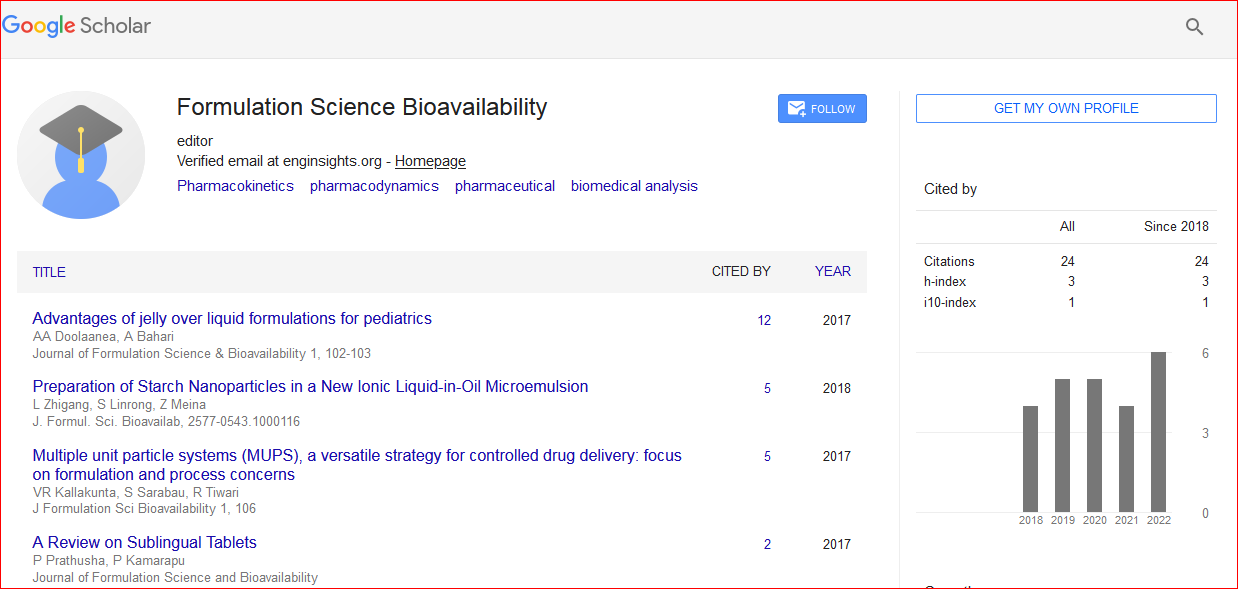
Journal of Formulation Science & Bioavailability received 23 citations as per Google Scholar report