Opinion - (2025) Volume 16, Issue 3
Received: 01-May-2025, Manuscript No. jnmrt-26-186368;
Editor assigned: 05-May-2025, Pre QC No. P-186368;
Reviewed: 19-May-2025, QC No. Q-186368;
Revised: 22-May-2025, Manuscript No. R-186368;
Published:
29-May-2025
, DOI: 10.37421/2155-9619.2025.16.649
Citation: Bianchi, Luca. ”Gamma Camera: Quantifying Hepatic
Functional Reserve.” J Nucl Med Radiat Ther 16 (2025):649.
Copyright: © 2025 Bianchi L. This is an open-access article distributed under the terms of the Creative Commons Attribution License, which permits unrestricted use,
distribution and reproduction in any medium, provided the original author and source are credited.
Gamma camera-based quantification of hepatic functional reserve is an evolving area in managing chronic liver disease, aiming to non-invasively assess liver function crucial for predicting disease progression, guiding treatment strategies, and determining eligibility for liver transplantation [1].
By analyzing the uptake and clearance of radiopharmaceuticals, such as technetium-99m mebrofenin or iodine-123-labeled compounds, clinicians can derive quantitative measures of liver perfusion and hepatocellular function [1].
These metrics offer valuable insights beyond standard biochemical tests, particularly in early or compensated stages of liver disease where traditional markers may not fully reflect functional capacity [1].
Advances in imaging technology and analytical methods are enhancing the accuracy and reproducibility of these assessments [1].
The role of SPECT/CT in evaluating liver function is gaining traction, with SPECT/CT providing superior spatial resolution and attenuation correction compared to traditional planar scintigraphy, leading to more accurate quantitative data [2].
This is particularly relevant for assessing liver parenchymal disease and its impact on overall function in chronic conditions, with the ability to combine functional information with anatomical details aiding in precise lesion characterization and assessment of diffuse liver disease [2].
Mebrofenin, a technetium-99m labeled hepatobiliary agent, is a key radiotracer for assessing hepatocellular function, as its extraction and excretion pathway mirrors that of bilirubin, making it an excellent marker for evaluating the functional capacity of hepatocytes [3].
Quantitative analysis of its uptake and clearance over time allows for the calculation of parameters like hepatic extraction fraction and biliary excretion rate, providing a direct measure of liver reserve [3].
In chronic liver disease, the functional reserve of the liver is progressively compromised, and early detection and quantification of this decline are vital for clinical management [4].
Gamma camera-based methods, particularly with SPECT/CT, offer a powerful tool to measure these functional changes by assessing the liver's ability to extract and excrete radiotracers, thus reflecting the health of hepatocytes and blood flow [4].
Gamma camera-based quantification of hepatic functional reserve is an evolving area in managing chronic liver disease, aiming to non-invasively assess liver function crucial for predicting disease progression, guiding treatment strategies, and determining eligibility for liver transplantation [1].
By analyzing the uptake and clearance of radiopharmaceuticals, such as technetium-99m mebrofenin or iodine-123-labeled compounds, clinicians can derive quantitative measures of liver perfusion and hepatocellular function [1].
These metrics offer valuable insights beyond standard biochemical tests, particularly in early or compensated stages of liver disease where traditional markers may not fully reflect functional capacity [1].
Advances in imaging technology and analytical methods are enhancing the accuracy and reproducibility of these assessments [1].
The role of SPECT/CT in evaluating liver function is gaining traction, with SPECT/CT providing superior spatial resolution and attenuation correction compared to traditional planar scintigraphy, leading to more accurate quantitative data [2].
This is particularly relevant for assessing liver parenchymal disease and its impact on overall function in chronic conditions, with the ability to combine functional information with anatomical details aiding in precise lesion characterization and assessment of diffuse liver disease [2].
Mebrofenin, a technetium-99m labeled hepatobiliary agent, is a key radiotracer for assessing hepatocellular function, as its extraction and excretion pathway mirrors that of bilirubin, making it an excellent marker for evaluating the functional capacity of hepatocytes [3].
Quantitative analysis of its uptake and clearance over time allows for the calculation of parameters like hepatic extraction fraction and biliary excretion rate, providing a direct measure of liver reserve [3].
In chronic liver disease, the functional reserve of the liver is progressively compromised, and early detection and quantification of this decline are vital for clinical management [4].
Gamma camera-based methods, particularly with SPECT/CT, offer a powerful tool to measure these functional changes by assessing the liver's ability to extract and excrete radiotracers, thus reflecting the health of hepatocytes and blood flow [4].
Gamma camera-based quantification of hepatic functional reserve is an evolving area in chronic liver disease management. Techniques like SPECT/CT using radiopharmaceuticals such as technetium-99m mebrofenin non-invasively assess liver function, providing insights beyond standard biochemical tests. Mebrofenin, mirroring bilirubin's pathway, serves as a key marker for hepatocellular function. Quantitative analysis of radiotracer uptake and clearance yields crucial parameters like hepatic extraction fraction and biliary excretion rate, directly measuring liver reserve. SPECT/CT offers superior spatial resolution and attenuation correction for more accurate functional data. Advances in imaging technology, analytical methods, and the integration of AI are enhancing accuracy and reproducibility. The clinical utility extends to predicting treatment outcomes and guiding interventions, while robust analytical techniques and quality control are essential for reliable assessments.
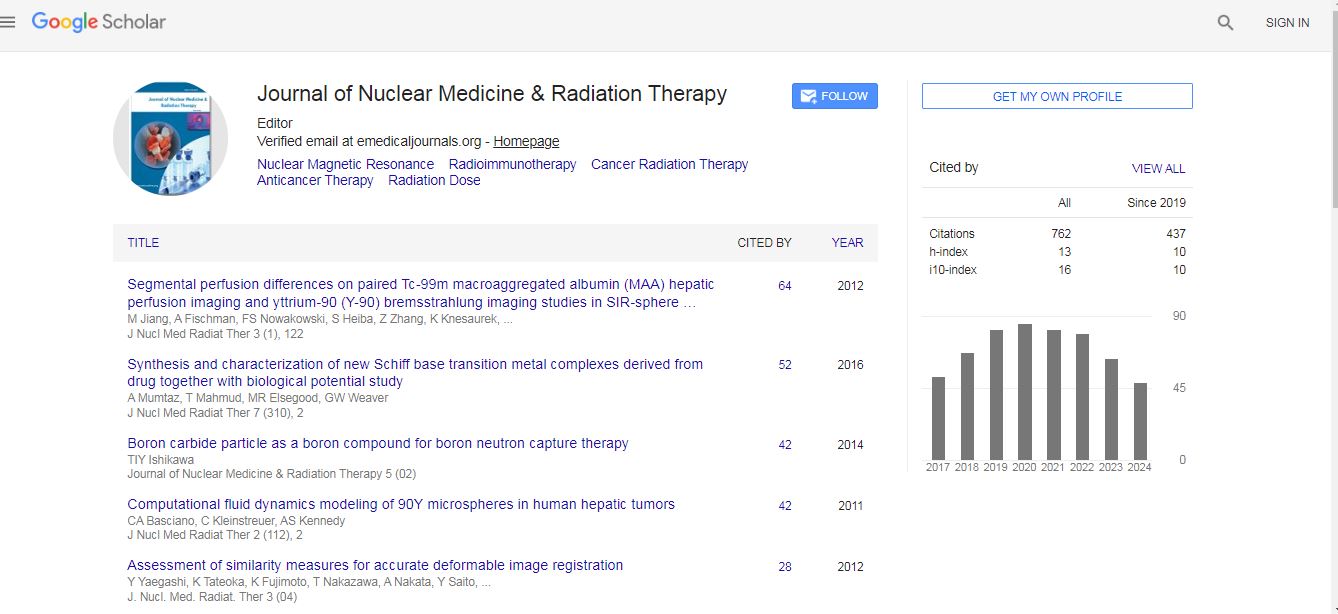
Nuclear Medicine & Radiation Therapy received 706 citations as per Google Scholar report