Brief Report - (2025) Volume 11, Issue 4
Received: 01-Aug-2025, Manuscript No. jctt-26-188412;
Editor assigned: 04-Aug-2026, Pre QC No. P-188412;
Reviewed: 18-Aug-2025, QC No. Q-188412;
Revised: 22-Aug-2025, Manuscript No. R-188412;
Published:
29-Aug-2025
, DOI: 10.37421/2471-9323.2024.10.330
Citation: Johansson, Lars. ”Future of Hair Care: Science-Driven Personalized Solutions.” J Cosmo Tricho 11 (2025):330.
Copyright: © 2025 Johansson L. This is an open-access article distributed under the terms of the Creative Commons Attribution License, which permits unrestricted use, distribution and reproduction in any medium, provided the original author and source are credited.
The intricate science of hair care has seen remarkable advancements, driven by a deeper understanding of hair's fundamental properties and the growing demand for personalized solutions. Early explorations into hair's composition and behavior laid the groundwork for modern cosmetic and trichological practices. The foundational principles of hair structure, including the biophysical characteristics of hair fibers, are essential for developing effective hair care formulations and treatments. This understanding informs the creation of advanced products designed to enhance hair health and aesthetics, moving beyond generic approaches to embrace individualized care. The codex of beauty and hair care is multifaceted, integrating scientific knowledge with practical application to achieve optimal results. Genetic predispositions, environmental influences, and lifestyle choices are now recognized as critical factors in determining hair health and appearance, necessitating a holistic approach to hair management. The development of advanced hair care strategies is deeply rooted in a comprehensive understanding of trichology, the study of hair and scalp. This field investigates the biological processes that govern hair growth, health, and condition, enabling the creation of targeted interventions. The integration of scientific research with cosmetic innovation has led to a new era of hair care, where efficacy is paramount and personalization is key. Understanding the unique characteristics of individual hair types allows for the formulation of bespoke treatments that address specific needs and concerns. This personalized approach ensures that each individual can achieve their desired hair health and aesthetic goals. The journey from understanding the basic science of hair to developing cutting-edge treatments involves a continuous cycle of research, innovation, and application. This evolving landscape of hair science promises even more sophisticated and effective solutions in the future. The pursuit of healthy and beautiful hair is a universal aspiration, and scientific inquiry continues to unlock new pathways to achieving it. As our knowledge expands, so too does our capacity to address the complex challenges associated with hair care, paving the way for transformative advancements in the field. The synergy between cosmetic science and trichological understanding is driving innovation, offering a brighter outlook for hair health and beauty. This integrated approach ensures that interventions are not only effective but also tailored to the individual, respecting the unique biological and environmental factors that influence hair condition. The future of hair care lies in this personalized and scientifically informed paradigm. The evolution of hair care practices is a testament to the ongoing scientific exploration of hair's complexity. [1] Recent advancements in diagnostic technologies have revolutionized the field of hair care, enabling a more precise and individualized approach. Novel imaging techniques and sophisticated biochemical assays are now capable of accurately assessing various aspects of hair health, including damage, porosity, and protein content. This level of diagnostic precision is crucial for moving beyond generalized treatment protocols and towards highly targeted regimens that address the specific needs of each individual's hair. The ability to precisely identify and quantify hair issues allows for the development of bespoke solutions, ensuring that treatments are not only effective but also efficient. Such innovations are transforming the landscape of personalized hair care, empowering consumers with solutions tailored to their unique hair profiles. The shift towards data-driven hair diagnostics signifies a major leap forward in cosmetic science, promising enhanced outcomes and greater client satisfaction. By understanding the nuances of individual hair structure and condition, professionals can recommend and apply treatments that yield optimal results. This precise diagnostics approach ensures that interventions are specifically designed to tackle identified problems, maximizing their impact. The integration of advanced diagnostic tools into routine hair care practices is becoming increasingly important for achieving superior hair health. These technologies provide objective data that informs treatment decisions, leading to more predictable and successful outcomes. The continuous development of these diagnostic methods underscores the industry's commitment to innovation and personalized care. The ability to understand hair at such a granular level allows for the creation of truly customized hair care experiences. This scientific rigor ensures that the recommendations and treatments provided are based on solid evidence, leading to improved hair quality and health. The era of one-size-fits-all hair care is rapidly giving way to a more sophisticated, individualized methodology. [2] The biomechanics of hair breakage represent a critical area of research for understanding and preventing structural integrity loss in hair fibers. This field investigates the various forces and stresses that hair is subjected to, from everyday styling to environmental factors, and how these contribute to weakening and eventual breakage. By developing predictive models, researchers can assess a hair's susceptibility to breakage based on its type, styling habits, and the chemical treatments it undergoes. This understanding is fundamental for creating effective preventative strategies and developing restorative products that strengthen hair and minimize damage. The biomechanical properties of hair are complex, involving its elasticity, tensile strength, and resilience. Understanding these properties allows for the development of interventions that can enhance hair's durability and resistance to damage. The study of hair breakage is not merely academic; it has direct implications for the development of products that promise stronger, healthier hair. By identifying the mechanisms behind breakage, scientists can design formulations that protect hair from the stresses that lead to its degradation. The ongoing research in this area contributes significantly to the advancement of hair care science. It provides a scientific basis for claims related to hair strengthening and breakage prevention. The insights gained from biomechanical studies enable the creation of more effective styling products and treatments. This scientific approach ensures that product development is guided by a deep understanding of hair's physical limitations and potential for damage. The focus on structural integrity is paramount for maintaining healthy, beautiful hair over time. [3] Environmental stressors, including ultraviolet (UV) radiation and atmospheric pollution, pose significant threats to hair cuticle integrity and color stability. The constant exposure to these external factors can lead to degradation of the hair's protective outer layer, resulting in dryness, brittleness, and loss of color vibrancy. Research in this area focuses on identifying the mechanisms by which these stressors damage hair and developing innovative solutions to mitigate their effects. Antioxidant-rich formulations and advanced protective coatings are being developed to shield hair from oxidative damage and maintain its healthy appearance and color. The hair cuticle, being the outermost layer, is the first line of defense against environmental aggressors. Its integrity is crucial for retaining moisture and protecting the inner cortex. Understanding how UV rays and pollutants compromise the cuticle allows for the design of targeted protective measures. These interventions aim to neutralize free radicals generated by UV exposure and pollution, thus preventing oxidative stress. Furthermore, protective coatings can create a physical barrier on the hair surface, repelling harmful particles and absorbing UV radiation. The development of these advanced solutions is vital for individuals living in urban environments or frequently exposed to the sun. It ensures that hair remains healthy, strong, and vibrant despite the challenges of its surroundings. The continuous research in this domain highlights the importance of environmental protection for hair well-being. [4] The scalp microbiome, a complex ecosystem of microorganisms residing on the scalp, plays a pivotal role in overall hair health. Imbalances within this microbial community have been increasingly linked to various scalp conditions, including dandruff and hair loss. Research is shedding light on the intricate relationship between the scalp's microbial balance and the health of hair follicles. Studies are highlighting the efficacy of prebiotics and probiotics as therapeutic interventions to restore this balance. By promoting a healthy scalp environment, these interventions can foster robust hair growth and improve the overall condition of the hair. The scalp microbiome is a dynamic entity, influenced by factors such as hygiene, diet, and product usage. Disruptions to this delicate balance can lead to inflammation and compromise the hair follicle's ability to produce healthy hair. Prebiotics act as food for beneficial bacteria, encouraging their growth, while probiotics introduce beneficial microorganisms directly to the scalp. This approach to managing scalp health is gaining traction due to its potential to address the root causes of hair issues. The focus on the scalp microbiome represents a significant shift towards a more holistic and biologically informed approach to hair care. It recognizes that healthy hair begins with a healthy scalp foundation. The research in this area continues to uncover new insights into the complex interplay between our bodies and the microorganisms that inhabit them. [5] Genetic factors significantly influence the diversity of hair texture and color observed across different human populations. By investigating specific gene polymorphisms, researchers gain insights into the biological basis underlying these variations. This knowledge is crucial for understanding the unique care requirements associated with different hair types and contributes to the development of more informed cosmetic formulations. The genetic blueprint dictates fundamental characteristics such as hair's curl pattern, thickness, and pigment production. Identifying the genes responsible for these traits allows for a deeper appreciation of hair diversity. This understanding is not only academic but also has practical implications for the cosmetic industry. It enables the creation of products that are better suited to the specific needs of various hair types, moving away from a one-size-fits-all approach. For instance, hair that is genetically predisposed to be fine and straight may require different care than hair that is naturally coarse and curly. The study of hair genetics contributes to the development of personalized hair care strategies, ensuring that individuals can achieve optimal results by understanding and catering to their unique genetic makeup. This scientific exploration helps to demystify the biological underpinnings of hair characteristics. [6] Innovations in hair restoration are increasingly leveraging the power of regenerative medicine, offering promising new avenues for treating hair loss conditions like alopecia. This research focuses on the potential of stem cell therapies and growth factor stimulation to enhance the activity of hair follicles and promote natural hair regrowth. By harnessing the body's own regenerative capabilities, these approaches aim to address the underlying causes of hair loss rather than merely managing its symptoms. Stem cells, with their ability to differentiate into various cell types, hold immense potential for regenerating damaged or dormant hair follicles. Similarly, growth factors, signaling molecules that regulate cell behavior, can stimulate follicle activity and encourage the production of new hair. The development of these advanced therapies represents a significant leap forward in the field of hair restoration. They offer hope to individuals suffering from various forms of alopecia by providing more effective and potentially permanent solutions. The ongoing research in regenerative medicine is poised to revolutionize how hair loss is treated. It moves beyond traditional methods to embrace cutting-edge biological interventions. [7] Diet and nutrition play a quantifiable and essential role in maintaining hair quality and promoting healthy hair growth. Specific vitamins, minerals, and proteins are vital for the health and structure of hair follicles, directly impacting the vitality and appearance of the hair. This understanding guides the development of nutritional recommendations aimed at optimizing hair health from within. The hair follicle is a metabolically active structure that requires a continuous supply of essential nutrients to function optimally. Deficiencies in key nutrients, such as iron, biotin, zinc, and protein, can lead to weakened hair, increased shedding, and impaired growth. Conversely, a well-balanced diet rich in these components supports robust hair follicle function and promotes the synthesis of strong, healthy hair strands. Quantitative analysis provides concrete evidence for the impact of specific dietary components on hair. This research empowers individuals to make informed choices about their diet to support hair health. The role of nutrition in hair care is often underestimated, but its impact is profound. By understanding these nutritional requirements, individuals can take proactive steps to ensure their hair receives the building blocks it needs to thrive. [8] The application of artificial intelligence (AI) and machine learning (ML) in trichology is ushering in a new era of precision medicine for hair care. These technologies are proving invaluable for predicting hair loss patterns and personalizing the efficacy of treatment interventions. Algorithms capable of analyzing scalp images and extensive patient data can forecast disease progression with remarkable accuracy. This predictive power allows for the optimization of therapeutic strategies, ensuring that treatments are tailored to individual needs and likely to yield the best possible outcomes. AI and ML can identify subtle patterns and correlations that might be missed by human observation, leading to more informed diagnostic and treatment decisions. For instance, AI can analyze scalp conditions from high-resolution images to detect early signs of hair loss or other scalp abnormalities. Machine learning models can then process this information along with patient history and genetic data to predict the likelihood of future hair loss and the potential response to different treatments. This integration of advanced computational tools enhances the precision and effectiveness of trichological interventions. The growing role of AI and ML in this field signifies a commitment to leveraging technology for improved patient care. [9] Styling tools and techniques, particularly those involving heat and mechanical manipulation, can have a significant impact on hair integrity. Excessive heat from blow dryers, straighteners, and curling irons, along with the physical stress of brushing and tight hairstyles, can lead to heat damage and breakage. Consequently, research is focused on developing advanced protective technologies and innovative formulation strategies designed to mitigate these damaging effects. The goal is to ensure that styling practices can be maintained without compromising hair health or leading to increased breakage. Understanding the mechanisms of heat damage, such as protein denaturation and cuticle lifting, is crucial. This knowledge informs the development of heat protectants that create a barrier between the hair and the heat source, absorbing or reflecting thermal energy. Similarly, strategies to reduce mechanical stress, such as using brushes with wider bristles or employing gentler styling techniques, are being promoted. The development of advanced formulations includes ingredients that can repair existing damage, moisturize the hair, and improve its tensile strength. This research is vital for consumers who frequently style their hair, offering solutions to maintain its health and beauty. [10] As our understanding of hair's biological complexity deepens, so too does our capacity to develop sophisticated and personalized hair care solutions. The integration of scientific research, advanced diagnostics, and technological innovation is reshaping the landscape of trichology and cosmetic science. From understanding the biomechanics of hair breakage to harnessing the power of the scalp microbiome, each area of research contributes to a more holistic and effective approach to hair health. The ongoing exploration into genetics, environmental impacts, and regenerative medicine further underscores the multifaceted nature of hair care. The future promises even more tailored treatments, driven by data and a profound respect for individual hair needs. The continuous evolution in this field ensures that individuals can achieve their desired hair health and aesthetic goals with greater efficacy and precision than ever before.
The field of hair care is undergoing a profound transformation, driven by a deeper scientific understanding of hair's structure, function, and its interaction with the environment. The initial research into the fundamental biophysical properties of hair fibers has paved the way for sophisticated cosmetic applications and advanced trichological health strategies. This evolution emphasizes personalized approaches, acknowledging that genetic predispositions, environmental influences, and lifestyle choices are critical determinants of hair health and appearance. The intricate relationship between these factors necessitates a comprehensive and individualized approach to hair management, moving beyond generalized solutions. The development of advanced hair care formulations and treatments is directly informed by this understanding, aiming to optimize both hair health and aesthetic outcomes for each individual. The pursuit of healthier, more resilient hair is a continuous journey, fueled by ongoing scientific discovery and technological innovation. The integration of cosmetic science with trichological knowledge is at the forefront of this progress. The aim is to create solutions that are not only effective but also precisely tailored to the unique needs of every person's hair. This personalized paradigm ensures that interventions are maximally beneficial, addressing specific concerns with scientific precision. The evolution of hair care practices reflects a growing appreciation for the biological intricacies of hair. [1] Revolutionizing personalized hair care, recent advancements in diagnostic tools provide unprecedented insights into individual hair needs. Novel imaging techniques and biochemical assays enable precise assessment of hair damage, porosity, and protein content, moving beyond subjective evaluation. This accurate diagnostic capability allows for the creation of highly targeted treatment regimens, effectively addressing specific hair concerns rather than applying generalized solutions. The ability to quantify and identify individual hair characteristics is paramount for developing effective, bespoke hair care plans. These advanced diagnostic methods are transforming how hair health is approached, ensuring that treatments are specifically designed to meet the unique requirements of each person's hair. This data-driven approach ensures that interventions are optimized for maximum efficacy. The continuous refinement of these diagnostic tools highlights the industry's commitment to innovation in personalized care. Understanding hair at such a detailed level allows for truly customized solutions. This scientific rigor ensures that recommendations are based on concrete evidence, leading to improved hair quality. The era of one-size-fits-all hair care is being supplanted by a more sophisticated, individualized methodology. [2] The biomechanics of hair breakage is a crucial area of study focused on understanding the forces and stresses that compromise hair's structural integrity. Research in this domain introduces sophisticated models capable of predicting susceptibility to breakage based on hair type, styling practices, and the impact of chemical treatments. This in-depth understanding is indispensable for the development of effective preventative strategies and restorative products aimed at strengthening hair and minimizing damage. Hair's inherent physical properties, such as its tensile strength and elasticity, are central to this research. By analyzing how these properties are affected by external factors, scientists can devise ways to enhance hair's resilience. The insights gained from biomechanical studies are directly translated into the development of products designed to protect hair from daily wear and tear. This scientific approach ensures that interventions are targeted and effective in combating breakage. The ongoing exploration of hair's mechanical behavior contributes significantly to the advancement of hair care science. It provides a solid foundation for claims related to hair strengthening and damage prevention. The focus on structural integrity is paramount for maintaining healthy, beautiful hair over time. [3] Environmental stressors, including UV radiation and air pollution, pose a significant threat to the integrity of the hair cuticle and the stability of hair color. This research investigates the impact of these external factors on hair health and explores innovative mitigation strategies. The focus is on developing advanced solutions, such as antioxidant-rich formulations and protective coatings, designed to shield hair from oxidative damage and maintain its vibrant color. The hair cuticle, the outermost protective layer, is particularly vulnerable to environmental aggressors. Damage to the cuticle can lead to moisture loss, increased porosity, and a dull appearance. UV radiation can degrade melanin, causing color fading, while pollutants can deposit on the hair shaft, leading to dullness and potential damage. Antioxidants help neutralize free radicals generated by UV exposure and pollution, thereby preventing oxidative stress. Protective coatings can form a physical barrier on the hair surface, repelling environmental contaminants and reflecting UV rays. These innovations are essential for protecting hair in challenging environments. The continuous development of such strategies underscores the importance of environmental protection for maintaining optimal hair health and appearance. [4] The scalp microbiome, a complex community of microorganisms, plays a vital role in maintaining overall hair health. Research indicates that imbalances within this ecosystem are linked to common scalp conditions such as dandruff and hair loss. This area of study highlights the therapeutic potential of prebiotics and probiotics in restoring microbial balance, thereby fostering a healthy scalp environment conducive to robust hair growth. The scalp microbiome is a dynamic entity, influencing scalp health and, consequently, hair follicle function. Disruptions can lead to inflammation and compromised hair growth. Prebiotics nourish beneficial bacteria, while probiotics introduce beneficial microorganisms. This approach addresses the fundamental health of the scalp, which is crucial for healthy hair. The focus on the scalp microbiome signifies a move towards a more holistic and biologically informed perspective on hair care. It recognizes that optimal hair health originates from a balanced and healthy scalp. Ongoing research continues to uncover the intricate interplay between the scalp's microbial inhabitants and hair vitality. [5] Genetic variations are fundamental to the diversity of hair texture and color observed across global populations. This research delves into the genetic underpinnings of these variations, analyzing specific gene polymorphisms to provide insights into the biological basis of different hair types. Such understanding is critical for recognizing the unique care requirements associated with each hair type and contributes to the development of more informed and effective cosmetic formulations. Hair characteristics, including its diameter, curl pattern, and pigmentation, are largely determined by an individual's genetic makeup. By identifying the genes involved, scientists can better understand the biological mechanisms that give rise to these differences. This knowledge is invaluable for the cosmetic industry, enabling the creation of products and treatments that are specifically designed to cater to the needs of diverse hair types. This approach moves beyond generic solutions towards truly personalized hair care, acknowledging and respecting the inherent biological diversity of hair. [6] Recent advancements in hair restoration are increasingly focused on regenerative medicine approaches, offering promising new avenues for treating conditions like alopecia. This research examines the potential of stem cell therapies and growth factor stimulation to enhance hair follicle activity and promote natural hair regrowth. By harnessing the body's innate regenerative capabilities, these innovative strategies aim to address the root causes of hair loss. Stem cells, with their capacity to differentiate, can be used to regenerate damaged or dormant hair follicles. Growth factors, acting as signaling molecules, can stimulate follicle activity, encouraging the production of new hair. These cutting-edge therapies represent a significant leap forward in the field of hair restoration, offering potential for more effective and potentially long-lasting solutions for individuals experiencing hair loss. The ongoing development in regenerative medicine is poised to revolutionize the treatment of hair loss conditions. [7] The impact of diet and nutrition on hair quality and growth is substantial and quantifiable. This research underscores the essential role of specific vitamins, minerals, and proteins in maintaining the health and structure of hair follicles. These essential nutrients are vital for optimal hair vitality and appearance. Hair follicles are highly metabolically active and require a consistent supply of nutrients to function effectively and produce healthy hair. Deficiencies in key nutrients, such as biotin, iron, zinc, and protein, can negatively affect hair strength, growth rate, and overall quality. Conversely, a balanced diet rich in these nutrients supports robust hair follicle function and promotes the synthesis of strong, resilient hair strands. Quantitative analysis provides empirical evidence for the direct link between specific dietary components and hair health, guiding evidence-based nutritional recommendations. Understanding these nutritional requirements empowers individuals to support their hair health from within through informed dietary choices. [8] The integration of artificial intelligence (AI) and machine learning (ML) in trichology is significantly advancing the field, particularly in predicting hair loss patterns and personalizing treatment efficacy. Algorithms that analyze scalp images and patient data are capable of forecasting disease progression and optimizing therapeutic interventions, thereby enhancing precision medicine in hair care. AI and ML can identify complex patterns and correlations within large datasets, leading to more accurate diagnoses and tailored treatment plans. For example, AI can analyze scalp images to detect early signs of thinning or disease, while ML models can predict the likelihood of response to different treatments based on individual patient profiles. This technological integration elevates the precision and effectiveness of trichological interventions. The growing role of AI and ML in trichology signifies a commitment to leveraging advanced computational tools for improved patient outcomes and more efficient hair care strategies. [9] Styling tools and techniques, especially those involving heat and mechanical manipulation, can significantly affect hair integrity. This research explores the impact of these methods on hair health and focuses on developing advanced protective technologies and formulation strategies to mitigate potential damage. The objective is to minimize negative effects such as heat damage and mechanical stress, thereby preserving hair health and reducing breakage. Understanding how heat and physical stress degrade hair is crucial for designing effective protective measures. Heat protectants, for instance, create a barrier between the hair and heat sources, reducing thermal damage. Strategies to minimize mechanical stress include using appropriate styling tools and techniques. Advanced formulations aim to repair existing damage, moisturize the hair, and enhance its tensile strength. These developments are vital for individuals who frequently style their hair, offering solutions to maintain its health and aesthetic appeal. [10] The ongoing advancements in hair science underscore a paradigm shift towards highly personalized and scientifically validated hair care. The convergence of trichological research, diagnostic innovation, and technological integration is leading to more effective and individualized solutions. Each area of study, from biomechanics to the scalp microbiome, contributes to a comprehensive understanding of hair health. Future developments, driven by genetics, environmental science, and regenerative medicine, promise even more precise and tailored interventions, ensuring optimal hair health and aesthetic outcomes for individuals worldwide. The continuous pursuit of knowledge in this field is paving the way for unprecedented levels of efficacy and personalization.
The field of hair care is rapidly advancing through a deeper scientific understanding of hair structure, function, and its interaction with various factors. Research highlights the importance of personalized approaches, considering genetics, environment, and lifestyle. Advanced diagnostic tools enable precise assessment of hair condition, leading to tailored treatment regimens. Biomechanics of hair breakage, environmental stressors like UV radiation, and the scalp microbiome are critical areas of study influencing hair health. Genetic factors dictate hair texture and color, while regenerative medicine offers new hope for hair restoration. Diet and nutrition play a vital role in hair quality and growth. Artificial intelligence and machine learning are transforming trichology by predicting hair loss and personalizing treatments. Additionally, understanding the impact of styling tools and techniques is crucial for developing protective measures. Overall, the evolution of hair science points towards a future of highly individualized, scientifically driven hair care solutions.
None
None
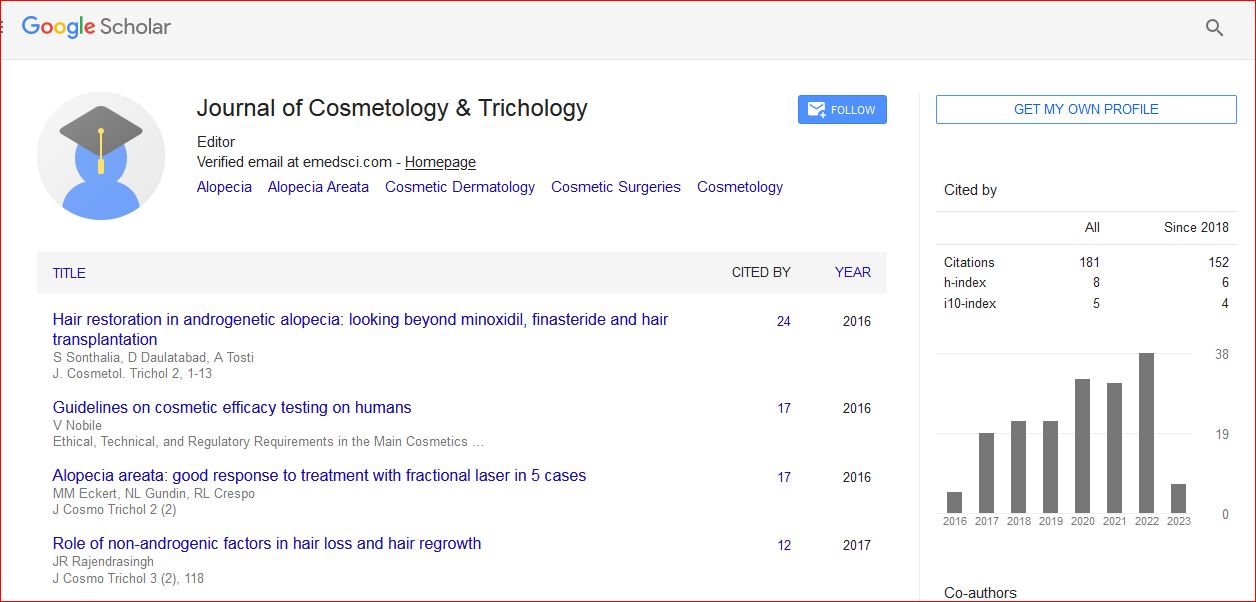
Journal of Cosmetology & Trichology received 180 citations as per Google Scholar report