Short Communication - (2025) Volume 9, Issue 6
Received: 03-Nov-2025, Manuscript No. jchd-26-185723;
Editor assigned: 05-Nov-2025, Pre QC No. P-185723;
Reviewed: 19-Nov-2025, QC No. Q-185723;
Revised: 24-Nov-2025, Manuscript No. R-185723;
Published:
01-Dec-2025
, DOI: 10.37421/2684-6020.2024.9.279
Citation: Andersson, Maria. ”Future of Coronary Heart Disease
Treatment.” J Coron Heart Dis 09 (2025):279.
Copyright: © 2025 Andersson M. This is an open-access article distributed under the terms of the Creative Commons Attribution License, which permits unrestricted use,
distribution and reproduction in any medium, provided the original author and source are credited.
The landscape of coronary heart disease (CHD) treatment is undergoing a profound transformation, propelled by significant breakthroughs in pharmacological interventions, interventional cardiology, and the burgeoning field of personalized medicine [1].
Novel therapeutic agents are emerging that target specific molecular pathways with remarkable precision, offering new hope for patients. Among these are PCSK9 inhibitors, which have demonstrated substantial efficacy in improving lipid management and reducing the incidence of cardiovascular events. Alongside these advancements, new antithrombotic agents are being developed to provide enhanced protection against thrombotic complications [1].
Regenerative medicine is opening up exciting new frontiers for myocardial repair, moving beyond traditional management strategies. Stem cell therapies, for instance, hold the promise of regenerating damaged heart tissue, potentially reversing the effects of myocardial infarction. Gene editing techniques are also being explored as a means to correct genetic defects or promote cellular repair mechanisms within the heart [1].
Furthermore, the integration of sophisticated technologies such as artificial intelligence (AI) and big data analytics is revolutionizing how CHD is approached. These tools enable earlier and more accurate diagnoses, facilitate precise risk stratification of patients, and lead to the optimization of treatment strategies. This convergence of technology and medicine is paving the way for a more personalized and effective approach to managing CHD [1].
The role of advanced lipid-lowering therapies, including PCSK9 inhibitors and bempedoic acid, is critically important in the current management of coronary heart disease. These medications offer substantial reductions in LDL cholesterol levels, proving especially beneficial for individuals who are intolerant to statins or those who present with a very high cardiovascular risk. Their proven impact on decreasing major adverse cardiovascular events has secured their position within established treatment guidelines. Future research may focus on combination therapies and novel targets for modifying lipid profiles [2].
Regenerative strategies aimed at treating myocardial infarction are progressing from preclinical research into active clinical trials. Stem cell-based therapies, utilizing cells derived from bone marrow, adipose tissue, and induced pluripotent stem cells, are designed to restore the function of damaged cardiac muscle. Gene therapy and tissue engineering techniques are also under investigation for their potential to stimulate new blood vessel formation and prevent detrimental cardiac remodeling. Despite ongoing challenges related to cell engraftment, survival, and functional integration, these innovative approaches represent a significant frontier in CHD treatment, offering the possibility of genuine tissue repair rather than merely symptom alleviation [3].
The advent of sophisticated imaging modalities, such as coronary CT angiography (CCTA) and cardiac magnetic resonance imaging (CMR), is dramatically reshaping the diagnosis and risk assessment of coronary heart disease. These non-invasive techniques provide intricate anatomical and functional data, allowing for the earlier identification of atherosclerosis and a more accurate evaluation of plaque stability and vulnerability. Their synergy with clinical data and genetic profiles is instrumental in fostering a personalized approach to CHD management and guiding therapeutic interventions [4].
Artificial intelligence (AI) is poised to profoundly impact the treatment of coronary heart disease by elevating diagnostic precision, improving risk prediction capabilities, and optimizing therapeutic decision-making. Machine learning algorithms are capable of analyzing extensive datasets encompassing imaging, genetic, and clinical information to discern subtle disease indicators or forecast treatment responses. This personalized methodology holds the potential to enhance patient outcomes and streamline clinical workflows [5].
The development of novel antithrombotic agents, particularly those engineered to target specific coagulation pathways, presents improved safety and efficacy profiles for patients diagnosed with coronary heart disease. These agents are indispensable in averting thrombotic events, such as myocardial infarctions and strokes, especially in scenarios involving percutaneous coronary intervention and acute coronary syndromes. Ongoing research efforts are dedicated to refining these therapies to enable more precise patient selection and more accurate outcome prediction [6].
Gene therapy presents a substantial potential for treating coronary heart disease by addressing the underlying genetic predispositions contributing to the condition or by promoting the regeneration of cardiac muscle. Current approaches involve the delivery of genes designed to enhance the formation of new blood vessels, protect heart muscle cells, or modulate inflammatory processes. Although many of these strategies are still in the early phases of clinical investigation, gene therapy offers a promising avenue for achieving long-term therapeutic benefits and potentially providing a cure for specific aspects of CHD [7].
Precision medicine, which harnesses genetic and molecular profiling to tailor treatments, is increasingly influential in guiding the management of coronary heart disease. By comprehending an individual's unique biological characteristics, clinicians can identify the most effective therapies and anticipate treatment responses, thereby minimizing adverse reactions and maximizing therapeutic advantages. Pharmacogenomics, for example, plays a crucial role in customizing antiplatelet and anticoagulant regimens [9].
The future of coronary heart disease (CHD) treatment is being profoundly reshaped by advancements in pharmacological therapies, interventional cardiology, and personalized medicine. Emerging novel drug classes targeting specific molecular pathways, such as PCSK9 inhibitors and new antithrombotic agents, are significantly improving lipid management and reducing cardiovascular events. Regenerative medicine, encompassing stem cell therapy and gene editing, shows great promise for myocardial repair. Furthermore, the integration of artificial intelligence and big data analytics is enabling earlier diagnosis, risk stratification, and optimized treatment strategies, paving the way for a more precise and effective approach to CHD management [1].
The role of advanced lipid-lowering therapies, including PCSK9 inhibitors and bempedoic acid, is crucial in the contemporary management of coronary heart disease. These agents offer significant reductions in LDL cholesterol, particularly for patients intolerant to statins or those with very high cardiovascular risk. Their impact on reducing major adverse cardiovascular events has been well-documented, solidifying their place in treatment algorithms. Future directions may involve combination therapies and novel targets for lipid modification [2].
Regenerative strategies for myocardial infarction are moving from preclinical promise to clinical trials. Stem cell therapies, including those derived from bone marrow, adipose tissue, and induced pluripotent stem cells, aim to restore damaged heart muscle. Gene therapy and tissue engineering approaches are also being investigated to promote angiogenesis and prevent adverse remodeling. While challenges remain in terms of cell engraftment, survival, and functional integration, these approaches represent a significant frontier in CHD treatment, potentially offering true repair rather than just symptom management [3].
The advent of advanced imaging techniques, such as coronary CT angiography (CCTA) and cardiac magnetic resonance imaging (CMR), is revolutionizing the diagnosis and risk stratification of coronary heart disease. These non-invasive methods provide detailed anatomical and functional information, enabling earlier detection of atherosclerosis and more accurate assessment of plaque vulnerability. Their integration with clinical data and genetic profiles is fostering a personalized approach to CHD management and guiding therapeutic interventions [4].
Artificial intelligence (AI) is poised to transform coronary heart disease treatment by enhancing diagnostic accuracy, predicting risk, and optimizing treatment decisions. Machine learning algorithms can analyze vast datasets of imaging, genetic, and clinical information to identify subtle patterns indicative of disease or predict treatment response. This personalized approach promises to improve patient outcomes and streamline clinical workflows [5].
The development of novel antithrombotic agents, particularly those targeting specific coagulation pathways, offers improved safety and efficacy profiles for patients with coronary heart disease. These agents are crucial in preventing thrombotic events, such as myocardial infarction and stroke, especially in the context of percutaneous coronary intervention and acute coronary syndromes. Research continues to refine these therapies for better patient selection and outcome prediction [6].
Gene therapy holds significant potential for treating coronary heart disease by addressing the underlying genetic predispositions or promoting myocardial regeneration. Approaches include delivering genes that enhance angiogenesis, protect cardiomyocytes, or modulate inflammatory responses. While still largely in early clinical stages, gene therapy offers a promising avenue for long-term therapeutic benefits and a potential cure for certain aspects of CHD [7].
The evolution of percutaneous coronary intervention (PCI) continues with advancements in stent technology and procedural techniques. Drug-eluting stents have further improved long-term outcomes by reducing in-stent restenosis. New imaging guidance and physiological assessment tools enhance lesion selection and treatment optimization, leading to better functional results and fewer complications. Radial artery access is increasingly preferred for its patient convenience and safety profile [8].
Precision medicine, leveraging genetic and molecular profiling, is increasingly guiding the treatment of coronary heart disease. By understanding an individual's unique biological makeup, clinicians can select the most effective therapies and predict response, thereby minimizing adverse effects and maximizing therapeutic benefit. Pharmacogenomics plays a vital role in tailoring antiplatelet and anticoagulant regimens, for instance [9].
The future of coronary heart disease treatment is characterized by a shift towards personalized, regenerative, and digitally-enabled strategies. Innovations in pharmacotherapy, interventional techniques, and the integration of AI and big data are creating a more proactive and effective approach to prevention, diagnosis, and management. Continuous research and clinical evaluation are essential to translate these advancements into improved patient outcomes [10].
The future of coronary heart disease (CHD) treatment is rapidly advancing with new pharmacological therapies like PCSK9 inhibitors and antithrombotics enhancing lipid management and reducing cardiovascular events. Regenerative medicine, including stem cell therapy and gene editing, shows promise for myocardial repair. Artificial intelligence and big data are revolutionizing diagnosis, risk stratification, and treatment optimization, leading to a more personalized and effective approach. Advanced imaging techniques aid in early detection and accurate assessment of atherosclerosis. Novel antithrombotic agents offer improved safety and efficacy, while gene therapy explores long-term benefits and potential cures. Percutaneous coronary intervention continues to evolve with improved stent technology and procedural techniques. Precision medicine, guided by genetic and molecular profiling, is tailoring treatments for optimal efficacy and reduced side effects. Overall, CHD management is moving towards personalized, regenerative, and digitally-enabled strategies.
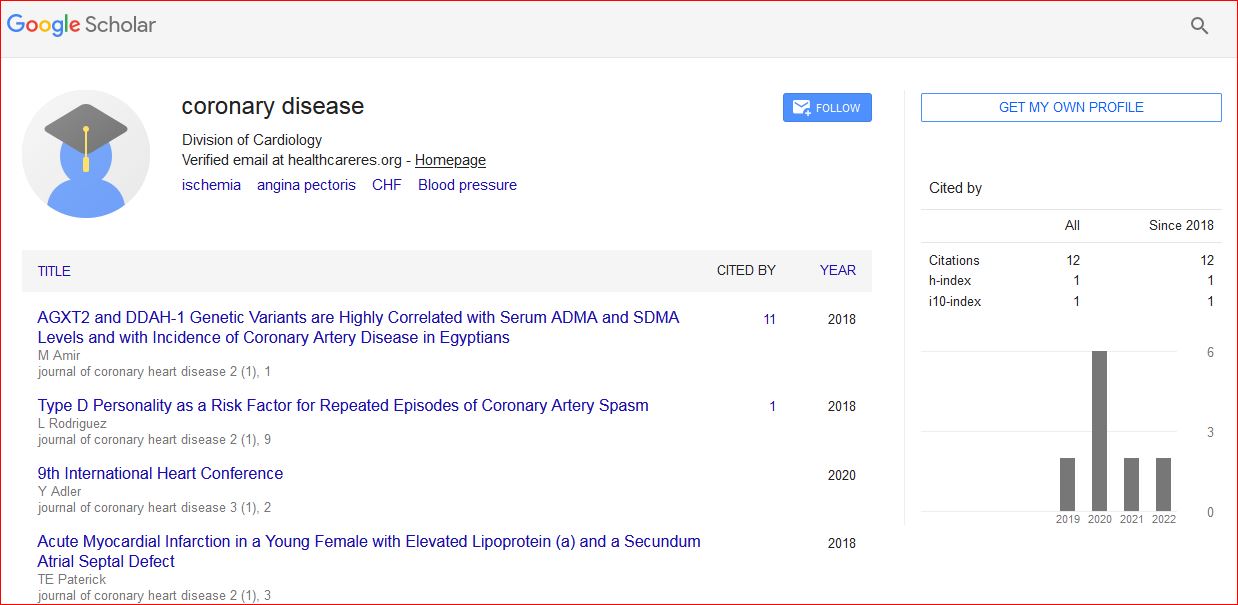
Journal of Coronary Heart Diseases received 15 citations as per Google Scholar report