Perspective - (2025) Volume 9, Issue 4
Received: 01-Aug-2025, Manuscript No. jgge-25-174636;
Editor assigned: 04-Aug-2025, Pre QC No. P-174636;
Reviewed: 18-Aug-2025, QC No. Q-174636;
Revised: 22-Aug-2025, Manuscript No. R-174636;
Published:
29-Aug-2025
, DOI: 10.37421/2684-4567.2025.9.186
Citation: Reinhardt, Sophia. ”Functional Genomics: Transforming Life’s Diverse Landscapes.” J Genet Genom 09 (2025):186.
Copyright: © 2025 Reinhardt S. This is an open-access article distributed under the terms of the Creative Commons Attribution License, which permits unrestricted use,
distribution and reproduction in any medium, provided the original author and source are credited.
This article explores the rapidly evolving field of single-cell functional genomics, explaining how it helps us map intricate cellular landscapes linked to various diseases. It details innovative techniques that allow researchers to analyze gene function at an unprecedented resolution, uncovering cell-type-specific mechanisms crucial for understanding disease progression and developing targeted therapies, moving beyond bulk tissue analysis to see exactly what individual cells are doing for precision medicine [1].
Here's the thing: CRISPR-based functional genomics has become a game-changer, especially when applied to human pluripotent stem cells. This paper reviews how these powerful genome editing tools are used to dissect gene function, model human diseases, and develop new therapeutic strategies within these versatile cells. It highlights the precision and efficiency of CRISPR, allowing for targeted manipulation of genes to understand their roles in development and pathology [2].
This article makes a strong case for functional genomics as an essential tool in cancer research. It covers how various functional genomic approaches, like CRISPR screens and proteomic analyses, are revealing novel oncogenes and tumor suppressor genes, identifying therapeutic targets, and predicting treatment responses. What this really means is we're getting smarter about how cancer works and finding better ways to fight it by looking at gene function on a grand scale [3].
Let's break down how computational approaches are reshaping functional genomics. This review focuses on the journey from raw genomic data to actionable biological insights, detailing methods for analyzing high-throughput data, predicting gene function, and constructing regulatory networks. It's about how smart algorithms and big data infrastructure are absolutely critical for making sense of the complex biological information we generate today [4].
This paper highlights the exciting advancements in plant functional genomics and its potential to unlock unprecedented crop potential. It discusses how these studies are identifying genes responsible for important traits like yield, disease resistance, and stress tolerance, leading to the development of more resilient and productive crops. Essentially, we're using genomics to engineer plants that can better feed a growing world [5].
Here's the scoop on functional genomics of complex diseases: it's all about moving beyond just finding genetic associations to understanding the actual underlying biological mechanisms. This article discusses how combining large-scale genomic data with functional assays is essential for pinpointing causal variants and pathways, ultimately leading to a deeper understanding of diseases like diabetes, heart disease, and autoimmune disorders. Itâ??s helping us connect the dots from genetic predisposition to disease pathology [6].
This article gives a thorough look at the functional genomics of aging, pulling insights from simple model organisms all the way to humans. It delves into the genetic and molecular pathways that govern the aging process, highlighting how functional genomic screens are identifying novel longevity genes and therapeutic targets to extend healthy lifespan. What this really means is we're uncovering the core mechanisms of aging to potentially intervene and promote healthier longevity [7].
Let's talk about microbial functional genomics, moving from analyzing single genes to understanding entire systems biology. This review covers how high-throughput technologies are being applied to microbes to reveal novel metabolic pathways, virulence factors, and antibiotic resistance mechanisms. It emphasizes the importance of a systems-level view to fully grasp microbial behavior and harness their potential or combat their threats [8].
This article highlights the critical role of functional genomics in immunology, helping us unravel immune cell function and dissect disease mechanisms. It explains how advanced techniques like single-cell transcriptomics and CRISPR screening are providing unprecedented insights into how immune cells develop, respond to pathogens, and contribute to autoimmune diseases or cancer. What this really means is we're gaining a much clearer picture of our immune system to better treat immune-related disorders [9].
Here's the thing about functional genomics in neuroscience: itâ??s providing powerful approaches and applications to understand the complexities of the brain. This review details how scientists are using functional genomics to identify genes and pathways involved in brain development, function, and neurological disorders, from schizophrenia to Alzheimer's. Itâ??s about cracking the genetic code of the brain to unlock new treatments for devastating conditions [10].
Functional genomics represents a comprehensive scientific discipline dedicated to understanding the functions of genes, proteins, and other regulatory elements on a genome-wide scale. It moves beyond simply identifying genetic sequences to elucidating how these elements contribute to an organism's phenotype, health, and disease. This often involves high-throughput experimental techniques coupled with advanced computational analyses. A pivotal advancement in this field is single-cell functional genomics, which precisely maps cellular landscapes and identifies cell-type-specific mechanisms underlying various diseases. This approach allows researchers to analyze gene function at an unprecedented resolution, moving past bulk tissue analysis to understand the individual activities of cells, paving the way for precision medicine [1].
Here's the thing, CRISPR-based functional genomics has emerged as a revolutionary tool, especially when applied to human pluripotent stem cells. These powerful genome editing technologies enable targeted manipulation of genes, which is crucial for dissecting gene function, creating models for human diseases, and developing novel therapeutic strategies within these versatile cell types [2]. The precision and efficiency of CRISPR screens are also making a strong case as an essential tool in cancer research. These screens, alongside proteomic analyses, are instrumental in revealing novel oncogenes and tumor suppressor genes, identifying potential therapeutic targets, and predicting patient responses to treatments. What this really means is that scientists are gaining a smarter understanding of how cancer works, leading to better strategies to combat it by examining gene function comprehensively [3, 9].
Let's break down how computational approaches are fundamental to reshaping functional genomics. The journey from raw genomic data to actionable biological insights critically depends on advanced computational methods. These methods include sophisticated algorithms for analyzing high-throughput data, predicting gene function, and constructing intricate regulatory networks. Without smart algorithms and robust big data infrastructure, making sense of the complex biological information generated today would be nearly impossible [4]. This computational backbone supports diverse applications across biology and medicine. For example, in plant science, advances in plant functional genomics are unlocking unprecedented crop potential. These studies identify genes responsible for vital traits such as yield, disease resistance, and stress tolerance, facilitating the development of more resilient and productive crops. Essentially, functional genomics is engineering plants to better feed a growing world [5].
Functional genomics is crucial for moving beyond mere genetic associations to understanding the actual underlying biological mechanisms of complex diseases. Combining large-scale genomic data with functional assays is essential for pinpointing causal variants and pathways that contribute to conditions like diabetes, heart disease, and autoimmune disorders. Itâ??s helping researchers connect the dots from genetic predisposition to the specific pathology of these diseases [6]. Similarly, the functional genomics of aging provides profound insights, drawing from simple model organisms all the way to humans. It delves into the genetic and molecular pathways governing the aging process, identifying novel longevity genes and therapeutic targets aimed at extending a healthy lifespan. What this really means is we're uncovering the core mechanisms of aging to potentially intervene and promote healthier longevity [7]. Moreover, microbial functional genomics is shifting from single-gene analysis to understanding entire systems biology. High-throughput technologies are being applied to microbes to reveal novel metabolic pathways, virulence factors, and antibiotic resistance mechanisms, emphasizing a systems-level view to grasp microbial behavior and address their impact [8].
The critical role of functional genomics extends to immunology, helping to unravel immune cell function and dissect disease mechanisms. Advanced techniques, including single-cell transcriptomics and CRISPR screening, offer unprecedented insights into how immune cells develop, respond to pathogens, and contribute to autoimmune diseases or cancer. This work is yielding a much clearer picture of our immune system, which is vital for developing better treatments for immune-related disorders [9]. Here's the thing about functional genomics in neuroscience: itâ??s providing powerful approaches to understand the complexities of the brain. Scientists are utilizing these genomic tools to identify genes and pathways involved in brain development, function, and various neurological disorders, ranging from schizophrenia to Alzheimer's disease. The goal is to crack the genetic code of the brain, ultimately unlocking new treatments for these devastating conditions [10].
Functional genomics is transforming our understanding of biological systems by investigating gene function on a large scale. It employs diverse approaches, from single-cell analysis that maps intricate cellular landscapes and identifies cell-type-specific disease mechanisms [1] to sophisticated CRISPR-based genome editing in human pluripotent stem cells for dissecting gene function and modeling diseases [2]. In cancer research, these tools identify oncogenes, tumor suppressors, and therapeutic targets, promising smarter strategies for treatment [3]. The field heavily relies on computational approaches to convert vast genomic data into actionable biological insights, using smart algorithms to predict gene function and construct regulatory networks [4]. Beyond human health, functional genomics is vital for agriculture, unlocking crop potential by identifying genes for improved yield and resistance, thus engineering more resilient plants [5]. It also helps move beyond genetic associations in complex diseases, uncovering underlying biological mechanisms and causal pathways [6]. Moreover, it sheds light on the aging process by identifying longevity genes [7]. A systems-level view through microbial functional genomics reveals metabolic pathways and antibiotic resistance [8]. In immunology, it clarifies immune cell function [9], and in neuroscience, it deciphers genes involved in brain development and neurological conditions [10]. This interdisciplinary approach accelerates precision medicine and addresses global challenges.
None
None
Andrew JG, Jay S, Joseph RE. "Single-Cell Functional Genomics: Mapping the Cellular Landscape of Disease".Cell 184 (2021):11-28.
Indexed at, Google Scholar, Crossref
Min X, Shan G, Xin M. "CRISPR-based functional genomics in human pluripotent stem cells".Nat Rev Genet 21 (2020):497-512.
Indexed at, Google Scholar, Crossref
Shuang H, Mengxuan L, Zhiwei W. "Functional genomics: A powerful tool for cancer research".J Cancer Res Clin Oncol 149 (2023):269-281.
Indexed at, Google Scholar, Crossref
David MV, Stephen JS, Mansoor AS. "Computational approaches in functional genomics: From data to insights".Brief Bioinform 22 (2021):bbab044.
Indexed at, Google Scholar, Crossref
Ajai S, Sudhanshu KS, Santosh KS. "Advances in Plant Functional Genomics: Unlocking Crop Potential".Front Plant Sci 13 (2022):843640.
Indexed at, Google Scholar, Crossref
Evan AB, Tuuli L, Erika ME. "Functional genomics of complex disease: From association to mechanism".Cell 186 (2023):14-27.
Indexed at, Google Scholar, Crossref
Carlos L, Maria AB, Linda P. "Functional genomics of aging: Insights from model organisms to humans".Cell 186 (2023):2953-2967.
Indexed at, Google Scholar, Crossref
Ross O, Robert O, Gordon DP. "Microbial functional genomics: From single-gene analysis to systems biology".Curr Opin Microbiol 64 (2021):64-71.
Indexed at, Google Scholar, Crossref
Roland M, Neville ES, Rahul S. "Functional genomics in immunology: Unraveling immune cell function and disease mechanisms".Nat Rev Immunol 20 (2020):631-645.
Indexed at, Google Scholar, Crossref
Joseph RE, Andrew JG, Jay S. "Functional genomics in neuroscience: Approaches and applications".Cell 184 (2021):293-308.
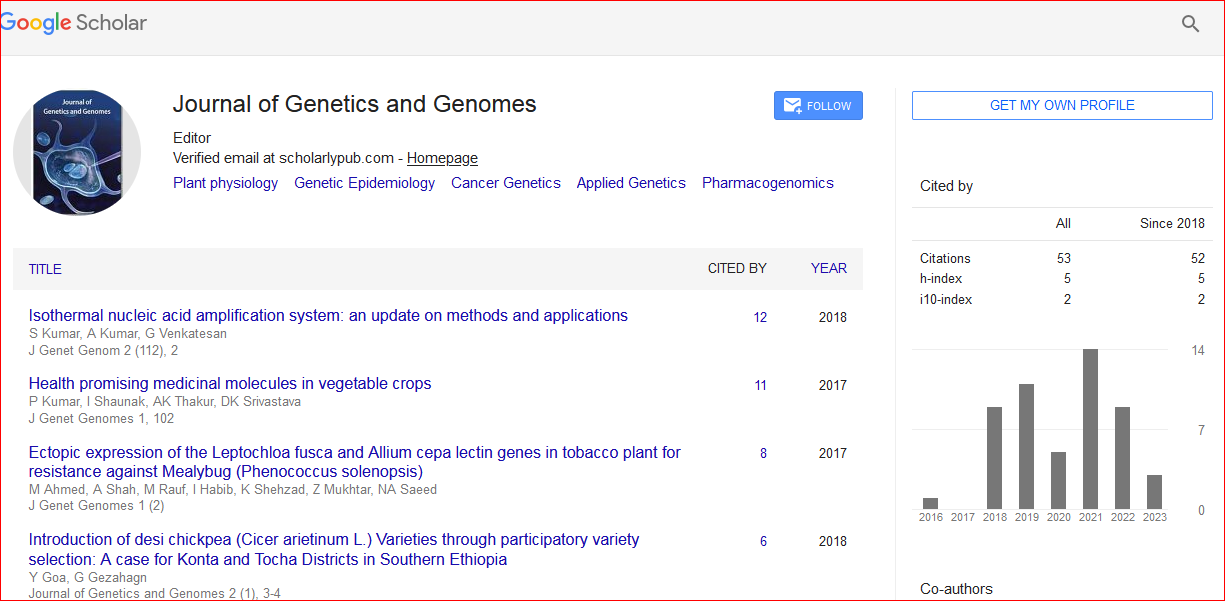
Journal of Genetics and Genomes received 65 citations as per Google Scholar report