Commentary - (2025) Volume 11, Issue 5
Received: 01-Oct-2025, Manuscript No. jctt-26-188425;
Editor assigned: 03-Oct-2025, Pre QC No. P-188425;
Reviewed: 17-Oct-2025, QC No. Q-188425;
Revised: 22-Oct-2025, Manuscript No. R-188425;
Published:
29-Oct-2025
, DOI: 10.37421/2471-9323.2024.10.343
Citation: Youssef, Salma Ben. ”From Alchemy to Science: Beauty’s Evolving Journey.” J Cosmo Tricho 11 (2025):343.
Copyright: © 2025 Youssef B. Salma This is an open-access article distributed under the terms of the Creative Commons Attribution License, which permits unrestricted use, distribution and reproduction in any medium, provided the original author and source are credited.
The field of cosmetic science has undergone a profound transformation, evolving from ancient practices often termed 'beauty alchemy' into a sophisticated discipline grounded in scientific principles. This evolution highlights a rich history of understanding natural substances and their effects on skin and hair, bridging traditional knowledge with modern research [1].
The exploration of phytochemistry has been central to this progression, with contemporary studies validating the efficacy of botanical extracts that were once used empirically in ancient beauty rituals [2].
Similarly, the intricate science behind hair care, now termed 'hair alchemy,' is being unraveled through molecular analysis, linking traditional methods to modern ingredients aimed at hair restoration and strengthening [3].
The cosmetic industry's journey is a testament to this transition, moving from simple empirical observations to complex biotechnological products driven by rigorous scientific investigation [4].
The use of minerals in skincare, a practice with deep historical roots in purification and rejuvenation, is now being substantiated by modern science, revealing their dermatological benefits [5].
Moreover, the therapeutic potential of essential oils, long revered in ancient perfumery and aromatherapy, is being systematically investigated for their applications in modern trichology, addressing scalp conditions and promoting hair growth [6].
The foundational principles of formulation stability and efficacy, crucial in modern cosmetics, find their genesis in time-tested 'beauty alchemy' techniques, underscoring the enduring relevance of historical wisdom [7].
Even seemingly simple traditional practices like cleansing and exfoliation are now being rigorously assessed using modern biophysical methods to understand their impact on skin barrier function, validating ancient empirical knowledge [8].
The historical use of pigments and dyes in cosmetics, from natural colorants to their synthetic counterparts, illustrates a continuous interplay between artistry and scientific understanding of color chemistry and safety in makeup formulation [9].
Finally, the sensory aspects of beauty, particularly in perfumery and aromatherapy, showcase how ancient olfactory traditions are being integrated into modern product design, considering the psychological and physiological effects of scent [10].
The historical and scientific underpinnings of cosmetic formulations, often referred to as 'beauty alchemy,' have paved the way for modern cosmetology. This evolution is marked by the study of natural ingredients and their synergistic effects on advanced skincare and haircare science [1].
A significant area of focus is the phytochemistry of botanicals integral to traditional beauty rituals, where their active compounds and scientific validation for skin and hair health are being rigorously examined, bridging ancient knowledge with contemporary research on antioxidants and anti-inflammatory properties [2].
The concept of 'hair alchemy' is also being explored, investigating traditional methods and modern ingredients for hair restoration and strengthening by analyzing the molecular mechanisms influencing hair follicle health and growth cycles [3].
The broader cosmetic industry's trajectory demonstrates a transition from empirical knowledge, characteristic of 'beauty alchemy,' to evidence-based practices driven by advanced scientific research and biotechnology [4].
Furthermore, the historical application of specific minerals for skin purification and rejuvenation is now being connected to modern understandings of mineral-based cosmetic ingredients and their proven dermatological benefits [5].
Essential oils, utilized for their therapeutic potential in ancient times, are now being studied within contemporary trichology to address scalp conditions and promote hair growth, highlighting the sophisticated understanding of botanical treatments in historical beauty practices [6].
The principles of formulation stability and efficacy in modern cosmetics are increasingly drawing parallels with time-tested 'beauty alchemy' techniques, emphasizing the importance of ingredient interactions and preservation methods for product longevity [7].
Traditional cleansing and exfoliating methods, once rooted in empirical knowledge, are now being evaluated for their biophysical effects on skin barrier function, validating ancient beauty rituals through modern scientific assessment [8].
The historical use of pigments and dyes in cosmetics, involving both natural and synthetic colorants, is being reviewed from a chemical perspective, considering safety and performance in contemporary makeup formulations [9].
Finally, the sensory dimensions of cosmetic experiences, particularly in perfumery and aromatherapy, are being analyzed to understand how traditional practices translate into modern product design, considering the psychological and physiological impacts of scent [10].
This collection of articles explores the evolution of cosmetic science from historical 'beauty alchemy' to modern cosmetology. It examines the scientific validation of traditional practices, including the use of botanical extracts, minerals, and essential oils for skin and hair health. The research highlights the transition from empirical knowledge to evidence-based practices driven by advanced scientific investigation and biotechnology. Key areas covered include formulation stability, hair restoration science, pigment chemistry, and the sensory impact of scents, all drawing connections between ancient wisdom and contemporary understanding in the beauty industry.
None
None
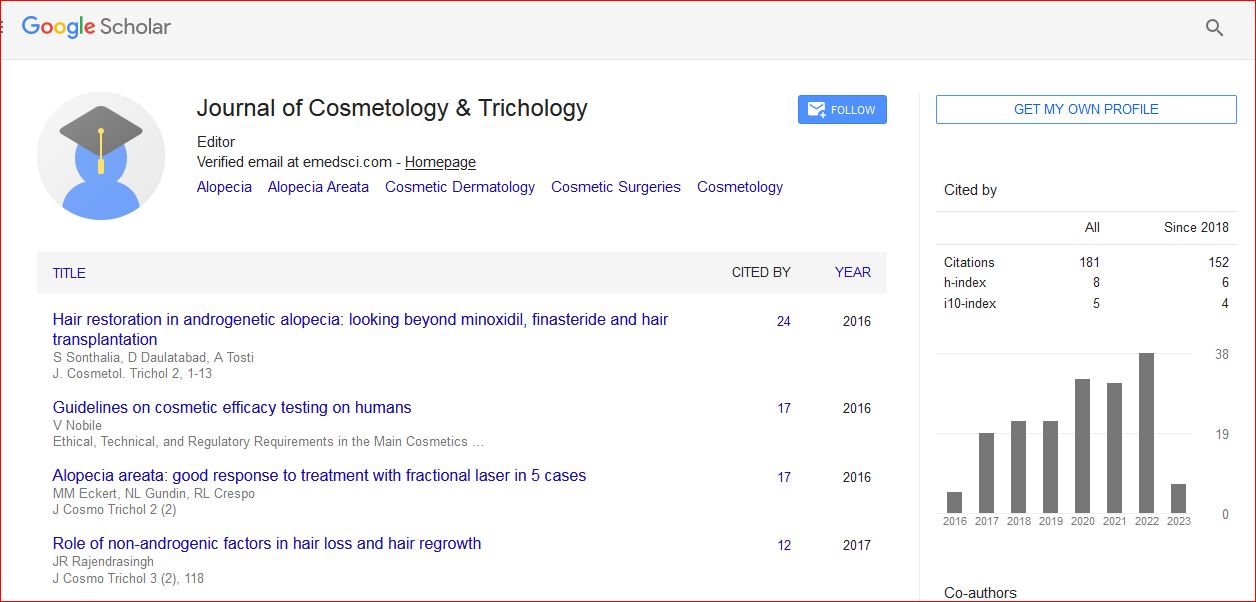
Journal of Cosmetology & Trichology received 180 citations as per Google Scholar report