Perspective - (2025) Volume 16, Issue 3
Received: 01-May-2025, Manuscript No. jpm-26-179408;
Editor assigned: 05-May-2025, Pre QC No. P-179408;
Reviewed: 19-May-2025, QC No. Q-179408;
Revised: 22-May-2025, Manuscript No. R-179408;
Published:
29-May-2025
, DOI: 10.37421/2090-0902.2025.16.535
Citation: Costa, Rafael. ”Fractional Calculus For Anomalous Transport Modeling.” J Phys Math 16 (2025):535.
Copyright: © 2025 Costa R. This is an open-access article distributed under the terms of the Creative Commons Attribution License, which permits unrestricted use, distribution and reproduction in any medium, provided the original author and source are credited.
Fractional calculus has emerged as a robust mathematical framework for understanding and modeling anomalous transport phenomena that diverge from classical Fickian diffusion. This advanced approach is instrumental in capturing the long-range memory effects and non-local interactions that are intrinsic to various complex systems, including porous media, biological tissues, and disordered materials. By leveraging the power of fractional-order derivatives, researchers can accurately describe transport processes exhibiting sub-diffusive or super-diffusive behavior, offering a more precise representation than traditional integer-order differential equations [1].
The application of fractional diffusion equations has been extensively explored for modeling anomalous solute transport within heterogeneous porous media. These models effectively account for the intricate pore structures and the presence of dead-end pores, which often lead to significant deviations from standard diffusion behavior. The capacity of fractional models to reproduce the characteristic long-tailed probability distributions of anomalous transport significantly enhances their predictive capabilities [2].
Within the realm of biological systems, fractional calculus has proven invaluable for modeling anomalous diffusion, particularly in the context of intracellular transport. The complex and heterogeneous environments within cells, where diffusion is frequently hindered and exhibits non-Markovian characteristics, can be more realistically described using fractional derivatives. This approach offers a more accurate portrayal of molecular movement in living cells compared to conventional diffusion models [3].
Furthermore, the utility of fractional calculus extends to the modeling of contaminant transport in fractured rock masses. The development of fractional advection-dispersion models has been crucial in accounting for the complex flow paths and trapping mechanisms prevalent in such fractured porous media. These models highlight the critical role of fractional derivatives in capturing the long-term memory effects observed in contaminant transport, leading to improved predictions of plume spreading and breakthrough curves [4].
In the study of viscoelastic materials, fractional-order time derivatives are employed to model anomalous diffusion. This methodology naturally incorporates the fading memory effects characteristic of viscoelasticity, thereby providing a more accurate description of the material's response to external stimuli. This application demonstrates the power of fractional calculus as a tool for analyzing transport phenomena in materials with complex rheological properties [5].
Anomalous transport in geological formations characterized by spatially variable hydraulic conductivity can be effectively described using fractional calculus. The application of fractional derivatives is particularly useful for capturing the scale-dependent and non-local effects that arise from the inherent heterogeneity of these geological media. Fractional models provide a more comprehensive understanding of contaminant fate and transport in such intricate environments [6].
The investigation of subdiffusion processes in disordered materials has also benefited from the application of fractional calculus. By deriving and analyzing fractional Fokker-Planck equations, researchers can describe anomalous behavior and represent the memory kernel associated with fractional derivatives, which models the trapping and release dynamics in disordered settings. This underscores the effectiveness of fractional calculus in characterizing non-Brownian motion [7].
Fractional calculus is exceptionally well-suited for modeling anomalous diffusion in porous media with fractal geometry. The inherent fractal characteristics of these systems, such as tortuous pore networks, are naturally addressed by fractional derivatives. This approach has been shown to enhance the accuracy of fractional models in predicting solute dispersion and breakthrough curves within these complex media [8].
In geophysical systems, including groundwater flow and solute migration, fractional calculus plays a significant role in modeling anomalous transport. The non-local and memory effects inherent in these complex systems, often marked by heterogeneity and intricate flow paths, are effectively captured by fractional derivatives. This allows for more realistic predictions of transport behavior [9].
Finally, a fractional kinetic model has been developed for anomalous transport in disordered porous media. This model utilizes fractional-order time derivatives to account for the non-Markovian nature of transport processes, which is essential in systems with complex pore structures and diffusion barriers. The proposed model accurately captures subdiffusive behavior and long-time tails, offering superior descriptive power over classical diffusion models [10].
Fractional calculus offers a sophisticated framework for characterizing anomalous transport phenomena that deviate from conventional Fickian diffusion principles. This approach is particularly adept at capturing the long-range memory effects and non-local interactions that are prevalent in complex systems, such as porous media, biological tissues, and disordered materials. By employing fractional-order derivatives, it becomes possible to describe transport processes that exhibit sub-diffusive or super-diffusive behavior, thereby providing a more accurate and nuanced representation compared to traditional integer-order differential equations [1].
In the domain of heterogeneous porous media, fractional diffusion equations have been successfully applied to model anomalous solute transport. The utility of fractional derivatives lies in their ability to account for the complex pore structures and the existence of dead-end pores, which are common causes for deviations from standard diffusion behavior. This modeling approach has demonstrated its effectiveness in reproducing the long-tailed probability distributions that are characteristic of anomalous transport, thereby improving predictive accuracy [2].
Within biological systems, fractional calculus is increasingly utilized to model anomalous diffusion, with a specific focus on intracellular transport. The complex and often heterogeneous environments found within cells, where diffusion can be significantly hindered and exhibit non-Markovian characteristics, are more realistically represented by fractional derivatives. This methodology provides a superior description of molecular movement within living cells compared to classical diffusion models [3].
Contaminant transport in fractured rock masses is another area where fractional calculus finds significant application. The development and application of fractional advection-dispersion models are essential for accurately representing the intricate flow paths and trapping mechanisms characteristic of fractured porous media. These fractional models effectively capture the long-term memory effects observed in contaminant transport, leading to more precise predictions of plume spreading and breakthrough curves [4].
For viscoelastic materials, fractional calculus, particularly through the use of fractional-order time derivatives, provides an effective means of modeling anomalous diffusion. This approach inherently incorporates the fading memory effects that are a hallmark of viscoelastic behavior, resulting in a more accurate description of the material's response to applied forces. This illustrates the value of fractional calculus in understanding materials with complex rheological properties [5].
Anomalous transport in geological formations that exhibit spatially variable hydraulic conductivity can be effectively modeled using fractional calculus. Fractional derivatives are employed to capture the scale-dependent and non-local effects that stem from the heterogeneity of the geological medium. These fractional models offer a more comprehensive understanding of how contaminants move and persist within these complex environments [6].
Subdiffusion processes occurring in disordered materials are well-described by fractional calculus. The use of fractional Fokker-Planck equations allows for the modeling of anomalous behavior, and the memory kernel associated with fractional derivatives effectively represents the dynamics of trapping and release within disordered environments. This highlights the capability of fractional calculus in characterizing non-Brownian motion [7].
When dealing with porous media that possess fractal geometry, fractional calculus proves to be an ideal tool for modeling anomalous diffusion. The fractal nature of these systems, including their tortuous pore networks, is naturally accommodated by fractional derivatives. Studies have shown that fractional models provide enhanced accuracy in predicting solute dispersion and breakthrough curves in such complex media [8].
In the context of geophysical systems, such as groundwater flow and solute migration, fractional calculus is employed to model anomalous transport. Fractional derivatives are particularly useful for capturing the non-local and memory effects that are inherent in these complex systems, which often feature heterogeneity and complex flow pathways. Fractional models offer more realistic predictions of transport behavior in these scenarios [9].
Finally, a fractional kinetic model has been proposed for anomalous transport in disordered porous media. This model leverages fractional-order time derivatives to capture the non-Markovian characteristics of transport, which is crucial in systems with complex pore structures and diffusion barriers. The model successfully describes subdiffusive behavior and the long-time tails observed in such media, offering an improvement over classical diffusion models [10].
Fractional calculus provides a powerful framework for modeling anomalous transport phenomena that deviate from classical diffusion. It is applied across various complex systems including porous media, biological tissues, disordered materials, and fractured rock masses. By utilizing fractional-order derivatives, these models accurately capture long-range memory effects, non-local interactions, and non-Markovian behavior, leading to more precise descriptions of sub-diffusive and super-diffusive transport. Applications range from understanding solute transport in heterogeneous environments and intracellular movement to contaminant migration in geological formations and diffusion in viscoelastic materials. Fractional models offer improved predictive capabilities for phenomena like plume spreading and breakthrough curves, providing a more realistic representation than traditional integer-order differential equations.
None
None
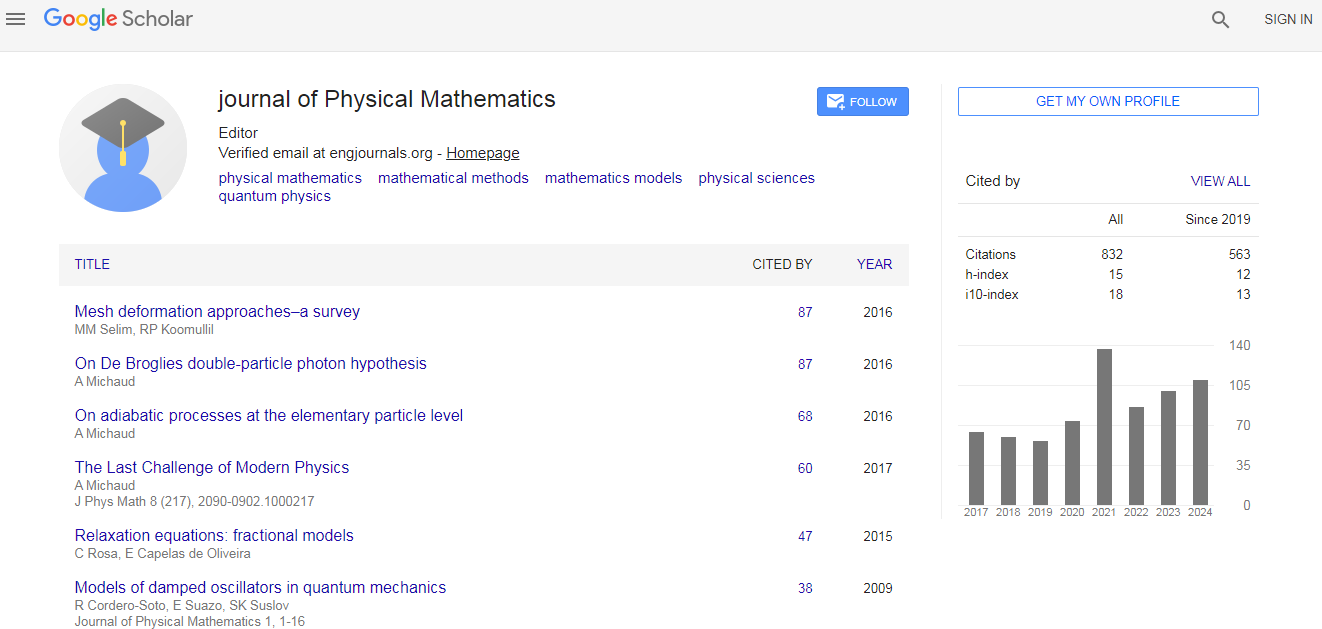
Physical Mathematics received 686 citations as per Google Scholar report