Brief Report - (127) Volume 14, Issue 5
Received: 01-Sep-2025, Manuscript No. jio-26-184824;
Editor assigned: 03-Sep-2025, Pre QC No. P-184824;
Reviewed: 17-Sep-2025, QC No. Q-184824;
Revised: 22-Sep-2025, Manuscript No. R-184824;
Published:
29-Sep-2025
, DOI: 10.37421/2329-6771.2025.14.573
Citation: Salem, Ahmed Ben. ”Phytochemicals: Natural Allies in Cancer Prevention And Treatment.” J Integr Onco 14 (2025):573.
Copyright: © 2025 Salem B. Ahmed This is an open-access article distributed under the terms of the Creative Commons Attribution License, which permits unrestricted use, distribution and reproduction in any medium, provided the original author and source are credited.
The multifaceted roles of phytochemicals in oncology, encompassing both cancer prevention and treatment, are a significant area of ongoing research. These natural compounds, including curcumin and green tea polyphenols, possess antioxidant, anti-inflammatory, and anti-proliferative properties that can influence critical cellular pathways involved in cancer development and progression. Emerging research indicates their potential to augment the effectiveness of conventional therapies and alleviate treatment-related side effects, suggesting a complementary approach to improving patient outcomes, though further clinical validation remains essential [1].
A key focus within this field is the exploration of how phytochemicals like epigallocatechin gallate (EGCG) from green tea and curcumin can modulate the tumor microenvironment. These compounds demonstrate an ability to influence immune cell function, angiogenesis, and the extracellular matrix, all of which are vital for tumor growth and metastasis. A deeper understanding of these interactions holds promise for the development of novel therapeutic strategies that synergistically combine phytochemicals with immunotherapy or anti-angiogenic agents [2].
The significance of phytochemicals in chemoprevention, the strategic use of natural agents to prevent cancer, is substantial. Compounds such as sulforaphane found in cruciferous vegetables and resveratrol derived from grapes have shown preclinical efficacy in inducing detoxification enzymes and inhibiting cancer cell growth. These findings emphasize the importance of dietary patterns rich in such phytochemicals for reducing cancer risk [3].
Investigating the bioavailability and pharmacokinetics of phytochemicals is paramount for their successful therapeutic application in oncology. Factors like solubility, metabolic pathways, and the chosen route of administration critically influence their ability to reach target sites and exert their intended effects. Consequently, strategies aimed at enhancing bioavailability, such as the development of nanoformulations, are actively being pursued [4].
The intersection of phytochemicals and immunotherapy represents a particularly promising avenue in contemporary cancer treatment. Phytochemicals may possess the capacity to modulate the immune system in ways that bolster the efficacy of established immunotherapies like checkpoint inhibitors. Their inherent anti-inflammatory and antioxidant properties could contribute to a more favorable microenvironment for immune surveillance and the generation of anti-tumor responses [5].
The mechanisms of action through which phytochemicals exert their effects in cancer are diverse and complex, often involving the modulation of critical signaling pathways such as NF-κB, STAT3, and PI3K/Akt. Their demonstrated ability to induce apoptosis, inhibit angiogenesis, and prevent metastasis positions them as attractive candidates for incorporation into cancer therapy regimens. A detailed molecular understanding is indispensable for optimizing their therapeutic utilization [6].
The role of dietary phytochemicals in cancer survivorship is an increasingly recognized area of interest. Beyond their direct therapeutic effects, these compounds may play a crucial role in aiding recovery, reducing the risk of recurrence, and enhancing the overall quality of life for cancer survivors. Their antioxidant and anti-inflammatory actions can help mitigate long-term treatment-related side effects and promote general health and well-being [7].
Synergistic effects observed between different phytochemicals, and importantly, between phytochemicals and conventional chemotherapeutics, are of considerable scientific interest. The strategic combination of agents that possess complementary mechanisms of action can lead to enhanced therapeutic efficacy and potentially allow for reduced dosages of individual components, thereby minimizing toxicity [8].
The clinical translation of promising phytochemical research encounters several challenges, including the standardization of plant extracts, the assurance of consistent product quality, and the necessity of conducting rigorous randomized controlled trials. Overcoming these substantial hurdles is essential for fully realizing the therapeutic potential of these compounds within the realm of oncology [9].
Phytochemicals such as curcumin and epigallocatechin gallate (EGCG) are also under investigation for their capacity to overcome drug resistance in cancer. These compounds have the potential to modulate cellular pathways implicated in multidrug resistance, thereby re-sensitizing cancer cells to chemotherapy and potentially improving treatment outcomes in tumors that have become resistant to conventional therapies [10].
The exploration into the roles of phytochemicals like curcumin, green tea polyphenols, and other naturally occurring compounds in oncology reveals their significant potential in cancer prevention and treatment [1].
These substances exhibit a range of beneficial properties, including antioxidant, anti-inflammatory, and anti-proliferative activities, which can profoundly influence the complex cellular pathways that govern cancer development and progression. Evidence suggests that these natural agents may enhance the effectiveness of standard cancer therapies and help mitigate the adverse effects associated with treatment, offering a complementary strategy to improve patient outcomes, although continued clinical research is necessary [1].
A pivotal area of research involves understanding how phytochemicals, specifically epigallocatechin gallate (EGCG) from green tea and curcumin, can modulate the tumor microenvironment. These bioactive compounds have shown the ability to influence the function of immune cells, the process of angiogenesis, and the composition of the extracellular matrixâ??all critical factors for tumor growth and the spread of cancer (metastasis). Gaining a deeper insight into these interactions is key to developing innovative therapeutic approaches that combine phytochemicals with other treatments like immunotherapy or anti-angiogenic drugs [2].
The contribution of phytochemicals to chemoprevention, defined as the use of natural compounds to prevent cancer, is substantial. Preclinical studies have demonstrated that agents like sulforaphane, abundant in cruciferous vegetables, and resveratrol, found in grapes, can effectively induce detoxification enzymes and inhibit the proliferation of cancer cells. These findings underscore the crucial role of diets rich in phytochemicals in reducing an individual's risk of developing cancer [3].
For phytochemicals to be effectively utilized in cancer therapy, thorough investigation into their bioavailability and pharmacokinetics is essential. Factors such as their solubility in biological fluids, how they are metabolized by the body, and the chosen method of administration all play a critical role in determining how efficiently these compounds can reach their intended cellular targets and exert their therapeutic effects. Consequently, significant effort is being directed towards developing strategies to improve their bioavailability, including the use of advanced delivery systems like nanoformulations [4].
The convergence of phytochemical research with the field of cancer immunotherapy presents an exciting frontier. Phytochemicals may possess the capacity to fine-tune the immune system's response, potentially enhancing the effectiveness of established immunotherapies, such as checkpoint inhibitors. Their inherent anti-inflammatory and antioxidant characteristics could foster a more conducive microenvironment for immune cells to identify and attack cancer cells, thereby improving anti-tumor immunity [5].
The mechanisms by which phytochemicals exert their anti-cancer effects are varied and involve the modulation of crucial intracellular signaling pathways, including NF-κB, STAT3, and PI3K/Akt. Their demonstrated capabilities in inducing programmed cell death (apoptosis), inhibiting the formation of new blood vessels (angiogenesis), and preventing the spread of cancer (metastasis) make them highly attractive candidates for cancer treatment strategies. A comprehensive understanding of these molecular actions is vital for optimizing their clinical application [6].
The impact of dietary phytochemicals on cancer survivorship is an area receiving increasing attention. Beyond their direct role in treatment, these compounds may contribute to the recovery process, help lower the likelihood of cancer recurrence, and improve the overall quality of life for individuals who have survived cancer. Their antioxidant and anti-inflammatory properties can be beneficial in managing long-term side effects of cancer treatments and promoting general health [7].
Research into the synergistic effects between different phytochemicals, as well as between phytochemicals and conventional cancer drugs, is of significant scientific and clinical interest. Combining therapeutic agents that act through complementary mechanisms can lead to enhanced treatment efficacy and may allow for the use of lower doses of each component, consequently reducing the overall toxicity experienced by the patient [8].
Translating the promising findings from phytochemical research into clinical practice faces several significant obstacles. These include the need for standardized methods for preparing plant extracts, ensuring consistent quality and potency of these agents, and the imperative to conduct well-designed, rigorous randomized controlled trials to confirm efficacy and safety. Overcoming these challenges is crucial for the full realization of the therapeutic potential of phytochemicals in oncology [9].
Specific phytochemicals, such as curcumin and epigallocatechin gallate (EGCG), are being investigated for their ability to counteract drug resistance in cancer. These compounds can influence cellular pathways responsible for multidrug resistance, potentially making cancer cells more susceptible to chemotherapy and thereby improving treatment outcomes in cases of resistant tumors [10].
Phytochemicals, including curcumin and green tea polyphenols, are being extensively studied for their roles in cancer prevention and treatment. They possess antioxidant, anti-inflammatory, and anti-proliferative properties, influencing cancer development and progression. These natural compounds show promise in enhancing conventional therapies, modulating the tumor microenvironment, and aiding cancer survivorship. Their mechanisms of action involve modulating signaling pathways, inducing apoptosis, and preventing metastasis. Challenges remain in clinical translation, including standardization and rigorous trials. Research also focuses on their ability to overcome drug resistance and their synergistic effects with other treatments. Overall, phytochemicals represent a significant area for complementary and innovative cancer care strategies.
None
None
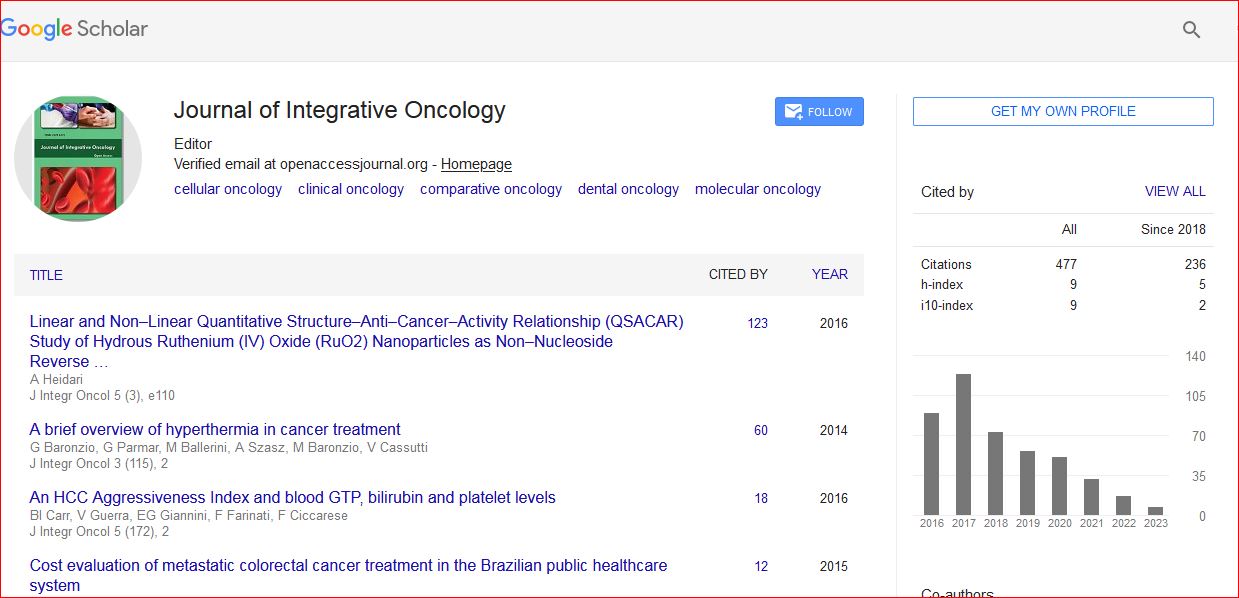
Journal of Integrative Oncology received 495 citations as per Google Scholar report