Commentary - (2025) Volume 16, Issue 5
Received: 01-Oct-2025, Manuscript No. jfr-26-184121;
Editor assigned: 03-Oct-2025, Pre QC No. P-184121;
Reviewed: 17-Oct-2025, QC No. Q-184121;
Revised: 22-Oct-2025, Manuscript No. R-184121;
Published:
29-Oct-2025
, DOI: 10.37421/2157-7145.2025.16.682
Citation: McLeod, Connor. ”Forensic Chemistry: Drug Analysis,
Novel Substances, and Evidence.” J Forensic Res 16 (2025):682.
Copyright: © 2025 McLeod C. This is an open-access article distributed under the terms of the Creative Commons Attribution License, which permits unrestricted use,
distribution and reproduction in any medium, provided the original author and source are credited.
Forensic chemistry is an indispensable scientific discipline that underpins the accurate identification and quantification of illicit substances, forming the bedrock of drug analysis. Its methodologies encompass a wide array of sophisticated analytical techniques designed to detect, confirm, and often measure the presence of drugs and their metabolic byproducts within biological samples such as blood, urine, and hair, as well as in seized materials. Essential to this process are chromatographic methods, including Gas Chromatography-Mass Spectrometry (GC-MS) and Liquid Chromatography-Mass Spectrometry (LC-MS), which excel at separating and identifying compounds. Spectroscopic techniques like Fourier-Transform Infrared (FTIR) and Ultraviolet-Visible (UV-Vis) spectroscopy are employed for detailed structural elucidation, while immunoassays serve as rapid initial screening tools. The accuracy and unwavering reliability of these forensic analytical methods are paramount, carrying significant weight in legal proceedings and influencing outcomes in criminal investigations, prosecution efforts, public health initiatives, and ongoing treatment monitoring [1].
Recent advancements, particularly in mass spectrometry and its hyphenated applications like GC-MS and LC-MS/MS, have profoundly transformed the landscape of drug analysis within forensic science. These cutting-edge methods offer unprecedented levels of sensitivity and selectivity, enabling the detection of even minute quantities of drugs and their metabolites, even when present in highly complex biological matrices. This enhanced capability is critically important for the identification of novel psychoactive substances (NPS), which pose a growing challenge, and for providing robust, irrefutable evidence in cases involving drug-facilitated crimes. The capacity to confirm both the identity and the precise quantity of a substance with a high degree of confidence remains a foundational principle of forensic chemistry [2].
The continuous emergence of novel psychoactive substances (NPS) presents an ongoing and significant challenge for forensic chemists worldwide. The rapid development and introduction of new designer drugs, often with subtly altered chemical structures, necessitate constant updates to analytical databases and the proactive development of novel detection and identification methodologies. Forensic chemistry laboratories are therefore required to maintain a state of agility and adaptability to effectively identify and characterize these evolving threats, frequently relying on the availability of certified reference standards and the application of highly sophisticated spectroscopic techniques for their elucidation [3].
Immunoassays have become widely adopted as initial screening tools in forensic drug analysis primarily due to their remarkable speed and cost-effectiveness. While these assays are highly effective in providing a preliminary indication of drug presence, it is imperative to recognize their inherent limitations. Confirmatory testing, utilizing more specific and definitive analytical techniques such as GC-MS or LC-MS, is absolutely essential to mitigate the risk of false positives and ensure the integrity of the analytical results. The core focus of forensic chemistry in this context is on the optimization of these screening methods and the establishment of rigorous protocols for reliable confirmatory testing [4].
The accurate interpretation of drug test results within forensic contexts demands a profound and comprehensive understanding of both pharmacokinetics and pharmacodynamics. Forensic chemists must meticulously consider a multitude of factors, including the administered dose, the route of administration, the intricate processes of drug metabolism, and the elimination half-life of the substance in question. This detailed consideration is vital for accurately interpreting the presence and concentration of drugs detected in biological samples and is indispensable for establishing relevant timelines and making informed determinations regarding impairment [5].
Powder analysis, a crucial component of forensic chemistry, specifically addresses the identification of controlled substances within seized drug samples. Techniques such as Fourier-transform infrared (FTIR) spectroscopy offer a rapid means of identifying the bulk chemical composition of the sample. For more definitive identification and precise quantification of the drug present, Gas Chromatography-Mass Spectrometry (GC-MS) is the method of choice. A fundamental aspect of this work involves a thorough understanding of the unique chemical properties and characteristic spectroscopic signatures associated with a wide range of illicit drugs [6].
The meticulous development and rigorous validation of analytical methods are cornerstones of forensic drug analysis, ensuring the reliability and legal admissibility of the generated evidence. Forensic chemists undertake a painstaking validation process for their methods, assessing parameters such as accuracy, precision, linearity, selectivity, and robustness. This comprehensive and demanding process guarantees that the analytical results obtained are scientifically sound, reproducible, and capable of withstanding intense legal scrutiny in a court of law [7].
The domain of forensic chemistry extends significantly into post-mortem toxicology, where the detailed analysis of biological samples collected from deceased individuals plays a critical role in determining the cause and manner of death. The precise identification and quantification of drugs and their metabolites can provide vital insights into whether drug intoxication or complex drug interactions may have contributed to the fatality. This specialized area often necessitates the analysis of a broader spectrum of biological matrices and the employment of exceptionally sensitive analytical techniques to achieve accurate results [8].
Chiral separation is progressively gaining importance in the field of forensic drug analysis, particularly when dealing with stereoisomeric drugs. It is crucial to recognize that different enantiomers of the same drug molecule can exhibit markedly different pharmacological activities and varying toxicological profiles. Forensic chemists employ specialized chiral chromatography techniques to effectively separate and quantify these enantiomers, thereby providing a more nuanced and comprehensive understanding of the drug's potential effects and implications [9].
The responsibilities of a forensic chemist engaged in drug analysis extend well beyond the laboratory bench and into the courtroom as an expert witness. In this capacity, they must possess the ability to articulate complex scientific findings in a clear, concise, and comprehensible manner to a non-scientific audience, which typically includes judges, attorneys, and juries. This crucial role demands not only exceptional analytical skills but also highly developed communication abilities to ensure that the scientific evidence is fully understood and appropriately considered in legal deliberations [10].
Forensic chemistry is fundamentally committed to providing the scientific underpinnings necessary for the precise identification and quantification of illicit substances, thereby playing a critical role in drug analysis. The discipline employs a comprehensive, multi-faceted strategy that integrates a variety of analytical techniques for the detection, confirmation, and often quantification of drugs and their metabolites. These analyses are performed on biological samples, including blood, urine, and hair, as well as on seized materials. Prominent among the utilized techniques are chromatography, specifically GC-MS and LC-MS, which are instrumental in separating and identifying various compounds. Spectroscopic methods, such as FTIR and UV-Vis, are employed for elucidating the structural characteristics of substances, while immunoassays are valuable for rapid preliminary screening. The accuracy and reliability of these methods are of utmost importance for their use in legal proceedings, directly impacting criminal investigations, prosecution, public health strategies, and patient monitoring within treatment programs [1].
Recent significant advancements in mass spectrometry, particularly the development of hyphenated techniques like GC-MS and LC-MS/MS, have led to a revolutionary impact on drug analysis within the realm of forensic science. These sophisticated methods provide enhanced sensitivity and selectivity, allowing for the detection of even trace amounts of drugs and their metabolites within complex biological and chemical matrices. This capability is indispensable for the identification of novel psychoactive substances (NPS) and for furnishing strong, evidence-based support in cases involving drug-facilitated crimes. The ability to definitively confirm the identity and quantify the amount of a substance with a high degree of confidence represents a cornerstone of forensic chemistry practices [2].
The forensic analysis of novel psychoactive substances (NPS) continually presents a dynamic and evolving challenge for forensic chemists. The accelerated pace at which new designer drugs, often with modified chemical structures, emerge onto the illicit market necessitates continuous updates to existing analytical databases and the proactive development of new and innovative detection methodologies. Forensic chemistry laboratories must therefore maintain a high degree of agility and adaptability to successfully identify and characterize these emerging threats, frequently relying on the procurement and use of reference standards and the application of advanced spectroscopic techniques for their identification [3].
Immunoassays are widely recognized and utilized as initial screening tools in forensic drug analysis due to their inherent speed and cost-effectiveness. While these assays can effectively provide a preliminary indication of the presence of certain drugs, it is crucial to acknowledge their limitations. Therefore, confirmatory testing, employing more specific and definitive analytical techniques such as GC-MS or LC-MS, is an indispensable step to effectively avoid the occurrence of false positives. Forensic chemistry research and practice focus on optimizing these screening methods and establishing robust protocols for reliable and accurate confirmation [4].
The accurate interpretation of drug test results within the specific context of forensic investigations requires a deep and nuanced understanding of pharmacokinetic and pharmacodynamic principles. Forensic chemists are obligated to meticulously consider various influencing factors, including the administered dose, the route through which the drug was administered, its metabolic pathways within the body, and its elimination half-life. This comprehensive consideration is vital for the precise interpretation of the presence and concentration of drugs detected in biological samples and is essential for establishing relevant timelines and determining the extent of impairment [5].
Powder analysis, a critical aspect of forensic chemistry, involves the detailed identification of controlled substances found in seized drug samples. Techniques such as Fourier-transform infrared (FTIR) spectroscopy are employed to provide a rapid identification of the bulk chemical composition of the sample. For more definitive identification and accurate quantification of the drug present, Gas Chromatography-Mass Spectrometry (GC-MS) is the preferred method. A fundamental requirement for this type of analysis is a thorough understanding of the chemical properties and characteristic spectroscopic signatures of various drugs [6].
The meticulous development and rigorous validation of analytical methods are fundamental prerequisites for ensuring the reliability and legal admissibility of forensic evidence. Forensic chemists engage in a thorough validation process for all their analytical methods, carefully assessing parameters such as accuracy, precision, linearity, selectivity, and robustness. This rigorous scientific process is essential to guarantee that the analytical results obtained are scientifically sound, reproducible, and capable of withstanding critical scrutiny in legal proceedings [7].
The scope of forensic chemistry extends into the critical area of post-mortem toxicology, where the comprehensive analysis of biological samples obtained from deceased individuals is crucial for determining the cause and manner of death. The precise identification and quantification of drugs and their metabolites can provide essential insights into whether drug intoxication or complex drug interactions may have contributed to a fatality. This specialized field often requires the analysis of a wider range of biological matrices and the utilization of highly sensitive analytical techniques to achieve accurate and reliable results [8].
Chiral separation techniques are increasingly recognized as playing a vital role in forensic drug analysis, particularly when dealing with drugs that exist as stereoisomers. It is important to understand that different enantiomers of a particular drug molecule can exhibit distinct pharmacological activities and varying toxicological effects. Forensic chemists employ specialized chiral chromatography methods to achieve the separation and quantification of these enantiomers, thereby enabling a more comprehensive and accurate understanding of the drug's effects [9].
The role of the forensic chemist involved in drug analysis extends significantly beyond the laboratory and into the courtroom, where they often serve as expert witnesses. In this capacity, they are tasked with the responsibility of clearly and concisely explaining complex scientific findings to individuals without a scientific background, including judges and juries. This demanding role necessitates not only exceptional analytical expertise but also superior communication skills to ensure that the scientific evidence presented is fully understood and appropriately considered during legal proceedings [10].
Forensic chemistry is central to drug analysis, employing techniques like GC-MS, LC-MS, FTIR, and immunoassays to identify and quantify drugs in biological and seized samples. Advances in mass spectrometry enhance sensitivity for detecting trace amounts and novel substances. The rapid emergence of new psychoactive substances (NPS) poses a continuous challenge, requiring adaptable laboratories and updated databases. While immunoassays offer rapid screening, confirmatory tests are essential to avoid false positives. Accurate interpretation of drug results demands knowledge of pharmacokinetics and pharmacodynamics. Powder analysis utilizes FTIR and GC-MS for seized drug identification. Method validation is critical for ensuring the reliability and legal admissibility of forensic evidence. Post-mortem toxicology, a key area, uses sensitive techniques to analyze biological samples for determining cause of death. Chiral separation is increasingly important for understanding stereoisomeric drugs. Forensic chemists also serve as expert witnesses, communicating complex findings to non-scientific audiences.
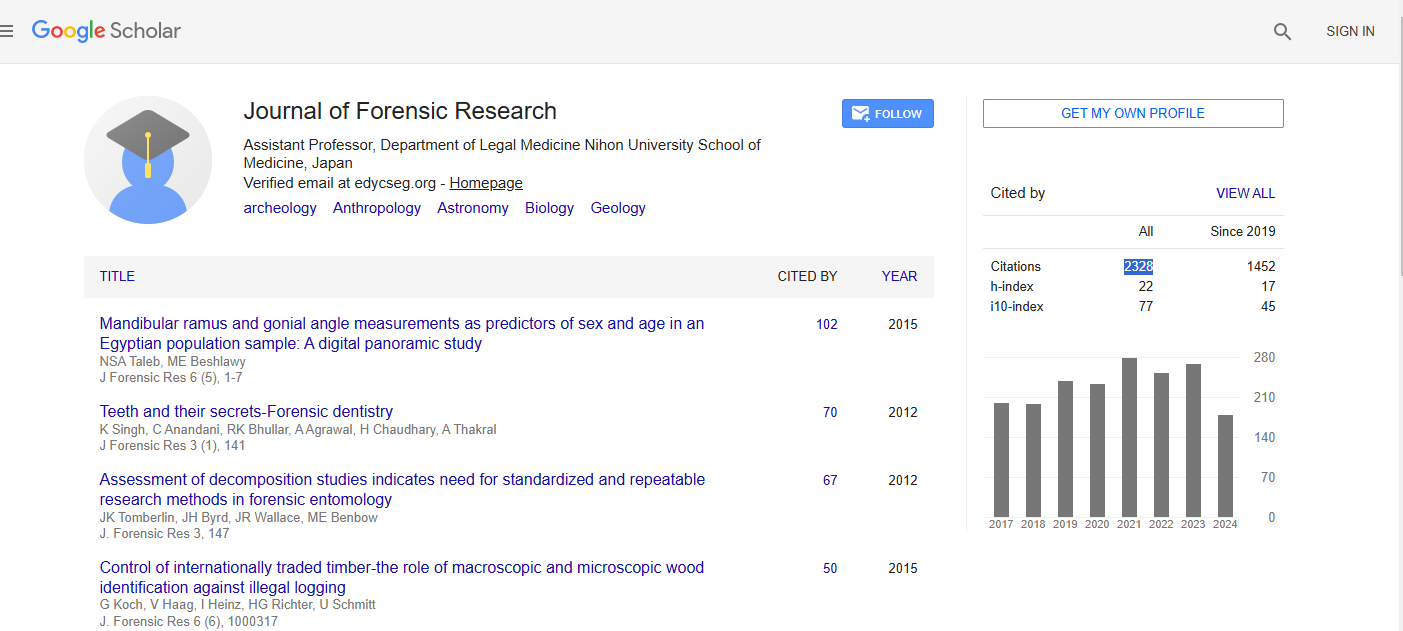
Journal of Forensic Research received 2328 citations as per Google Scholar report