Commentary - (2025) Volume 16, Issue 3
Received: 01-May-2025, Manuscript No. bej-26-182421;
Editor assigned: 05-May-2025, Pre QC No. P-182421;
Reviewed: 19-May-2025, QC No. Q-182421;
Revised: 22-May-2025, Manuscript No. R-182421;
Published:
29-May-2025
, DOI: 10.37421/2161-6219.2025.16.555
Citation: Prakash, Ravi. ”Firm Excellence Drives Macroeconomic
Prosperity: A Research Synthesis.” Bus Econ J 16 (2025):555.
Copyright: © 2025 Prakash R. This is an open-access article distributed under the terms of the Creative Commons Attribution License, which permits unrestricted use,
distribution and reproduction in any medium, provided the original author and source are credited.
This article delves into the crucial relationship between the operational practices of businesses and their broader economic impact, recognizing that the granular successes of individual firms aggregate into significant macroeconomic outcomes. The intricate interplay between how companies operate and their influence on the national and global economy is a subject of growing importance for policymakers and business leaders alike.
Understanding the micro-level efficiencies and strategic decisions within firms is paramount, as these directly translate into observable macroeconomic indicators such as GDP growth, employment levels, and inflation. The study emphasizes that the effectiveness of business practices, including optimized supply chains, judicious resource allocation, and proactive innovation, is not merely an internal concern but has far-reaching economic consequences. Policy decisions that shape the business environment, ranging from taxation to trade agreements, are therefore critical in influencing the aggregate economic performance of a nation. The research highlights how advancements in operational efficiency, such as the adoption of lean manufacturing and digital transformation, correlate with national economic indicators. When firms enhance their productivity and financial health, they inherently contribute to a nation's overall economic output and stability. This research also examines the dynamic relationship between business investment strategies and their influence on economic growth, positing that investments in R&D, capital, and human capital are key drivers. Furthermore, the study explores how supply chain resilience and efficiency impact national economic stability, demonstrating that well-managed supply chains can mitigate disruptions and reduce operational costs. Finally, the paper investigates the link between corporate governance practices and economic performance, asserting that strong governance fosters investor confidence and efficient resource allocation, which in turn supports a stable economy.This article explores the intricate relationship between how businesses operate and their overall economic impact, highlighting that efficient business practices directly influence a company's profitability and market competitiveness. These micro-level successes, when aggregated across numerous firms, contribute significantly to macroeconomic indicators like GDP growth, employment rates, and inflation. The study emphasizes that policy decisions impacting the business environment can have profound ripple effects on economic performance. Understanding this interdependence is crucial for policymakers and business leaders to foster sustainable economic development [1].
This research investigates how advancements in operational efficiency within businesses correlate with national economic indicators. It demonstrates that when firms adopt lean manufacturing, embrace digital transformation, and improve workforce productivity, they not only enhance their own financial health but also contribute to a nation's overall economic output and stability. The findings suggest that policies encouraging such operational improvements can yield substantial economic dividends, underscoring the bottom-up effect of business operations on broader economic performance [2].
This paper examines the dynamic relationship between business investment strategies and their influence on economic growth. It argues that strategic investments in research and development, capital goods, and human capital by firms are key drivers of productivity gains, innovation, and ultimately, sustained economic expansion. The study analyzes how government policies that incentivize such investments can amplify their positive economic effects, emphasizing that the health of the economy is intrinsically linked to the strategic decisions made within the business sector [3].
This article focuses on how supply chain resilience and efficiency impact national economic stability. It reveals that well-managed and robust supply chains not only reduce operational costs for businesses but also mitigate the risk of economic disruptions, such as those caused by natural disasters or geopolitical events. The research suggests that policies promoting supply chain diversification and technological integration within logistics can strengthen both individual firms and the broader economy against shocks, highlighting the critical role of operational design in economic performance [4].
This study examines the link between corporate governance practices and economic performance. It argues that strong governance mechanisms, including transparency, accountability, and ethical leadership within firms, foster investor confidence, attract capital, and promote efficient resource allocation. These factors, in turn, contribute to higher profitability for businesses and a more stable, dynamic economy overall. The research points to the necessity of robust regulatory frameworks that encourage good corporate governance to achieve broader economic prosperity [5].
This paper analyzes the impact of innovation strategies on both firm-level success and macroeconomic growth. It finds that businesses that consistently invest in and implement innovative products, processes, and business models are more likely to achieve competitive advantages and higher profits. On a larger scale, a vibrant ecosystem of innovative firms drives technological progress, boosts productivity, and creates new markets, thereby contributing significantly to economic development. The study highlights the importance of an environment that supports and rewards business innovation [6].
This research explores the relationship between financial management practices within firms and their contribution to economic stability. It demonstrates that prudent financial planning, effective risk management, and sound capital structure decisions by businesses not only enhance their own financial resilience but also reduce systemic financial risks. The study suggests that supportive financial sector policies and financial literacy initiatives can amplify these positive effects, leading to a more robust and stable economy [7].
This article investigates how human resource management strategies influence business performance and, by extension, economic outcomes. It argues that investing in employee training, development, and well-being leads to increased productivity, innovation, and employee retention within firms. These micro-level improvements contribute to a skilled workforce and a more dynamic labor market, which are essential for sustained economic growth and reduced unemployment. The study underscores the importance of people-centric operational approaches [8].
This paper examines the role of marketing and sales operations in driving economic performance. It posits that effective market analysis, customer relationship management, and innovative marketing strategies not only boost a firm's revenue and market share but also stimulate consumer demand, leading to broader economic activity. The study highlights how businesses that excel in reaching and serving their markets contribute to job creation and economic dynamism, emphasizing the interconnectedness of business outreach and economic vitality [9].
This study analyzes how operational risk management within businesses contributes to overall economic stability. It argues that proactive identification, assessment, and mitigation of operational risks by firms reduce the likelihood of business failures and financial losses. These micro-level risk reductions translate into a more stable business environment, fewer economic disruptions, and enhanced investor confidence, ultimately benefiting the broader economy. The research underscores the importance of robust risk management frameworks in achieving sustainable economic performance [10].
This compilation of research underscores the profound link between firm-level operational excellence and macroeconomic outcomes. It demonstrates that efficient business practices, strategic investments, innovation, sound financial management, robust corporate governance, effective human resource strategies, and resilient supply chains collectively contribute to a company's success. These microeconomic successes, when aggregated, drive national economic growth, stability, and overall prosperity. Policies that foster these business strengths are thus crucial for sustainable economic development. The studies highlight a bottom-up effect where improvements within individual firms have significant positive repercussions on the broader economy, influencing GDP, employment, and market dynamics.
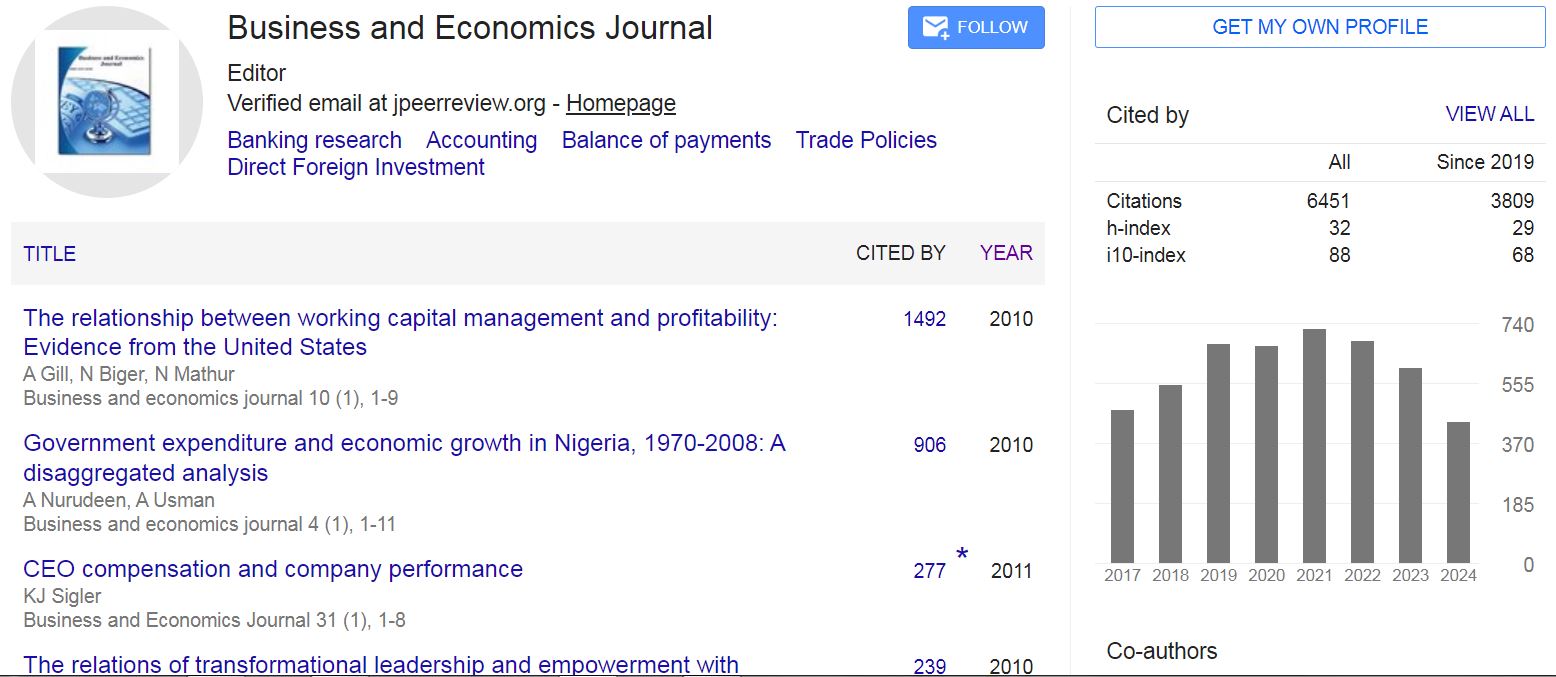
Business and Economics Journal received 6451 citations as per Google Scholar report