Opinion - (2025) Volume 16, Issue 5
Received: 01-Sep-2025, Manuscript No. bej-26-182513;
Editor assigned: 03-Sep-2025, Pre QC No. P-182513;
Reviewed: 17-Sep-2025, QC No. Q-182513;
Revised: 22-Sep-2025, Manuscript No. R-182513;
Published:
29-Sep-2025
, DOI: 10.37421/2161-6219.2025.16.577
Citation: Williams, Chloe. ”External Forces Shape Business Performance:
Adapt To Thrive.” Bus Econ J 16 (2025):577.
Copyright: © 2025 Williams C. This is an open-access article distributed under the terms of the Creative Commons Attribution License, which permits unrestricted use,
distribution and reproduction in any medium, provided the original author and source are credited.
The contemporary business landscape is characterized by dynamic and often unpredictable external forces that significantly influence organizational performance and strategic decision-making. Understanding these forces is paramount for sustained success and competitive advantage. This exploration delves into the multifaceted nature of these influences, providing insights into how businesses can navigate and adapt to the ever-changing global environment. External market forces, encompassing a broad spectrum of influences, play a pivotal role in shaping the trajectory of businesses. These forces can range from intense competition and evolving consumer demands to the dynamic landscape of regulatory changes. Companies that exhibit a strong capacity for adaptability and strategic foresight are better equipped to thrive amidst these volatilities, impacting critical areas such as product development and market entry strategies. Research consistently indicates a strong correlation between a firm's ability to anticipate and react effectively to market dynamics and its overall profitability and market share [1].
Global market forces, particularly those related to supply chain disruptions and geopolitical uncertainties, have emerged as significant factors affecting the operational efficiency and financial health of multinational corporations. The study of these impacts underscores the critical need for robust risk management frameworks and the implementation of diversified sourcing strategies to mitigate potential negative consequences on performance. The findings suggest that businesses that cultivate greater resilience within their supply chains are more likely to exhibit stable financial outcomes, even when faced with unpredictable global events [2].
Evolving consumer preferences represent another powerful external force that profoundly influences business strategy and profitability. The increasing demand for sustainable products, for instance, compels companies to re-evaluate their offerings and operational practices. Businesses that proactively align their strategies with these consumer shifts are often rewarded with a distinct competitive advantage. Research in this area demonstrates that a commitment to transparency in sourcing and production can substantially enhance brand loyalty and overall market performance [3].
Technological disruption and market saturation present formidable challenges for established businesses. In such environments, continuous innovation and strategic diversification become not merely advantageous but imperative for survival and continued growth. The findings from analyses of these phenomena suggest that firms that exhibit resistance to change or are slow to adopt new technologies frequently experience a decline in performance and a diminished market relevance, highlighting the critical need for agility [4].
The interplay between regulatory environments and business performance is particularly pronounced in nascent industries. While stringent regulations can introduce considerable challenges, well-designed regulatory frameworks possess the potential to foster innovation and cultivate stable market conditions. Proactive engagement by businesses with policymakers can significantly influence their operational landscape and contribute to long-term success, demonstrating the strategic importance of navigating regulatory complexities [5].
Competitive intensity within an industry significantly affects firm-level innovation and the strategic allocation of resources. A moderate level of competition can serve as a catalyst for innovation, spurring creativity and efficiency. However, extreme competitive intensity may precipitate destructive competition, which can ultimately have a detrimental impact on overall performance. This highlights the necessity for businesses to strategically position themselves within their respective competitive landscapes to optimize outcomes [6].
Macroeconomic factors, including inflation rates and interest rate policies, exert a substantial influence on business investment decisions and subsequent performance. Firms that maintain flexible financial structures and implement effective hedging strategies are generally better positioned to navigate macroeconomic volatility. The research clearly indicates a direct link between sound financial management practices and enhanced resilience when confronting economic fluctuations [7].
The digital market transformation, marked by the proliferation of e-commerce and the rise of platform economies, is fundamentally reshaping traditional business models. Embracing digital technologies and adapting business processes are essential for maintaining competitiveness in this evolving environment. The findings suggest that digital transformation represents more than just an operational adjustment; it is a fundamental strategic imperative that requires deep organizational commitment [8].
Shifts in labor market dynamics, such as the emergence of talent shortages and evolving skill requirements, profoundly affect organizational productivity and innovation. Proactive human resource strategies, including robust upskilling initiatives and targeted talent acquisition efforts, are critical for achieving business success. This research underscores the intricate interconnectedness between labor market conditions and overall firm performance, emphasizing the strategic importance of human capital [9].
International trade agreements and the broader trend of global economic integration exert a significant influence on firm-level competitiveness and the accessibility of markets. Businesses must strategically leverage trade policies and cultivate international partnerships to enhance their performance within an increasingly globalized marketplace. Understanding and adapting to these international market forces is therefore crucial for sustained growth and success [10].
The contemporary business environment is profoundly shaped by a complex interplay of external market forces. These forces, ranging from competitive pressures and shifts in consumer demand to evolving regulatory landscapes, significantly impact a firm's performance and strategic direction. Adaptability and proactive strategic responses are crucial for sustained success, influencing everything from product development to market entry strategies. Empirical research consistently demonstrates a strong correlation between a firm's capacity to anticipate and react to these market dynamics and its profitability and market share. This underscores the need for businesses to remain agile and responsive to external influences [1].
In the globalized economy, multinational corporations face significant challenges stemming from global market forces such as supply chain disruptions and geopolitical uncertainties. These external factors can profoundly affect operational efficiency and financial health. Consequently, the development and implementation of robust risk management frameworks, coupled with diversified sourcing strategies, are essential for mitigating adverse performance consequences. Studies indicate that businesses possessing greater resilience in their supply chains tend to exhibit more stable financial outcomes, even amidst considerable global volatility [2].
Evolving consumer preferences, particularly the growing demand for sustainable products, have become a critical driver of business strategy and profitability. Companies that proactively align their product offerings and operational practices with these shifting consumer expectations are increasingly gaining a competitive advantage. Research highlights that a strong emphasis on transparency in sourcing and production processes can significantly enhance brand loyalty and bolster overall market performance, demonstrating the strategic value of aligning with consumer values [3].
Technological disruption and market saturation present substantial challenges for established businesses, necessitating a continuous focus on innovation and strategic diversification for survival and growth. Firms that are slow to embrace technological advancements or resist necessary changes often experience a decline in performance and a loss of market relevance. This underscores the imperative for incumbents to adopt a forward-thinking approach to technology and market dynamics to maintain their competitive edge [4].
The regulatory environment plays a crucial role in shaping business performance, especially within emerging industries. While stringent regulations can introduce complexities, well-designed regulatory frameworks can act as catalysts for innovation and contribute to the establishment of stable market conditions. Businesses that proactively engage with policymakers and regulatory bodies can significantly influence their operational landscape and foster long-term success, highlighting the strategic importance of regulatory navigation [5].
Competitive intensity within an industry is a key determinant of firm-level innovation and resource allocation strategies. A moderate level of competition can stimulate innovation and drive efficiency. However, excessive competitive pressure may lead to destructive competition, negatively impacting overall performance. Therefore, businesses must strategically position themselves within their competitive landscapes to optimize their innovation efforts and resource deployment for sustained success [6].
Macroeconomic factors, including inflation rates and interest rate policies, have a direct impact on business investment decisions and subsequent financial performance. Firms that possess flexible financial structures and employ effective hedging strategies are better equipped to withstand macroeconomic volatility. The evidence points to a clear link between sound financial management and enhanced resilience in the face of economic fluctuations, emphasizing the importance of financial prudence [7].
The digital transformation of markets, characterized by the rise of e-commerce and platform economies, is fundamentally altering traditional business models. Embracing digital technologies and adapting business processes are no longer optional but essential for maintaining competitiveness. This shift represents a fundamental strategic imperative that requires organizations to undergo a comprehensive transformation, rather than merely making operational adjustments [8].
Shifts in labor market dynamics, such as talent shortages and evolving skill requirements, significantly influence organizational productivity and innovation. Proactive human resource strategies, including continuous upskilling and strategic talent acquisition, are critical for business success. This research underscores the integral connection between labor market conditions and firm performance, highlighting the strategic importance of human capital management [9].
International trade agreements and global economic integration critically impact firm-level competitiveness and market access. Businesses that strategically leverage trade policies and foster international partnerships are better positioned to enhance their performance in the global marketplace. A thorough understanding and adept adaptation to these international market forces are essential for long-term success and expanded market reach [10].
This compilation of research examines the profound impact of various external market forces on business performance. It highlights how competition, consumer demand shifts, regulatory changes, supply chain disruptions, geopolitical uncertainties, and technological advancements necessitate strategic adaptation and innovation for sustained success. The studies emphasize the importance of resilience, proactive engagement with market dynamics, and embracing digital transformation. Furthermore, evolving consumer preferences for sustainability, the strategic navigation of regulatory environments, and effective management of labor market dynamics and macroeconomic factors are identified as crucial for profitability and competitiveness. Ultimately, businesses that can effectively anticipate, adapt to, and leverage these external forces are better positioned for long-term growth and market leadership.
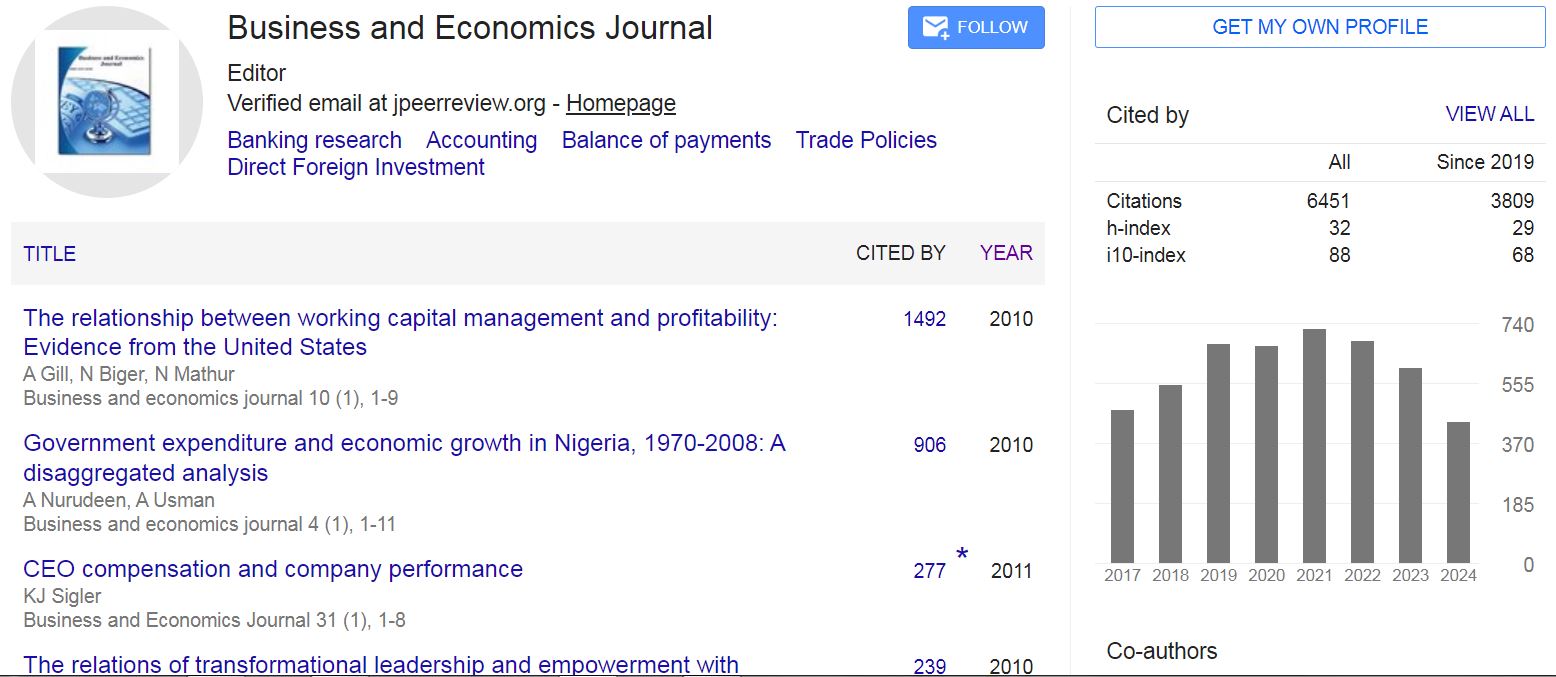
Business and Economics Journal received 6451 citations as per Google Scholar report