Opinion - (2025) Volume 11, Issue 2
Received: 01-Apr-2025, Manuscript No. jctt-26-188386;
Editor assigned: 03-Apr-2025, Pre QC No. P-188386;
Reviewed: 17-Apr-2025, QC No. Q-188386;
Revised: 22-Apr-2025, Manuscript No. R-188386;
Published:
29-Apr-2025
, DOI: 10.37421/2471-9323.2024.10.314
Citation: Dubois, Sophie. ”Exploring Hair And Scalp Health: Science And Innovation.” J Cosmo Tricho 11 (2025):314.
Copyright: © 2025 Dubois S. This is an open-access article distributed under the terms of the Creative Commons Attribution License, which permits unrestricted use, distribution and reproduction in any medium, provided the original author and source are credited.
The intricate relationship between hair and scalp health forms the foundation of modern cosmetology and dermatological inquiry, drawing upon biological mechanisms and cosmetic innovations. This field is increasingly investigating the fundamental processes governing follicular vitality and the diverse applications that aim to enhance both hair and scalp condition. Early research has illuminated the biological underpinnings of hair growth, exploring the complex signaling pathways and cellular interactions essential for a healthy hair cycle. Coupled with this foundational understanding, cosmetic science has rapidly advanced, developing sophisticated formulations to modulate these biological processes and improve aesthetic outcomes [1].
The continuous search for novel ingredients and formulations specifically designed for scalp health represents a significant frontier in cosmetic research. Studies are rigorously examining the efficacy of these new agents in bolstering the scalp's barrier function and improving overall hair quality. This focus has direct implications for the development of advanced cosmetic products, leading to more targeted and effective solutions for consumers. The scientific community is actively exploring how specific compounds can interact with the scalp's ecosystem to foster a healthier environment for hair growth [2].
Recent scientific endeavors have increasingly focused on the scalp microbiome, recognizing its profound influence on hair follicle biology and the pathogenesis of various hair disorders. Understanding the complex microbial communities residing on the scalp is opening up new avenues for both therapeutic and cosmetic interventions. The delicate balance of these microorganisms is now understood to be a key player in maintaining follicle health, and disruptions can lead to detrimental effects [3].
Furthermore, the impact of environmental factors on the integrity of both the scalp and hair is a growing area of concern and research. Studies are highlighting the critical protective and restorative roles that cosmetic formulations can play in mitigating damage caused by environmental aggressors such as pollutants and ultraviolet radiation. This research underscores the importance of safeguarding hair and scalp from external stressors [4].
The science behind advanced hair care technologies is continually evolving, incorporating cutting-edge ingredients and delivery systems. This includes the utilization of peptides, growth factors, and innovative nanocarrier systems, all designed to actively promote hair growth and significantly improve scalp conditions. These technological advancements promise more potent and targeted hair care solutions [5].
Beyond topical applications and technological advancements, the role of nutrition in maintaining healthy hair and scalp is gaining significant attention. Research is exploring the impact of essential vitamins, minerals, and proteins that are crucial for supporting follicular function and maintaining the structural integrity of hair. A well-nourished body is fundamental to healthy hair [6].
Moreover, the biological mechanisms underlying hair aging and the development of effective cosmetic treatments to counteract these effects are subjects of intense investigation. The focus is on preserving hair density, improving hair quality, and maintaining a youthful appearance of the hair and scalp. Understanding the aging process at a cellular level is key to developing effective interventions [7].
Complementary approaches to hair care, such as scalp massage, are also being scientifically examined for their effectiveness. Research is investigating the potential of scalp massage in promoting hair growth and enhancing scalp circulation, offering insights into its utility as an adjunct to traditional hair care strategies. The physical stimulation of the scalp may have beneficial effects [8].
The complexities of hair shedding and loss, common concerns for many individuals, are being explored from multiple angles. This includes a detailed discussion of the underlying causes of hair loss and the specific role that cosmetic products can play in effectively managing these conditions. A comprehensive understanding is needed for effective management [9].
Finally, the application of botanical extracts in hair and scalp care represents a long-standing tradition now being validated by scientific evidence. This area of research highlights the antioxidant, anti-inflammatory, and hair growth-promoting properties of various plant-derived compounds, supporting their use in cosmetic applications. Nature continues to provide valuable resources for hair care [10].
The exploration of hair and scalp health is deeply rooted in understanding the fundamental biological processes that govern follicular vitality, complemented by the continuous innovation in cosmetic applications designed to enhance both. This research delves into the biological basis of hair growth, investigating the intricate mechanisms that sustain a healthy hair cycle and exploring how cosmetic interventions can effectively modulate these processes for improved outcomes. The synergy between biological understanding and cosmetic application is paramount in addressing concerns related to hair and scalp well-being [1].
A significant area of focus within cosmetic science involves the investigation of novel ingredients and formulations specifically engineered for scalp health. These studies rigorously assess the efficacy of new agents in strengthening the scalp's natural barrier function and elevating the quality of hair. The findings from such research directly inform the development of next-generation cosmetic products, offering more targeted and effective solutions for a wide range of scalp and hair concerns [2].
The scalp microbiome has emerged as a critical area of scientific interest, recognized for its substantial impact on the health of hair follicles and the development of hair-related disorders. Research is actively working to elucidate the roles of these microbial communities, uncovering new therapeutic and cosmetic strategies. Understanding the complex interplay between the scalp's resident microbes and hair follicle biology is proving to be a key to unlocking innovative treatments [3].
Environmental factors exert a considerable influence on the health of both the scalp and hair, making their impact a vital subject of study. Investigations are increasingly emphasizing the protective and restorative capabilities of cosmetic formulations in counteracting the damage induced by environmental stressors, including pollutants and ultraviolet radiation. This highlights the necessity of robust cosmetic strategies for environmental defense [4].
Advancements in hair care technology are rapidly transforming the landscape of hair and scalp treatments. This field encompasses the use of sophisticated ingredients and delivery systems, such as peptides, growth factors, and nanocarriers, which are engineered to stimulate hair growth and ameliorate scalp conditions. These innovations represent a significant leap forward in the efficacy of hair care products [5].
The nutritional aspect of hair health is an increasingly recognized determinant of follicular function and hair structure. Research is exploring the essential roles of various vitamins, minerals, and proteins that are indispensable for supporting robust hair growth and maintaining the physical integrity of hair strands. Adequate nutrition is fundamental to healthy hair [6].
In parallel with growth and nutrition, the study of hair aging and the development of cosmetic interventions to mitigate its effects are gaining prominence. This research aims to understand the biological mechanisms of hair aging and to formulate treatments that can help preserve hair density and improve its overall quality, addressing age-related concerns effectively [7].
Complementary techniques, such as scalp massage, are also being evaluated for their potential benefits in hair care. Scientific reviews are examining the evidence linking scalp massage to increased hair growth and improved scalp circulation, positioning it as a potentially valuable adjunct to established hair care regimens. The physical stimulation of the scalp is an area of growing interest [8].
The complex issue of hair shedding and loss is being approached from a comprehensive perspective, encompassing its myriad causes and the role of cosmetic interventions in its management. This research provides a deeper understanding of the factors contributing to hair loss and outlines how cosmetic products can be effectively utilized to address these concerns. Managing hair shedding requires a multifaceted approach [9].
Lastly, the utilization of botanical extracts in hair and scalp care, a practice with historical roots, is being scientifically validated for its efficacy. This research highlights the valuable antioxidant, anti-inflammatory, and hair growth-promoting properties inherent in various plant-derived compounds, thereby supporting their integration into modern cosmetic applications. Natural ingredients continue to offer significant benefits for hair health [10].
This collection of research underscores the multifaceted approach to understanding and enhancing hair and scalp health. It explores the biological underpinnings of hair growth, investigates novel cosmetic ingredients and their efficacy on scalp barrier function, and examines the crucial role of the scalp microbiome. Environmental factors and their impact are discussed, alongside advancements in hair care technologies like peptides and nanocarriers. The importance of nutrition for follicular health and the science behind addressing hair aging are highlighted. Additionally, the potential benefits of scalp massage, strategies for managing hair shedding, and the application of botanical extracts in hair care are reviewed. Collectively, these studies provide a comprehensive view of current research and development in the field of hair and scalp wellness.
None
None
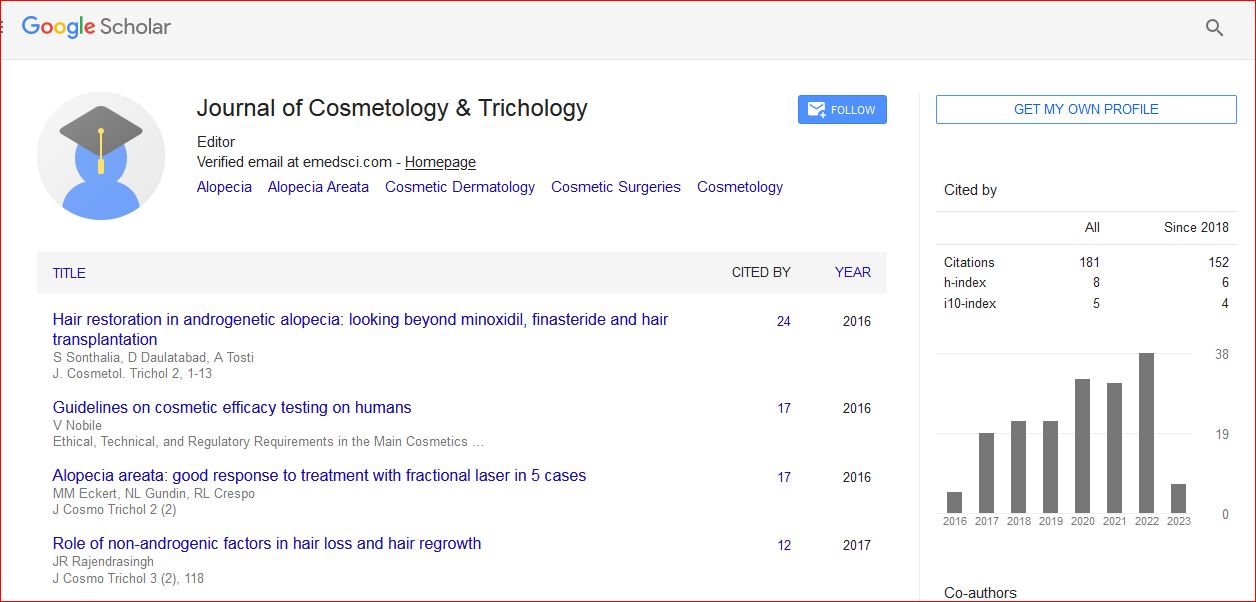
Journal of Cosmetology & Trichology received 180 citations as per Google Scholar report