Short Communication - (2025) Volume 9, Issue 3
Received: 01-May-2025, Manuscript No. jchd-26-185693;
Editor assigned: 04-May-2025, Pre QC No. P-185693;
Reviewed: 18-May-2025, QC No. Q-185693;
Revised: 22-May-2025, Manuscript No. R-185693;
Published:
29-May-2025
, DOI: 10.37421/2684-6020.2024.9.249
Citation: Johansson, Sophia. ”Evolving Coronary Heart Disease
Management: Personalized, Novel Therapies.” J Coron Heart Dis 09 (2025):249.
Copyright: © 2025 Johansson S. This is an open-access article distributed under the terms of the Creative Commons Attribution License, which permits unrestricted use,
distribution and reproduction in any medium, provided the original author and source are credited.
Recent advancements in the understanding and management of coronary heart disease (CHD) have ushered in a new era of personalized cardiovascular care, emphasizing proactive risk assessment and tailored therapeutic interventions. The growing importance of personalized risk assessment, which leverages a combination of genetic predispositions and modifiable lifestyle factors, is a cornerstone of modern CHD prevention strategies [1].
Further exploration into the intricate role of inflammation in the pathogenesis of atherosclerosis has revealed novel therapeutic targets. By specifically targeting inflammatory pathways, clinicians aim to significantly reduce the incidence of cardiovascular events, suggesting a paradigm shift that extends beyond traditional lipid-lowering approaches for high-risk individuals [2].
The efficacy and safety profiles of PCSK9 inhibitors have been extensively investigated across a broad spectrum of patient populations, including those with genetic predispositions like familial hypercholesterolemia and individuals experiencing statin intolerance. These agents have demonstrated a substantial impact on reducing low-density lipoprotein cholesterol levels and, consequently, cardiovascular events, solidifying their place in aggressive lipid management [3].
Concurrently, significant strides have been made in non-invasive imaging techniques for assessing coronary artery disease (CAD). Technologies such as advanced computed tomography angiography (CTA) and cardiac magnetic resonance imaging (CMR) now offer enhanced diagnostic accuracy and valuable prognostic information, facilitating earlier and more precise clinical interventions [4].
The genetic underpinnings of CHD are being increasingly elucidated, with polygenic risk scores (PRS) emerging as powerful tools for identifying individuals with a heightened susceptibility. The potential to integrate this genetic information into clinical practice holds promise for developing highly personalized prevention strategies [5].
Beyond the widely recognized impact of diet and exercise, a more holistic view of lifestyle modifications is gaining traction. The influence of factors such as sleep quality, stress management techniques, and the broader social determinants of health on cardiovascular well-being is now being recognized as crucial for comprehensive CHD prevention [6].
In parallel, the development and validation of advanced biomarkers are revolutionizing the early detection and risk stratification of CHD. Novel markers, extending beyond traditional lipid profiles and high-sensitivity C-reactive protein (hs-CRP), including insights from proteomics and metabolomics, are poised to refine risk prediction models [7].
Addressing the secondary prevention of CHD remains a critical challenge, with ongoing evaluation of current guideline-recommended therapies. Strategies to enhance patient adherence and minimize recurrent cardiovascular events, particularly within vulnerable patient cohorts, are central to improving long-term outcomes [8].
The management of acute coronary syndromes (ACS) continues to evolve, with a strong emphasis on the synergistic integration of antithrombotic therapies and timely revascularization strategies. This comprehensive approach aims to optimize survival and enhance the quality of life for affected individuals [9].
Finally, the complex interplay between mental health and cardiovascular disease is receiving increased attention. The bidirectional relationship between conditions such as depression and anxiety and the development or exacerbation of CHD underscores the necessity of integrated care models that address both physical and psychological aspects of patient well-being [10].
The current landscape of coronary heart disease (CHD) management is marked by a paradigm shift towards personalized medicine, integrating genetic insights and lifestyle data for precise risk assessment. This approach acknowledges that individual susceptibility to CHD is influenced by a complex interplay of factors, moving beyond generalized risk models [1].
Inflammation's pivotal role in the development and progression of atherosclerosis is a key area of ongoing research, with a focus on how modulating specific inflammatory pathways can significantly reduce cardiovascular morbidity and mortality. Recent clinical trials examining anti-inflammatory agents suggest a new therapeutic avenue for high-risk patients, complementing established lipid-lowering strategies [2].
PCSK9 inhibitors have emerged as a powerful class of drugs for aggressive lipid management, demonstrating remarkable efficacy in lowering LDL cholesterol levels and reducing cardiovascular events across diverse patient groups, including those with familial hypercholesterolemia and statin intolerance [3].
The advancement of non-invasive imaging modalities, such as high-resolution CT angiography and cardiac MRI, provides clinicians with unprecedented capabilities for diagnosing and characterizing coronary artery disease. These technologies enhance diagnostic accuracy and offer crucial prognostic information, enabling more timely and targeted interventions [4].
Genetic risk stratification using polygenic risk scores (PRS) is becoming increasingly sophisticated, offering a means to identify individuals at significantly elevated risk for CHD, even in the absence of traditional risk factors. This genetic information is poised to play a crucial role in tailoring primary prevention strategies [5].
A broader understanding of lifestyle's impact on cardiovascular health includes factors beyond diet and exercise. The influence of sleep, stress, and social determinants of health is being recognized as integral to a comprehensive approach to preventing and managing CHD [6].
The utility of advanced biomarkers in refining risk prediction for CHD is a rapidly evolving field. Novel molecular markers identified through proteomic and metabolomic analyses hold the potential to improve early detection and risk stratification beyond current clinical standards [7].
Strategies for secondary prevention of CHD are continually being optimized to improve patient outcomes and reduce the risk of recurrent events. Enhancing adherence to evidence-based therapies and developing targeted interventions for high-risk populations remain key objectives [8].
The management of acute coronary syndromes (ACS) is characterized by the coordinated application of antithrombotic therapies and prompt revascularization, aiming to minimize myocardial damage and improve long-term survival. Ongoing research focuses on optimizing these treatment pathways [9].
The profound connection between mental health conditions like depression and anxiety, and cardiovascular disease is increasingly evident. Recognizing this bidirectional relationship highlights the importance of integrated care models that address the holistic well-being of patients [10].
Coronary heart disease (CHD) management is rapidly evolving with advancements in personalized risk assessment utilizing genetic and lifestyle data. Novel therapeutic strategies, including PCSK9 inhibitors and anti-inflammatory approaches, are improving patient outcomes. Early detection is enhanced by advanced imaging techniques and novel biomarkers. Lifestyle modifications beyond diet and exercise, such as sleep and stress management, are recognized for their cardiovascular benefits. Genetic risk scores are aiding in identifying high-risk individuals for tailored prevention. Secondary prevention strategies aim to reduce recurrent events, while the management of acute coronary syndromes emphasizes timely interventions. The bidirectional relationship between mental health and CHD underscores the need for integrated care.
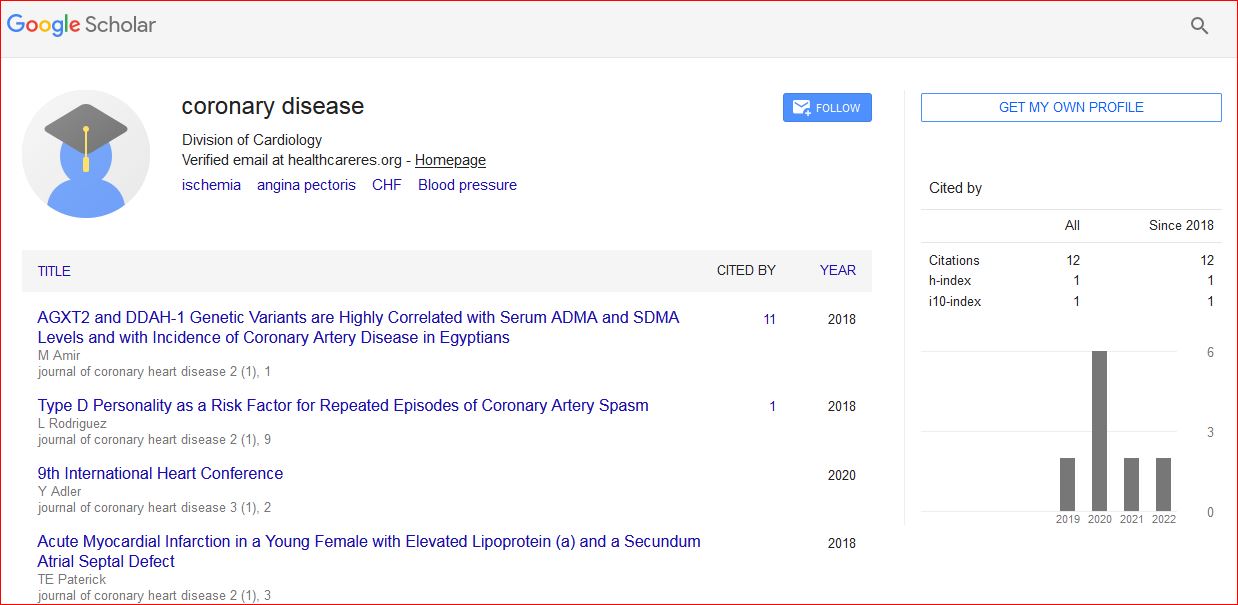
Journal of Coronary Heart Diseases received 15 citations as per Google Scholar report