Brief Report - (2025) Volume 15, Issue 6
Received: 02-Dec-2025, Manuscript No. jeat-26-188661;
Editor assigned: 04-Dec-2025, Pre QC No. P-188661;
Reviewed: 18-Dec-2025, QC No. Q-188661;
Revised: 23-Dec-2025, Manuscript No. R-188661;
Published:
30-Dec-2025
, DOI: 10.37421/2161-0525.2025.15.881
Citation: Kovalenko, Natalia. ”Environmental Toxicology: Understanding
Contaminant Impacts, Risks.” J Environ Anal Toxicol 15 (2025):881.
Copyright: © 2025 Kovalenko N. This is an open-access article distributed under the terms of the Creative Commons Attribution License, which permits unrestricted use,
distribution and reproduction in any medium, provided the original author and source are credited.
The escalating global burden of environmental pollutants poses a significant and multifaceted threat to both public health and ecological integrity. Understanding the complex interactions between various contaminants and biological systems is paramount for developing effective mitigation and management strategies. The intricate relationship between environmental pollutants and their toxicological impacts necessitates robust risk assessment frameworks to safeguard health and ecosystems [1].
Persistent organic pollutants (POPs) represent a class of chemicals that are resistant to environmental degradation, leading to their widespread presence and potential for bioaccumulation [2].
Heavy metals, often released from industrial activities, exert detrimental ecotoxicological effects on soil microbial communities, disrupting essential ecosystem functions and long-term soil health [3].
Emerging contaminants, such as those detected by novel biosensors, present new challenges for water quality management and public health protection due to their continuously evolving nature [4].
Microplastics, ubiquitous in the environment, are increasingly recognized as a potential risk to human health, with ongoing research exploring their toxicological effects within the food chain [5].
Plasticizers, commonly found in plastic products, have raised concerns regarding their environmental persistence, bioaccumulation, and potential endocrine-disrupting properties, impacting both wildlife and human health [6].
Biomonitoring of airborne pollutants offers a crucial approach to assess human exposure and health risks associated with particulate matter and volatile organic compounds, aiding in the evaluation of air quality control measures [7].
Per- and polyfluoroalkyl substances (PFAS) are a group of synthetic chemicals with widespread industrial applications, and their toxicological profile in occupational settings is under scrutiny, highlighting the need for stringent safety guidelines [8].
Polycyclic aromatic hydrocarbons (PAHs) are common environmental contaminants with known genotoxic effects, necessitating advanced molecular techniques to assess DNA damage and understand their carcinogenic potential in exposed organisms and contaminated sites [9].
The study of environmental toxicology and risk assessment is critical for bridging the gap between scientific understanding and effective policy-making, emphasizing the importance of exposure pathways and dose-response relationships for public and ecological health [1].
Advancements in analytical chemistry, particularly in chromatography and mass spectrometry, are crucial for the sensitive and specific detection of persistent organic pollutants (POPs) in aquatic ecosystems, thereby enabling better environmental quality monitoring and remediation [2].
The ecotoxicological effects of heavy metals on soil microbial communities are being investigated to understand their impact on vital ecosystem functions, providing insights into the long-term consequences of industrial pollution on soil health and biodiversity [3].
Novel biosensors are being developed for the rapid detection of emerging contaminants in drinking water, utilizing biomimetic materials to create sensitive platforms for proactive water quality management and public health protection [4].
Human health risks associated with microplastic exposure in the food chain are being assessed, reviewing current knowledge on ingestion pathways and potential toxicological effects, underscoring the need for further research into long-term health implications [5].
The environmental fate and toxicological effects of plasticizers are being explored, examining their persistence, bioaccumulation, and endocrine-disrupting properties, with a call for regulation to mitigate risks to wildlife and human health [6].
Biomonitoring of airborne pollutants utilizes biological samples to assess exposure to particulate matter and volatile organic compounds, focusing on the development of biomarkers for health risk assessment and the evaluation of air quality control measures [7].
The toxicological profile of per- and polyfluoroalkyl substances (PFAS) in occupational settings is being examined, assessing exposure levels and potential health outcomes among workers, emphasizing the need for improved industrial hygiene practices [8].
Genotoxic effects of polycyclic aromatic hydrocarbons (PAHs) in environmental samples are being investigated using advanced molecular techniques to assess DNA damage and inform risk management strategies for contaminated sites, particularly concerning their carcinogenic potential [9].
Risks posed by endocrine-disrupting chemicals (EDCs) in agricultural runoff, including pesticides and pharmaceuticals, are being assessed for their impact on aquatic organisms, highlighting the need for sustainable agricultural practices to minimize water contamination [10].
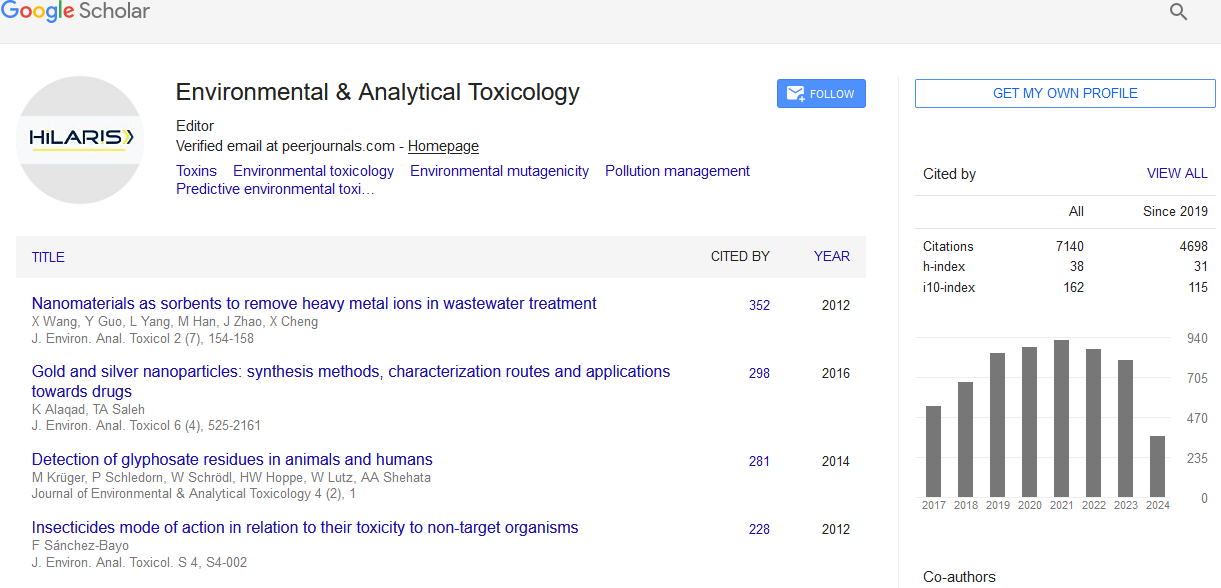
Environmental & Analytical Toxicology received 6818 citations as per Google Scholar report