Opinion - (2025) Volume 15, Issue 3
Received: 02-Jun-2025, Manuscript No. jeat-26-188627;
Editor assigned: 04-Jun-2025, Pre QC No. P-188627;
Reviewed: 18-Jun-2025, QC No. Q-188627;
Revised: 23-Jun-2025, Manuscript No. R-188627;
Published:
30-Jun-2025
, DOI: 10.37421/2161-0525.2025.15.852
Citation: Tanaka, Hiroshi. ”Endocrine Disruptors: Environmental
Threats, Health Impacts, and Solutions.” J Environ Anal Toxicol 15 (2025):852.
Copyright: © 2025 Tanaka H. This is an open-access article distributed under the terms of the Creative Commons Attribution License, which permits unrestricted use,
distribution and reproduction in any medium, provided the original author and source are credited.
The pervasive presence of endocrine-disrupting chemicals (EDCs) in our environment poses a significant toxicological threat, prompting extensive research into their widespread exposure and long-term health consequences, particularly concerning hormonal systems. The challenges in accurately detecting and quantifying these substances at minute concentrations necessitate the development and application of robust analytical methods and sophisticated toxicological assays to elucidate their mechanisms of action and potential adverse effects. Environmental contamination and human health are intricately linked, underscoring the urgent need for stringent regulations and proactive strategies to mitigate the risks associated with EDCs, including developmental, reproductive, and metabolic disorders [1].
Specific classes of EDCs, such as bisphenols (BPs), have been identified in various environmental matrices, raising concerns about their interference with crucial biological processes. Toxicological assessments have explored how BPs can disrupt thyroid hormone signaling and compromise reproductive development in both wildlife and potentially human populations. The efficacy of advanced analytical techniques, including liquid chromatography-tandem mass spectrometry (LC-MS/MS), in detecting trace levels of BPs is a subject of ongoing investigation, reinforcing the demand for biomonitoring and epidemiological studies to establish clearer correlations between exposure and health outcomes, thereby driving policy reforms for improved chemical management [2].
The impact of per- and polyfluoroalkyl substances (PFAS) on the endocrine system is another area of critical concern, given their environmental persistence and propensity to bioaccumulate. These substances can lead to significant disruptions in steroid hormone production and function. Current toxicological studies emphasize the necessity for comprehensive risk assessments that account for the cumulative effects of various PFAS compounds. Methodologies for sample preparation and analysis, utilizing techniques like GC-MS/MS and LC-MS/MS, are continually being evaluated to enhance detection limits and analytical accuracy in understanding the risks posed by PFAS [3].
Assessing the combined effects of multiple EDCs, a phenomenon known as mixture toxicity, presents substantial challenges. While low doses of individual EDCs may exhibit minimal impact, their co-occurrence in the environment can trigger synergistic or additive toxicological responses. These complex interactions can particularly affect reproductive health and metabolic processes. Advanced computational and in vitro methods, including high-throughput screening and omics technologies, are being developed and employed to unravel these intricate relationships and inform environmental monitoring strategies that account for EDC mixtures [4].
Phthalates, a common group of EDCs found in numerous consumer products, are frequently released into the environment, leading to widespread contamination. Toxicological evaluations have highlighted their role in disrupting steroidogenesis and negatively impacting developmental outcomes, especially during critical early life stages. Advances in analytical techniques for phthalate detection in both environmental and biological samples are improving, with a focus on miniaturized and rapid analysis, thereby supporting calls for increased public awareness and regulatory interventions to curb exposure from everyday sources [5].
Organophosphate pesticides (OPPs), beyond their recognized neurotoxicity, exert significant effects on the endocrine system. Toxicological studies have demonstrated their capacity to interfere with the regulation of thyroid and reproductive hormones. Challenges in environmental monitoring of OPPs arise from the variability in their usage patterns and degradation rates. An integrated approach to risk assessment is advocated, one that encompasses both acute and chronic endocrine-disrupting effects alongside conventional toxicity endpoints, to provide a more holistic understanding of OPP risks [6].
Microplastics have emerged as potential vectors for EDCs in aquatic environments, with EDCs readily sorbing onto their surfaces. This interaction increases the bioavailability of EDCs, enhancing their potential for uptake by aquatic organisms and consequently leading to toxicological implications for endocrine disruption. Effects on reproduction and development in marine life are of particular concern. The development of advanced analytical techniques capable of simultaneously measuring microplastics and their associated EDCs in complex environmental samples is crucial for effective monitoring and risk assessment [7].
Flame retardants, especially brominated flame retardants (BFRs), are recognized for their persistence, bioaccumulation, and endocrine-disrupting potential. They are known to interfere with thyroid hormone homeostasis and reproductive function. Significant challenges persist in developing comprehensive analytical methods for the vast array of BFR congeners and their degradation products. Global regulatory efforts aimed at phasing out harmful BFRs and promoting safer alternatives are highlighted as essential for mitigating these risks [8].
Significant advancements in analytical methodologies are enhancing the detection and quantification of EDCs in environmental and biological samples. Techniques such as liquid chromatography-high-resolution mass spectrometry (LC-HRMS) and gas chromatography-high-resolution mass spectrometry (GC-HRMS) offer increased sensitivity and specificity, enabling the identification of previously undetected compounds and low-level exposures. These analytical improvements are crucial for understanding dose-response relationships and cumulative exposure effects, although challenges related to matrix effects and the need for standardized protocols remain [9].
Emerging EDCs, including pharmaceuticals and personal care products (PPCPs), are increasingly detected in wastewater effluents and natural waters, posing risks to aquatic ecosystems. These compounds have the potential to disrupt endocrine functions in aquatic organisms, leading to reproductive impairment and developmental abnormalities. The need for enhanced wastewater treatment technologies and the development of green chemistry alternatives is emphasized as a critical strategy to reduce the release of these pervasive contaminants into the environment and protect aquatic life [10].
Endocrine-disrupting chemicals (EDCs) represent a critical environmental and public health concern due to their widespread presence and ability to interfere with hormonal systems. The toxicological impact of these substances, ranging from developmental and reproductive disorders to metabolic imbalances, necessitates robust analytical and assessment strategies. The review of EDCs in the environment highlights the challenges in detecting these compounds at low concentrations and understanding their long-term health effects. This underscores the importance of developing sophisticated analytical techniques and toxicological assays to comprehensively evaluate their risks. The interconnectedness of environmental contamination and human health mandates the implementation of stricter regulations and proactive risk management approaches to mitigate the adverse consequences of EDC exposure [1].
Bisphenols (BPs) are a specific category of EDCs frequently found in diverse environmental settings. Their toxicological profile indicates a potential to disrupt thyroid hormone signaling and impact reproductive development in various organisms, including humans. The application of advanced analytical methods, such as LC-MS/MS, is crucial for the accurate detection of BPs at trace levels. This emphasizes the ongoing need for biomonitoring programs and epidemiological research to establish definitive links between BP exposure and health outcomes, thereby informing policy decisions for better chemical management [2].
Per- and polyfluoroalkyl substances (PFAS) are recognized for their environmental persistence and tendency to accumulate in biological tissues, posing a significant threat to endocrine function. Their potential to disrupt steroid hormone production and function requires thorough investigation. Current toxicological studies on PFAS stress the importance of comprehensive risk assessments that consider the cumulative effects of different compounds. Critically evaluating analytical methodologies, including GC-MS/MS and LC-MS/MS, is essential for improving detection limits and ensuring accurate quantification of PFAS in various matrices [3].
The assessment of mixture toxicity, which involves understanding the combined effects of multiple EDCs, presents a complex scientific challenge. While individual EDCs at low doses may not elicit significant adverse effects, their concurrent presence can lead to synergistic or additive toxicological outcomes, particularly impacting reproductive health and metabolic functions. The development and application of advanced computational and in vitro methods, such as high-throughput screening and omics technologies, are vital for characterizing these complex interactions and guiding environmental monitoring efforts to consider EDC mixtures [4].
Phthalates are a pervasive class of EDCs commonly found in consumer products and readily released into the environment. Toxicological assessments reveal their capacity to disrupt steroidogenesis and negatively influence developmental processes, especially during sensitive early life stages. Advances in analytical techniques for detecting phthalates in environmental and biological samples are continuously being made, with a growing emphasis on miniaturized and rapid analysis. These developments support increased public awareness and the implementation of regulatory actions to reduce exposure from common sources [5].
Organophosphate pesticides (OPPs) are known for their neurotoxic effects but also exert considerable influence on the endocrine system. Toxicological studies have documented their interference with the regulation of thyroid and reproductive hormones. Environmental monitoring of OPPs is complicated by their variable usage and degradation patterns. A more integrated approach to risk assessment, encompassing both acute and chronic endocrine-disrupting effects alongside traditional toxicity endpoints, is advocated for a comprehensive understanding of OPP-related risks [6].
Microplastics have been identified as significant carriers of EDCs in aquatic ecosystems. The adsorption of EDCs onto microplastic surfaces enhances their bioavailability and increases the likelihood of uptake by aquatic organisms. This phenomenon has serious toxicological implications for endocrine disruption in marine life, particularly affecting reproductive and developmental processes. The development of sophisticated analytical techniques for simultaneous detection of microplastics and associated EDCs in environmental samples is crucial for effective risk assessment and management [7].
Brominated flame retardants (BFRs) are a class of chemicals with significant environmental persistence, bioaccumulation potential, and endocrine-disrupting properties. They are known to interfere with thyroid hormone homeostasis and reproductive function. The analytical challenges associated with quantifying the diverse array of BFR congeners and their transformation products are substantial. Global efforts to phase out hazardous BFRs and promote safer alternatives are paramount for mitigating their widespread environmental and health impacts [8].
Substantial progress has been made in analytical methodologies for the detection and quantification of EDCs. Techniques like LC-HRMS and GC-HRMS have significantly improved sensitivity and specificity, allowing for the identification of previously undetected compounds and assessment of low-level exposures. These analytical advancements are critical for establishing accurate dose-response relationships and understanding cumulative exposures. However, challenges such as matrix effects and the need for standardized analytical protocols persist, requiring ongoing research and development [9].
Emerging contaminants, particularly pharmaceuticals and personal care products (PPCPs), represent a growing concern as EDCs in aquatic environments. Their widespread presence in wastewater effluents and natural waters has been linked to disruptions in endocrine functions of aquatic organisms, leading to reproductive impairment and developmental abnormalities. Addressing this issue requires improved wastewater treatment technologies and the proactive development of green chemistry alternatives to minimize the release of these persistent pollutants and protect aquatic ecosystems [10].
This collection of research highlights the critical issue of endocrine-disrupting chemicals (EDCs) in the environment and their toxicological impacts. EDCs, including bisphenols, PFAS, phthalates, organophosphate pesticides, flame retardants, and emerging contaminants like PPCPs, are pervasive and can interfere with hormonal systems, leading to developmental, reproductive, and metabolic disorders. Advanced analytical techniques are crucial for their detection and quantification, while assessing mixture toxicity and understanding long-term effects remain significant challenges. Microplastics are identified as potential vectors for EDCs in aquatic environments. The research emphasizes the need for stricter regulations, improved wastewater treatment, and the development of safer alternatives to mitigate the risks associated with EDC exposure and protect both human and environmental health.
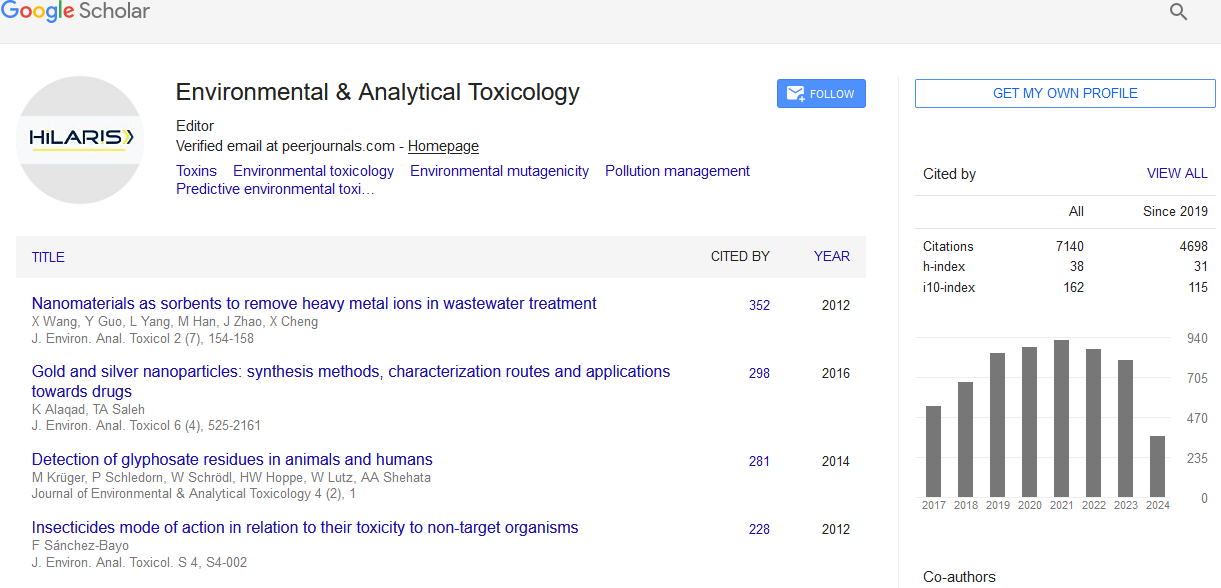
Environmental & Analytical Toxicology received 6818 citations as per Google Scholar report