Perspective - (2025) Volume 16, Issue 3
Received: 02-Jun-2025, Manuscript No. jar-25-176623;
Editor assigned: 04-Jun-2025, Pre QC No. P-176623;
Reviewed: 18-Jun-2025, QC No. Q-176623;
Revised: 23-Jun-2025, Manuscript No. R-176623;
Published:
30-Jun-2025
, DOI: 10.37421/2155-6113.2025.16.1068
Citation: Mwangi, John. ”Eliminating HIV-1 Reservoirs: Diverse
Cure Strategies.” J AIDS Clin Res 16 (2025):1068.
Copyright: © 2025 Mwangi J. This is an open-access article distributed under the terms of the Creative Commons Attribution License, which permits unrestricted use,
distribution and reproduction in any medium, provided the original author and source are credited.
Efforts to cure HIV-1 continue to be a major scientific endeavor, primarily due to the persistence of latent viral reservoirs that evade antiretroviral therapy. A widely studied approach to address this challenge is the 'Kick and Kill' strategy. This method involves a 'Kick' phase designed to reactivate dormant proviruses, making previously hidden infected cells visible to the immune system or targeted antiretroviral drugs. The subsequent 'Kill' phase then aims to eliminate these reactivated cells [1].
Advancing HIV-1 cure strategies inherently hinges on two main objectives: reactivating these latent viral reservoirs and significantly enhancing the clearance of the now-visible infected cells [4].
Latency-reversing agents (LRAs) are crucial components of these 'shock and kill' strategies. These agents aim to awaken dormant HIV-1 proviruses within latent reservoirs, with current LRAs including histone deacetylase inhibitors, protein kinase C agonists, and various immune modulators. The central challenges involve achieving robust latency reversal in living systems and then effectively combining LRAs with immune effector mechanisms to eliminate reactivated cells, ultimately aiming for a sustained HIV cure [8].
Beyond strategies centered on latency reversal, broadly neutralizing antibodies (bNAbs) offer another promising avenue for achieving HIV-1 remission. These antibodies can directly target and neutralize a wide range of HIV-1 strains, potentially reducing the viral reservoir, enhancing immune responses against infected cells, and providing long-term viral control. Their utility extends to both prevention and therapeutic cure regimens, with ongoing clinical trials assessing their efficacy either alone or in combination with other interventions [2].
By targeting conserved regions on the viral envelope, bNAbs potently block infection and also mediate Fc-dependent effector functions that aid in the elimination of infected cells. These tools are being evaluated for pre-exposure prophylaxis, passive immunization, and as part of combination therapies to reduce the viral reservoir and achieve ART-free remission [5].
Gene editing technologies, particularly CRISPR-Cas9, are also gaining considerable traction as a potential strategy to eliminate HIV-1 infection. This innovative approach directly targets and excises the integrated proviral DNA from host cell genomes. The promise of gene editing lies in its capacity for a permanent cure by physically removing the source of latency. Ongoing research in this area focuses on optimizing delivery methods, ensuring specificity to avoid off-target effects, and rigorously assessing the efficacy of CRISPR-Cas9 in clearing the diverse cellular and anatomical HIV reservoirs [3].
Immunotherapy is emerging as a cornerstone of modern HIV-1 cure research, emphasizing the enhancement of the host's own immune system to control or eliminate the virus [7].
One specific immunotherapeutic approach involves immune checkpoint blockade. This strategy investigates targeting HIV-1 reservoirs by blocking inhibitory checkpoints like PD-1, thereby aiming to reinvigorate exhausted T cells. Reinvigorated T cells would then be better equipped to recognize and clear HIV-infected cells that have been reactivated from latency. While promising, this approach requires careful consideration of potential immune-related adverse events and optimal combinations with latency-reversing agents to maximize efficacy and safety [6].
Recent breakthroughs in immunotherapy encompass a range of approaches, including therapeutic vaccines, immune checkpoint inhibitors, and adoptive cell therapies, all with the goal of inducing robust, sustained antiviral immunity capable of clearing productively infected cells and managing reactivated reservoir cells, leading to ART-free remission or eradication [7].
Acknowledging that single interventions are unlikely to be sufficient, researchers are increasingly exploring combination immunotherapy to eradicate the HIV-1 latent reservoir. These strategies aim to synergistically combine latency-reversing agents with various immune-enhancing therapies, such as therapeutic vaccines, broadly neutralizing antibodies, or CAR T-cells. The ultimate goal is to generate a powerful, multi-pronged attack that can effectively expose and eliminate HIV-infected cells, leading to a durable ART-free remission [9].
Moving beyond the traditional 'kick and kill' paradigm, novel strategies for targeting HIV-1 latent reservoirs are being developed. These advanced approaches include 'block and lock,' which seeks to permanently silence the provirus, 'shock and edit,' which combines latency reversal with gene editing, and various cell-based therapies like engineered T cells. This ongoing discussion highlights the critical need for innovative methods that can overcome the limitations of current strategies, offering more precise and durable solutions for reservoir elimination and ultimately, an HIV cure [10].
Current HIV-1 cure research heavily focuses on eliminating the latent viral reservoir, a major barrier to eradication. A cornerstone strategy is the 'Kick and Kill' approach, which involves reactivating dormant proviruses to make infected cells visible, followed by their elimination. The 'Kick' phase specifically aims to rouse latent HIV, making these previously hidden cells targets for either the immune system or antiretroviral drugs. The subsequent 'Kill' phase then works to clear these reactivated cells from the body. Challenges inherent to this strategy include achieving effective reactivation of a significant portion of the reservoir and ensuring the efficient and precise clearance of these reactivated cells without causing harm to uninfected cells. Recent research continues to refine latency-reversing agents (LRAs) and develop potent immune-mediated clearance mechanisms to address these hurdles [1]. Advancements in understanding the molecular mechanisms of latency and the development of novel LRAs are central to these efforts, alongside strategies to bolster host immunity, such as therapeutic vaccines or immune checkpoint inhibitors, aiming for sustained virologic remission without daily antiretrovirals [4]. Latency-reversing agents are considered crucial components of 'shock and kill' strategies, encompassing classes like histone deacetylase inhibitors, protein kinase C agonists, and immune modulators. The ongoing research focuses on their mechanisms, overcoming limitations in vivo, and effectively combining them with immune effector mechanisms for a sustained cure [8].
Broadly neutralizing antibodies (bNAbs) represent a promising and versatile tool in HIV-1 remission strategies, moving beyond traditional antiretroviral therapy. These antibodies are notable for their ability to directly target and neutralize a wide array of HIV-1 strains. Their potential utility spans reducing the viral reservoir, enhancing immune responses directed against infected cells, and facilitating long-term viral control. Clinical trials are actively exploring the application of bNAbs in both prevention and therapeutic cure regimens, assessing their efficacy either as standalone treatments or in combination with other interventions [2]. By targeting conserved regions on the viral envelope, bNAbs potently block infection and also mediate Fc-dependent effector functions crucial for eliminating infected cells. These tools are under evaluation for pre-exposure prophylaxis, passive immunization, and as part of combination therapies aimed at reducing the viral reservoir and achieving ART-free remission [5].
Gene editing technologies, with CRISPR-Cas9 at the forefront, are emerging as a powerful and direct strategy for eliminating HIV-1 infection. This innovative method aims to permanently excise the integrated proviral DNA directly from the host cell genomes. The profound promise of gene editing lies in its potential to deliver a permanent cure by fundamentally removing the source of viral latency. Current research efforts are dedicated to optimizing the delivery methods for these gene editing tools, ensuring their specificity to prevent undesirable off-target effects, and meticulously assessing the efficacy of CRISPR-Cas9 in clearing the diverse cellular and anatomical HIV reservoirs that exist within the body [3].
Immunotherapy is increasingly recognized as a foundational pillar in HIV-1 cure research, primarily by enhancing the host's own immune system to control or eliminate the virus. This encompasses a range of approaches, including therapeutic vaccines designed to boost anti-HIV immunity, immune checkpoint inhibitors that re-energize exhausted T cells, and adoptive cell therapies. Immune checkpoint blockade, for example, investigates targeting HIV-1 reservoirs by blocking inhibitory checkpoints like PD-1, with the goal of reinvigorating exhausted T cells to better recognize and clear reactivated HIV-infected cells. While offering significant promise, this strategy necessitates careful consideration of potential immune-related adverse events and the identification of optimal combinations with latency-reversing agents to maximize both efficacy and safety [6]. The ultimate goal of these immunotherapeutic approaches is to induce robust and sustained antiviral immunity capable of clearing productively infected cells and effectively managing reactivated reservoir cells, thereby paving the way for ART-free remission or complete viral eradication [7].
Given the complex nature of the HIV-1 latent reservoir, it is widely acknowledged that single interventions are unlikely to achieve a complete cure. This recognition has driven intensive exploration into combination immunotherapy. These advanced strategies synergistically integrate latency-reversing agents with various immune-enhancing therapies, such as therapeutic vaccines, broadly neutralizing antibodies, or genetically engineered CAR T-cells. The overarching objective is to orchestrate a powerful, multi-pronged attack that can effectively expose and then eliminate HIV-infected cells, ultimately leading to a durable ART-free remission [9]. The field is also evolving beyond the traditional 'kick and kill' paradigm to explore entirely novel strategies for targeting HIV-1 latent reservoirs. These advanced approaches include 'block and lock,' which endeavors to permanently silence the provirus, 'shock and edit,' a method that combines latency reversal with gene editing, and various sophisticated cell-based therapies. This continued innovation underscores the critical need for new methods that can surmount the limitations of existing strategies, offering more precise, effective, and durable solutions for reservoir elimination and a definitive HIV cure [10].
Research into an HIV-1 cure centers on eliminating latent viral reservoirs, which persist despite effective antiretroviral therapy. A primary approach involves the 'Kick and Kill' or 'Shock and Kill' strategy, where latency-reversing agents reactivate dormant proviruses, making infected cells vulnerable to clearance. Successfully reactivating a significant portion of the reservoir and ensuring efficient elimination without harming healthy cells remain key challenges. Beyond this paradigm, broadly neutralizing antibodies (bNAbs) directly target and neutralize a wide range of HIV-1 strains, aiming to reduce the reservoir and enhance immune responses. Gene editing technologies, particularly CRISPR-Cas9, show promise by directly excising integrated proviral DNA from host cell genomes, offering a permanent cure by removing the source of latency. Immunotherapy plays a critical role, focusing on enhancing the body's own immune system, including therapeutic vaccines, adoptive cell therapies, and immune checkpoint blockade, which aims to reinvigorate exhausted T cells to clear infected cells. Combination immunotherapy, often pairing latency-reversing agents with immune-enhancing therapies like bNAbs or CAR T-cells, is increasingly seen as essential for a multi-pronged attack. Novel strategies like 'block and lock' to permanently silence the provirus, or 'shock and edit' combining latency reversal with gene editing, are also being explored. The overall goal is to achieve sustained ART-free remission or complete eradication, overcoming the limitations of current single interventions and offering more precise, durable solutions for reservoir elimination.
Indexed at, Google Scholar, Crossref
Indexed at, Google Scholar, Crossref
Indexed at, Google Scholar, Crossref
Indexed at, Google Scholar, Crossref
Indexed at, Google Scholar, Crossref
Indexed at, Google Scholar, Crossref
Indexed at, Google Scholar, Crossref
Indexed at, Google Scholar, Crossref
Indexed at, Google Scholar, Crossref
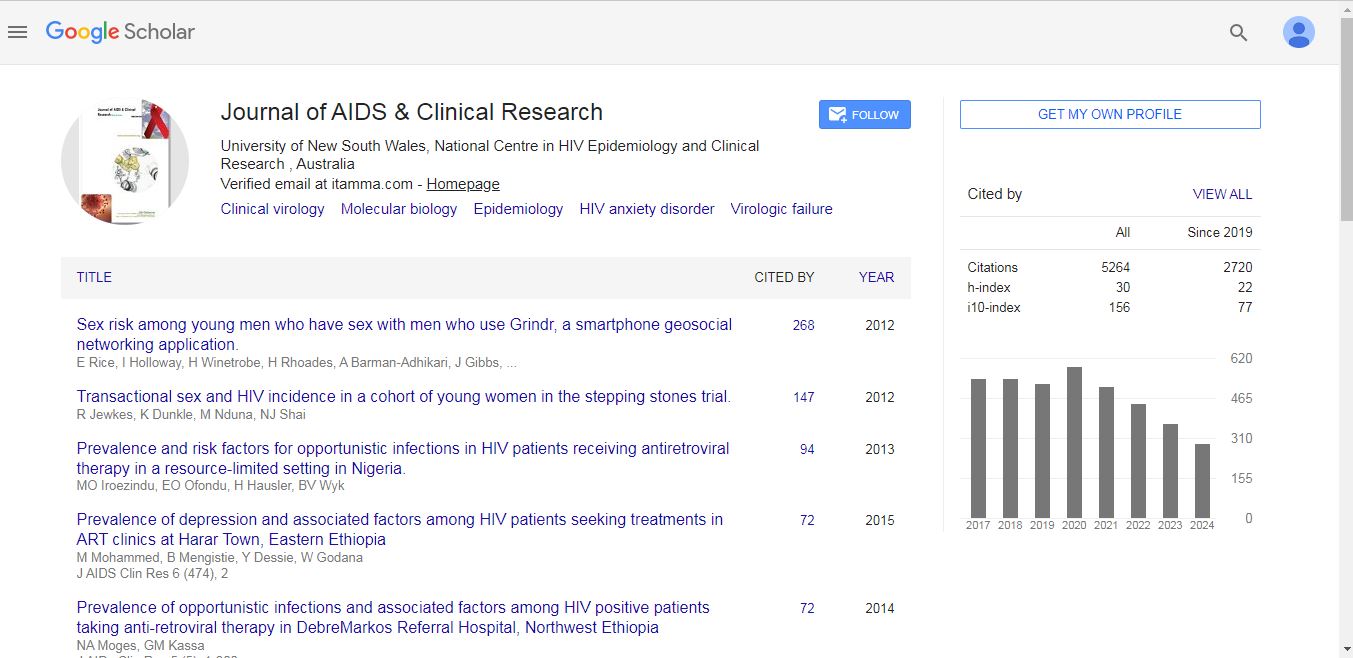
Journal of AIDS & Clinical Research received 5264 citations as per Google Scholar report