Opinion - (2025) Volume 16, Issue 5
Received: 01-Sep-2025, Manuscript No. bej-26-182509;
Editor assigned: 03-Sep-2025, Pre QC No. P-182509;
Reviewed: 17-Sep-2025, QC No. Q-182509;
Revised: 22-Sep-2025, Manuscript No. R-182509;
Published:
29-Sep-2025
, DOI: 10.37421/2161-6219.2025.16.576
Citation: Harris, Michael. ”Economics: A Foundation for Business
Success.” Bus Econ J 16 (2025):576.
Copyright: © 2025 Harris M. This is an open-access article distributed under the terms of the Creative Commons Attribution License, which permits unrestricted use, distribution
and reproduction in any medium, provided the original author and source are credited.
Economics serves as a foundational pillar for effective business management, equipping leaders with the analytical tools necessary for informed decision-making. By understanding core economic principles, such as the dynamics of supply and demand, the intricacies of various market structures, and the factors influencing consumer behavior, managers are empowered to optimize the allocation of resources, accurately forecast market trends, and formulate robust pricing strategies, ultimately fostering improved profitability and sustained business expansion [1].
This body of research meticulously investigates the direct influence of microeconomic principles on strategic decision-making within firms. It meticulously highlights the practical application of concepts like elasticity of demand, marginal cost analysis, and the pursuit of profit maximization, demonstrating their critical role in enhancing operational efficiency and cultivating a distinct competitive advantage. The studies emphasize that a profound comprehension of these economic instruments is indispensable for successfully navigating the complexities of the contemporary business environment and achieving overarching organizational objectives [2].
The integration of macroeconomic analysis into the fabric of business management practices is a critical area of exploration. These insights detail how a firm grasp of national and global economic indicators, encompassing inflation rates, prevailing interest rates, and the trajectory of Gross Domestic Product (GDP) growth, enables businesses to proactively anticipate shifts in market conditions, effectively manage inherent financial risks, and judiciously identify emerging opportunities for strategic expansion. This broader economic perspective is underscored as paramount for ensuring long-term business prosperity [3].
A focused investigation into the role of behavioral economics is presented, specifically examining its impact on understanding consumer decision-making processes and the subsequent implications for crafting effective marketing and sales strategies. This research accentuates how psychological factors, which frequently diverge from purely rational decision-making models, significantly influence purchasing choices. Consequently, managers can harness these nuanced insights to design more impactful product offerings and sophisticated communication campaigns tailored to consumer psychology [4].
The economic rationale underpinning innovation and the adoption of new technologies within business enterprises is thoroughly examined. This study posits that fundamental economic principles serve as guiding forces for investment decisions in research and development (R&D) and the integration of novel technologies, meticulously emphasizing the critical trade-offs between upfront costs and the anticipation of future returns. It suggests that cultivating a deep understanding of economic incentives is vital for fostering an organizational culture that actively embraces and drives innovation [5].
This article delves into the multifaceted economic considerations inherent in strategies for international business expansion. It meticulously discusses how fluctuating currency exchange rates, the complexities of international trade policies, and prevailing global economic conditions collectively shape and influence a company's strategic decisions regarding entry into foreign markets. The study underscores the absolute necessity of developing keen economic foresight for achieving successful global market penetration [6].
The application of game theory as a potent economic tool for developing competitive strategies in business management is thoroughly explored. This paper effectively illustrates how a nuanced understanding of strategic interactions among competing firms, particularly in critical decision-making areas such as pricing strategies or market entry approaches, can lead to demonstrably more advantageous business outcomes. It firmly emphasizes the significant predictive power of economic game theory when applied to competitive business scenarios [7].
This study undertakes an in-depth exploration of the economic principles that form the bedrock of corporate finance and strategic investment decisions. It precisely highlights how core economic concepts, including net present value calculations, the cost of capital, and rigorous risk assessment methodologies, guide managerial decisions in the critical allocation of financial resources. The primary objective is to achieve optimal shareholder value, and the paper strongly stresses the indispensable and critical link that exists between established economic theory and effective financial management practices [8].
The pervasive influence of economic policy on the operational landscape of businesses is subjected to rigorous analysis. This paper meticulously details how government regulations, encompassing fiscal policies and broader monetary measures, collaboratively shape the economic environment within which businesses must strategically operate. It strongly underscores the imperative for managers to possess a comprehensive understanding of these policies to ensure regulatory compliance and to effectively capitalize on emergent economic opportunities [9].
This research meticulously investigates the economic implications associated with the adoption of sustainability initiatives and corporate social responsibility (CSR) frameworks within modern business management. It delves into how the proactive integration of environmental and social considerations, frequently motivated by economic incentives or regulatory mandates, can profoundly impact both a company's financial profitability and its long-term business valuation. The study emphatically highlights a rapidly growing economic imperative for the widespread adoption of sustainable business practices [10].
Economics provides an essential analytical framework for effective business management, enabling optimal resource allocation, accurate market forecasting, and the development of sound pricing strategies to enhance profitability and ensure sustainable growth [1].
Microeconomic principles, such as demand elasticity and marginal cost, are directly applied in firms to improve operational efficiency and gain a competitive edge, underscoring the importance of economic tools for navigating complex business environments [2].
Macroeconomic analysis, including an understanding of inflation and GDP growth, allows businesses to anticipate market shifts, manage financial risks, and identify expansion opportunities, contributing to long-term success [3].
Behavioral economics offers insights into consumer decision-making by considering psychological factors, helping managers create more effective marketing and sales strategies by understanding non-rational purchasing influences [4].
The economic rationale behind innovation and technological adoption is guided by principles that weigh costs against expected returns, emphasizing the need for understanding economic incentives to foster innovation [5].
Economic factors like exchange rates and trade policies are crucial for international business expansion, necessitating economic foresight for successful globalization [6].
Game theory, as an economic tool, helps businesses understand strategic interactions and make advantageous decisions in competitive scenarios, highlighting its predictive power [7].
Economic principles form the foundation of corporate finance and investment decisions, guiding resource allocation for optimal shareholder value through concepts like net present value and risk assessment [8].
Navigating the economic landscape shaped by government regulations, fiscal, and monetary policies is vital for business compliance and capitalizing on opportunities, demonstrating the importance of understanding economic policy [9].
The economic imperative of sustainability and CSR is explored, showing how environmental and social considerations, driven by economic factors, can influence profitability and long-term business value, highlighting the growing demand for sustainable practices [10].
Economics is fundamental to effective business management, providing frameworks for decision-making, resource allocation, and market analysis. Microeconomic principles directly inform strategic choices, enhancing operational efficiency and competitive advantage. Macroeconomic factors like inflation and interest rates influence market anticipation and risk management. Behavioral economics sheds light on consumer psychology for improved marketing strategies. Economic principles also guide innovation investment and technological adoption. For international expansion, understanding global economic conditions and trade policies is crucial. Game theory offers tools for competitive strategy development. Corporate finance and investment decisions are rooted in economic theory, aiming for optimal shareholder value. Businesses must navigate economic policies and regulations to ensure compliance and seize opportunities. Increasingly, economic considerations are driving the adoption of sustainable practices and corporate social responsibility for long-term value.
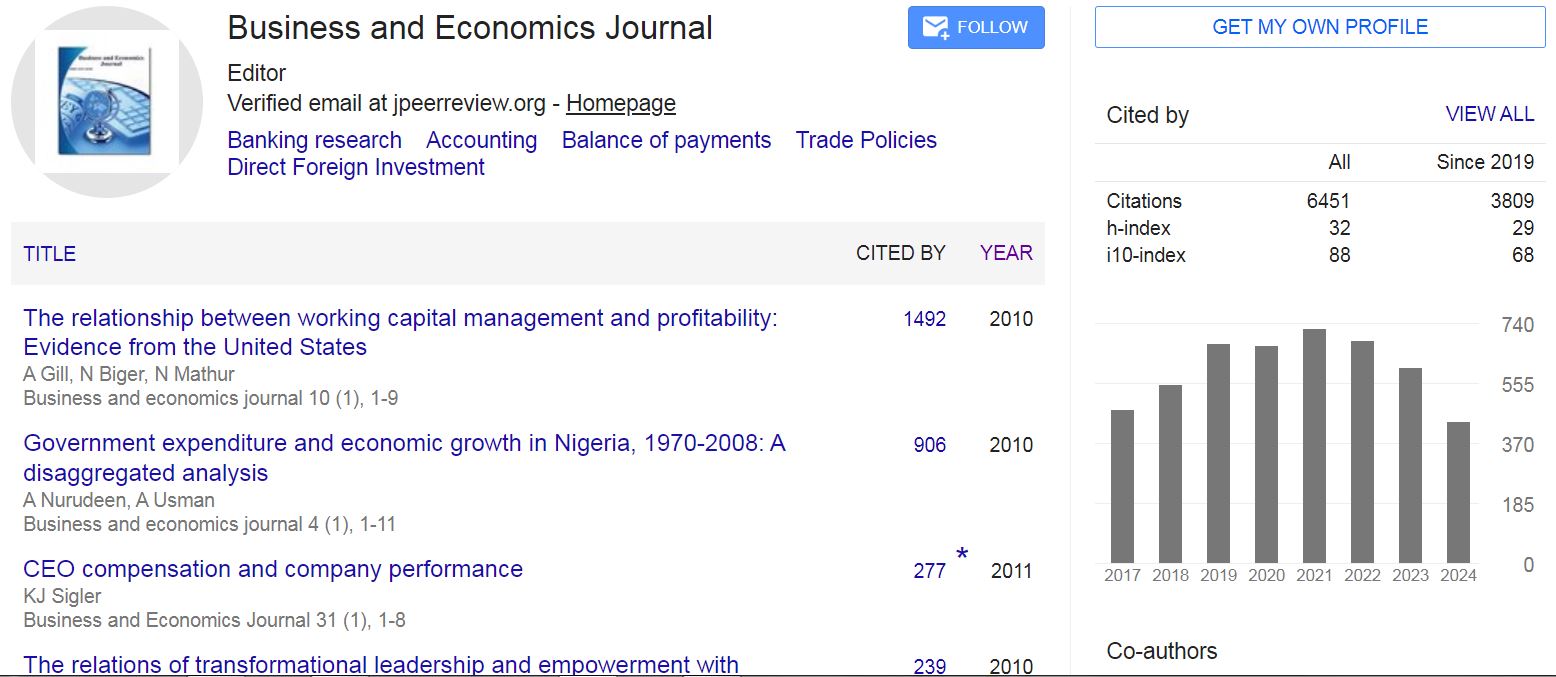
Business and Economics Journal received 6451 citations as per Google Scholar report