Perspective - (2025) Volume 16, Issue 6
Received: 01-Nov-2025, Manuscript No. bej-26-182560;
Editor assigned: 03-Nov-2025, Pre QC No. P-182560;
Reviewed: 17-Nov-2025, QC No. Q-182560;
Revised: 22-Nov-2025, Manuscript No. R-182560;
Published:
29-Nov-2025
, DOI: 10.37421/2161-6219.2025.16.589
Citation: Velázquez, Diana. ”Economic Interdependence: Managing
Risks For Growth.” Bus Econ J 16 (2025):589.
Copyright: © 2025 Velázquez D. This is an open-access article distributed under the terms of the Creative Commons Attribution License, which permits unrestricted use,
distribution and reproduction in any medium, provided the original author and source are credited.
The contemporary global landscape is characterized by an unprecedented degree of economic interdependence, a phenomenon driven by globalization and facilitated by technological advancements. This interconnectedness necessitates a thorough understanding of the complex systems that underpin international trade, finance, and labor markets. The intricate web of business and economic interdependence, as highlighted by various studies, underscores how globalized markets require a deeper comprehension of interconnected supply chains, financial flows, and labor dynamics. Disruptions in one sector or region can indeed trigger cascading effects, emphasizing the critical need for strategic resilience and adaptive policy-making in navigating these complexities [1].
Multinational corporations play a pivotal role in shaping national economies, and their interplay with these economies is a subject of significant research. Foreign direct investment and international trade, while potent catalysts for economic growth, also engender dependencies that can be leveraged or become detrimental, particularly during periods of crisis. Therefore, careful management of these relationships is paramount to maximize the benefits derived from them while concurrently mitigating inherent risks [2].
Technological progress has profoundly reshaped economic interdependence, with digital platforms and cross-border data flows emerging as key drivers. These innovations, while fostering new avenues for collaboration, simultaneously introduce novel vulnerabilities. Consequently, there is a pressing need for updated regulatory frameworks and robust cybersecurity measures to govern this evolving digital economic sphere [3].
The financial integration of emerging and developed economies has created intricate linkages, offering access to capital but also exposing nations to international volatility. This financial interdependence underscores the vital role of sound financial regulation in effectively managing these complex interdependencies and safeguarding economies against external shocks [4].
Geopolitical factors exert a substantial influence on economic interdependence, with trade wars, sanctions, and political instability capable of disrupting established economic ties and necessitating the reconfiguration of global supply networks. In this context, a comprehensive understanding of political risk is as essential as rigorous economic analysis for effective strategic planning [5].
The movement of labor across borders, encompassing both skilled and unskilled workers, is a significant implication of economic interdependence. While international migration can address labor shortages and stimulate economies, it also presents challenges related to wage disparities and social integration, demanding coordinated international policy responses [6].
Environmental sustainability is increasingly intertwined with economic interdependence, particularly as global supply chains possess substantial environmental footprints. Mitigating these impacts requires concerted international cooperation, underscoring the growing linkage between ecological health and global economic stability [7].
International organizations play a crucial role in managing economic interdependence by setting standards, facilitating trade, and resolving disputes. Despite their sometimes-contested influence, these bodies are instrumental in maintaining a stable global economic order through their governance functions [8].
Regional trade agreements have a demonstrable impact on economic interdependence, deepening ties within specific blocs while potentially creating trade diversion effects with non-member countries. This dynamic highlights the necessity of balancing regional integration strategies with broader global economic engagement to foster overall stability [9].
Supply chain resilience has emerged as a critical concern in the face of escalating economic interdependence. Recent global disruptions have exposed the inherent fragility of extensive and complex supply chains, compelling businesses and governments to proactively develop more robust and diversified networks to navigate future challenges [10].
The pervasive nature of economic interdependence in the modern world is a complex phenomenon driven by globalization and amplified by technological advancements. It necessitates a sophisticated understanding of the interconnectedness of supply chains, financial markets, and labor dynamics across the globe. The systemic approach reveals how disruptions in one area can have ripple effects throughout the entire system, underscoring the imperative for strategic resilience and adaptable policy frameworks to manage these intricate relationships [1].
Multinational corporations are central actors in this interconnected global economy, influencing national economic trajectories through foreign direct investment and international trade. While these activities are instrumental in driving economic growth, they also create dependencies that carry inherent risks, particularly during times of crisis. Therefore, a balanced approach to managing these corporate-national economic interactions is crucial to harness their benefits while mitigating potential downsides [2].
The transformative power of technology has significantly reshaped economic interdependence, with digital platforms and the rapid flow of data across borders becoming defining features. These innovations, while enabling new forms of global collaboration, also introduce unprecedented vulnerabilities that demand updated regulatory approaches and advanced cybersecurity measures to ensure a secure and functional digital economy [3].
Financial interdependence between emerging and developed economies presents both opportunities and risks. While global financial integration provides access to capital, it also exposes economies to the vagaries of international financial volatility. This underscores the critical importance of implementing robust financial regulatory systems to effectively manage these interdependencies and maintain economic stability [4].
Geopolitical considerations are increasingly intertwined with economic interdependence. Trade disputes, the imposition of sanctions, and periods of political instability can severely disrupt established economic relationships, leading to significant reconfigurations of global supply networks. Consequently, a keen understanding of political risk is as vital as economic analysis for navigating the complexities of international commerce [5].
The movement of labor across international borders is a significant aspect of economic interdependence. While labor migration can alleviate workforce shortages and stimulate economic activity, it also gives rise to challenges such as wage disparities and issues of social integration, necessitating coordinated international policies to address these multifaceted concerns [6].
Environmental sustainability is intrinsically linked to economic interdependence, with global supply chains contributing significantly to environmental impacts. Addressing these challenges requires international cooperation to mitigate ecological footprints and recognize the profound connection between the health of the environment and the stability of the global economy [7].
International organizations serve as crucial facilitators and regulators in the complex landscape of economic interdependence. Their roles in establishing standards, promoting trade, and mediating disputes are essential for maintaining a stable global economic order, even as their influence is sometimes subject to debate [8].
Regional trade agreements play a significant role in shaping economic interdependence by fostering deeper ties within specific blocs. However, they can also lead to trade diversion effects with countries outside these agreements, highlighting the need to strike a balance between regional integration and broader global economic engagement [9].
Supply chain resilience has become a paramount concern amidst growing economic interdependence. Recent global events have exposed the fragility of extended supply chains, emphasizing the need for businesses and governments to proactively build more robust and diversified networks capable of withstanding future disruptions [10].
This collection of research delves into the multifaceted nature of economic interdependence in a globalized world. It examines how interconnected supply chains, financial flows, and labor markets are shaped by multinational corporations, technological advancements, and geopolitical factors. The studies highlight both the opportunities and challenges presented by this interdependence, emphasizing the need for strategic resilience, adaptive policymaking, robust financial regulation, and effective international cooperation. Key areas explored include the impact of digital transformation, environmental sustainability, and regional trade agreements. Ultimately, the research underscores the critical importance of managing these complex relationships to foster economic growth while mitigating risks.
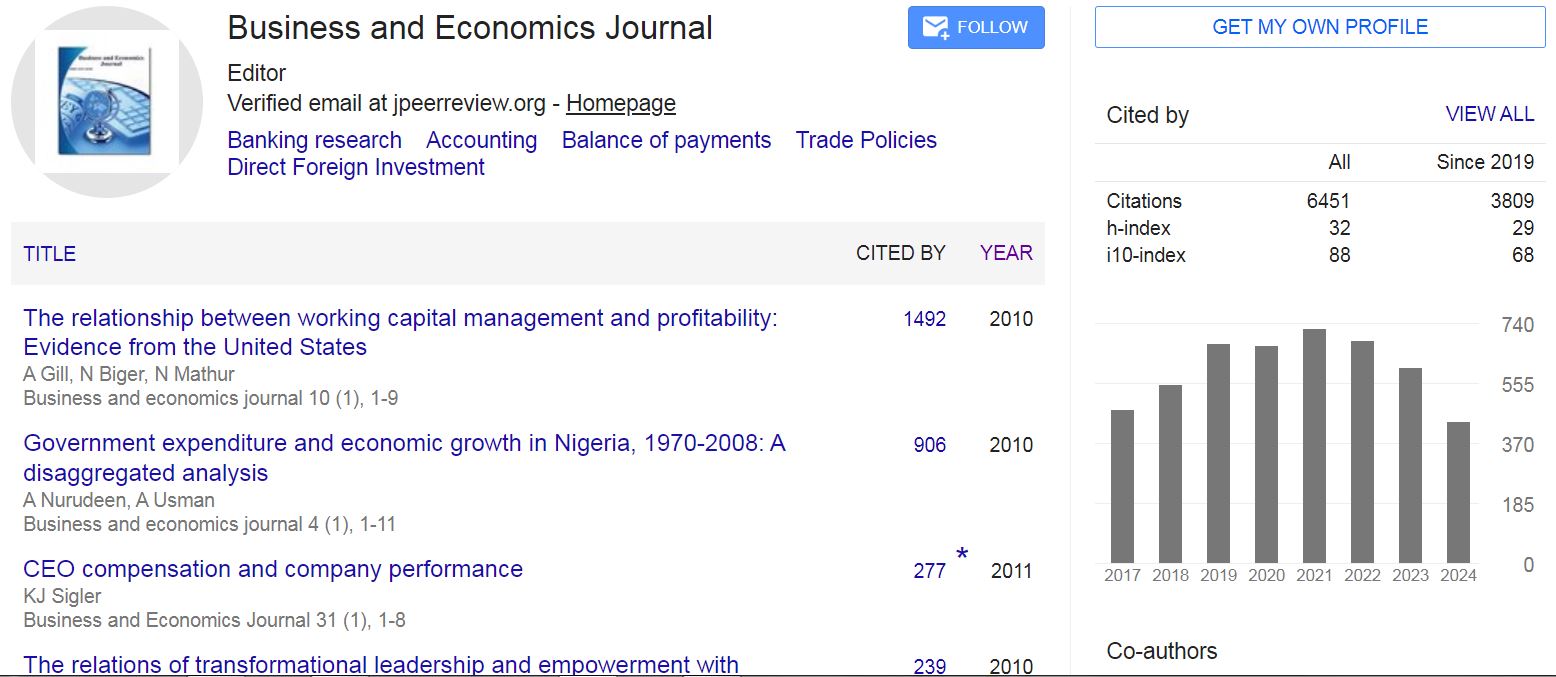
Business and Economics Journal received 6451 citations as per Google Scholar report