Opinion - (2025) Volume 13, Issue 3
Received: 03-Jun-2025, Manuscript No. JGPR-26-188018;
Editor assigned: 05-Jun-2025, Pre QC No. P-188018;
Reviewed: 17-Jun-2025, QC No. Q-188018;
Revised: 24-Jun-2025, Manuscript No. R-188018;
Published:
30-Jun-2025
, DOI: 10.37421/2329-9126.2025.13.617
Citation: OConnor, James. ”Early CKD Detection in Family Practice: A Call.” J Gen Pract 13 (2025):617.
Copyright: © 2025 OConnor J. This is an open-access article distributed under the terms of the Creative Commons Attribution License, which permits unrestricted use, distribution and reproduction in any medium, provided the original author and source are credited.
The early identification of Chronic Kidney Disease (CKD) within family practice settings is paramount for initiating timely interventions, thereby slowing disease progression and preventing the onset of serious complications. General practitioners are integral to this process, tasked with screening populations at high risk, recognizing subtle clinical indicators, and commencing essential diagnostic investigations. This proactive approach necessitates a thorough understanding of key risk factors such as hypertension, diabetes, a family history of kidney disease, and advanced age. Furthermore, it relies on the judicious application of laboratory tests, including serum creatinine and urinalysis, to assess renal function and detect early signs of damage. The overarching goal is to foster proactive management strategies within the primary care domain, ensuring that CKD is addressed at its nascent stages. [1] Integrating CKD screening into the routine care of individuals with pre-existing cardiovascular disease or diabetes represents a highly effective strategy. This approach capitalizes on existing patient contact points to identify at-risk individuals who might otherwise be missed. Risk stratification, facilitated by straightforward tools and established guidelines, is crucial for pinpointing those who stand to benefit most from early detection measures. Ultimately, by mitigating both cardiovascular and renal events, this integrated approach significantly enhances patient outcomes. [2] This study critically examines the multifaceted challenges and emergent opportunities that confront general practitioners in their efforts to diagnose CKD. A significant finding is the pronounced need for enhanced educational resources and robust support systems to bolster practitioners' confidence and competence in recognizing the subtle early signs of CKD and in managing the condition effectively. The research strongly suggests that well-designed, targeted training programs are instrumental in substantially improving the rates of early CKD detection. [3] The practical utility of estimated glomerular filtration rate (eGFR) and the albumin-to-creatinine ratio (ACR) as cornerstone screening tools for CKD in family practice environments is thoroughly discussed. The paper offers practical, evidence-based guidance on interpreting these vital biomarkers within the unique context of a primary care setting. It meticulously highlights their demonstrated sensitivity and specificity in accurately identifying patients who are exhibiting early-stage kidney damage. [4] A comprehensive systematic review was conducted to rigorously assess the comparative effectiveness of various screening strategies employed for CKD within primary care. This review meticulously analyzes the cost-effectiveness and the demonstrable impact on patient outcomes associated with different approaches, encompassing both opportunistic screening and targeted screening of well-defined high-risk groups. The collective findings strongly advocate for a balanced, strategic approach designed to optimize both resource utilization and the tangible benefit to patients. [5] The crucial role of technological advancements, including the integration of electronic health records (EHRs) and sophisticated decision support systems, in facilitating the early diagnosis of CKD within family practice is explored in depth. This paper specifically examines how these digital tools can effectively prompt clinicians to consider CKD, enable efficient patient tracking, and foster improved adherence to established screening guidelines, thereby significantly enhancing the overall efficiency of CKD detection processes. [6] This article provides valuable insights into the critical patient perspective concerning CKD screening within primary care settings. It delves into nuanced aspects of patient awareness regarding kidney health, their comprehension of CKD, and their general willingness to actively participate in recommended screening programs. A deep understanding of these patient-centric factors is unequivocally essential for the successful design and implementation of screening initiatives that are both effective and truly patient-centered. [7] The management of CKD during its nascent stages, specifically within the context of a family practice setting, is examined with a particular focus on essential lifestyle modifications, stringent blood pressure control, and meticulous glycemic management. The article strongly underscores the indispensable role of the general practitioner in comprehensively educating patients about their condition and actively motivating them to adopt and maintain healthy habits that are conducive to slowing disease progression. [8] This research undertakes an investigation into the prevalence of CKD, with a specific emphasis on underserved populations, and identifies the significant barriers that impede early diagnosis within these vulnerable communities. The study proposes innovative strategies, including community-based outreach programs and the development of culturally sensitive screening initiatives, all aimed at improving detection rates and effectively reducing existing health disparities. [9] The significant economic burden associated with late-stage CKD, juxtaposed with the clear cost-effectiveness of early diagnosis and prompt intervention, is thoroughly analyzed. This paper compellingly highlights how strategic investments in primary care-based CKD screening programs can yield substantial long-term cost savings. These savings are primarily achieved by effectively preventing costly complications and significantly reducing the eventual reliance on more expensive treatments like dialysis and transplantation. [10]
The crucial role of general practitioners in the early identification of Chronic Kidney Disease (CKD) within primary care settings cannot be overstated. Their ability to screen high-risk populations, recognize subtle symptoms, and initiate basic investigations is fundamental to slowing disease progression and preventing severe complications. This requires a comprehensive understanding of risk factors such as hypertension, diabetes, family history, and age, alongside proficient use of laboratory tests like serum creatinine and urinalysis to detect early signs of kidney damage. The emphasis is on a proactive management approach within the accessible framework of primary care. [1] A highly effective strategy for enhancing CKD detection involves integrating screening into the routine primary care visits of individuals already diagnosed with cardiovascular disease or diabetes. This approach leverages existing healthcare touchpoints to reach at-risk patients efficiently. The implementation of risk stratification, guided by simple tools and established clinical guidelines, is essential to identify those who would benefit most from early diagnostic measures. Ultimately, this integrated strategy aims to improve overall patient outcomes by actively mitigating the risk of both cardiovascular and renal events. [2] This study offers a detailed examination of the challenges and opportunities faced by general practitioners in the diagnosis of CKD. It specifically highlights the critical need for improved educational initiatives and more robust support systems designed to enhance practitioners' confidence and competence in identifying early signs of the disease and managing affected patients. The findings strongly indicate that the implementation of targeted training programs can lead to a significant improvement in the early detection rates of CKD. [3] The paper discusses the practical utility of estimated glomerular filtration rate (eGFR) and albumin-to-creatinine ratio (ACR) as primary screening tools for CKD within family practice settings. It provides clear, actionable guidance on how to interpret these key biomarkers in the context of primary care. The document emphasizes their established sensitivity and specificity in identifying patients who are in the early stages of kidney damage, making them invaluable diagnostic aids. [4] A systematic review was conducted to evaluate the effectiveness of different CKD screening strategies employed in primary care. The review analyzed the cost-effectiveness and impact on patient outcomes for various approaches, including opportunistic screening and targeted screening of high-risk groups. The conclusions support adopting a balanced approach to optimize both the efficient use of healthcare resources and the delivery of maximum patient benefit. [5] The potential of technology, specifically electronic health records (EHRs) and decision support systems, to facilitate the early diagnosis of CKD in general practice is explored. This research examines how these technological tools can effectively prompt clinicians to consider CKD, assist in patient tracking, and improve adherence to established screening guidelines, thereby enhancing the overall efficiency of CKD detection processes. [6] This article addresses the patient's perspective on CKD screening within primary care. It explores patient awareness levels, their understanding of CKD, and their willingness to participate in screening programs. Understanding these patient-centric factors is crucial for developing screening initiatives that are both effective and tailored to patient needs, ensuring higher engagement and better outcomes. [7] The management of CKD in its early stages within a family practice context is examined, with a focus on key interventions such as lifestyle modifications, effective blood pressure control, and careful glycemic management. The article underscores the vital role of general practitioners in educating patients about their condition and motivating them to adopt and adhere to healthy habits to slow disease progression. [8] This research investigates the prevalence of CKD in underserved populations and identifies the barriers that hinder early diagnosis in these communities. It proposes targeted strategies, including community-based outreach and culturally sensitive screening programs, designed to improve detection rates and reduce existing health disparities among vulnerable groups. [9] The economic consequences of late-stage CKD and the financial benefits of early diagnosis and intervention are thoroughly analyzed. This paper highlights how proactive investment in primary care-based CKD screening can lead to substantial long-term cost savings by preventing expensive complications and reducing the need for costly treatments like dialysis and transplantation. [10]
Early identification of Chronic Kidney Disease (CKD) in family practice is crucial for effective intervention and slowing progression. General practitioners play a key role in screening high-risk individuals, recognizing subtle symptoms, and utilizing laboratory tests like serum creatinine and urinalysis. Integrating CKD screening into routine care for patients with cardiovascular disease or diabetes is an effective strategy. Challenges in diagnosis highlight the need for enhanced training for practitioners. Tools like eGFR and ACR are vital for early detection, and systematic reviews support balanced screening strategies. Technology, including EHRs, can improve detection efficiency. Patient perspectives are important for designing patient-centered screening. Early management focuses on lifestyle, blood pressure, and glycemic control. Addressing disparities in underserved populations requires targeted outreach. The economic benefits of early detection are significant, reducing long-term healthcare costs.
None
None
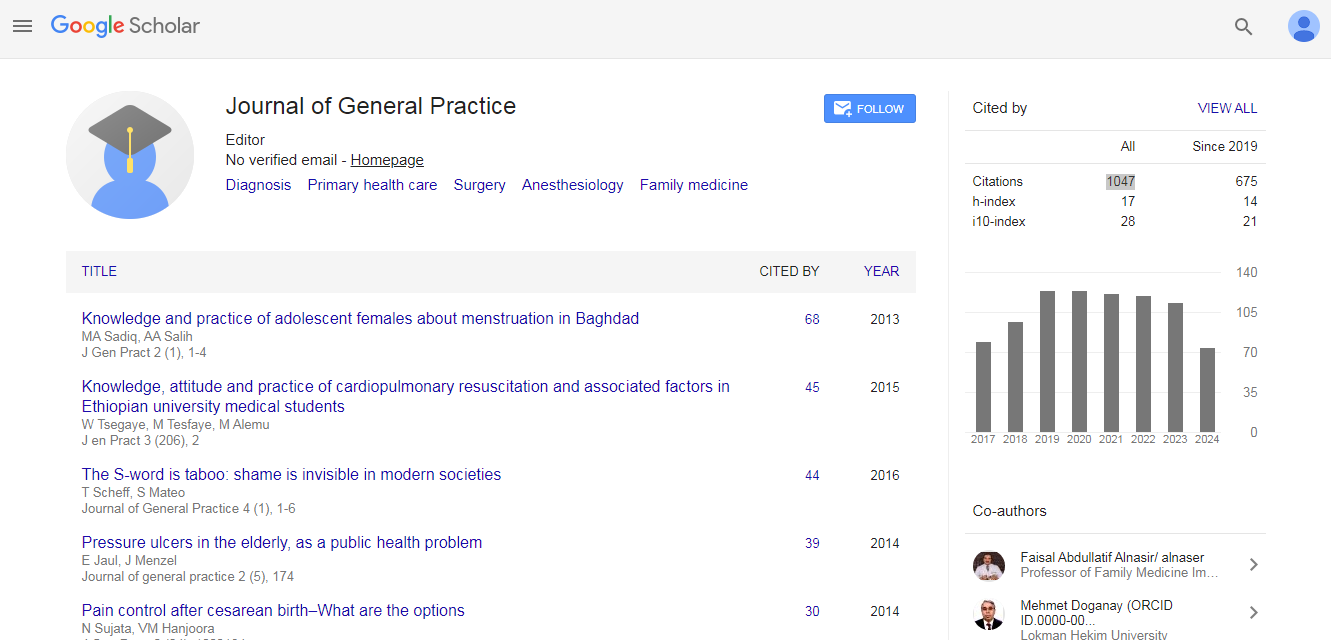
Journal of General Practice received 1047 citations as per Google Scholar report