Commentary - (2025) Volume 16, Issue 4
Received: 01-Jul-2025, Manuscript No. hycr-25-174940;
Editor assigned: 03-Jul-2025, Pre QC No. P-174940;
Reviewed: 17-Jul-2025, QC No. Q-174940;
Revised: 22-Jul-2025, Manuscript No. R-174940;
Published:
29-Jul-2025
, DOI: 10.37421/2157-7587.2025.16.607
Citation: Armitage, Selene. ”Drought: A Multifaceted Global Crisis and Response.” Hydrol Current Res 16 (2025):607.
Copyright: © 2025 Armitage S. This is an open-access article distributed under the terms of the Creative Commons Attribution License, which permits unrestricted use,
distribution and reproduction in any medium, provided the original author and source are credited.
The global climate crisis continues to intensify, bringing with it a notable increase in the frequency and intensity of extreme weather events, among which drought stands out as a particularly devastating phenomenon. This body of research meticulously examines the profound and multifaceted impacts of drought across diverse natural and human systems, simultaneously exploring critical adaptation and mitigation strategies. A core theme emerging from these studies is the direct link between climate change and the exacerbated vulnerability of water resources and agricultural systems. Specifically, the increasing frequency and intensity of droughts contribute significantly to water scarcity, directly reducing crop yields and posing a substantial threat to global food security, especially in regions already prone to such environmental stressors [1].
The technological front offers crucial tools for confronting this challenge. Significant advancements have been made in drought monitoring and early warning systems, which now effectively integrate satellite remote sensing, ground-based observations, and sophisticated hydrological models. These improvements are instrumental in providing more accurate and timely information, empowering decision-makers to implement proactive drought management and mitigate impacts across a wide array of sectors, from vital agricultural practices to essential water utilities [2].
Concurrently, comprehensive assessments of drought risk are being undertaken, particularly in vulnerable regions like the semi-arid Yellow River Basin. These studies utilize a blend of climate data, hydrological modeling, and socio-economic indicators to pinpoint drought vulnerability, proposing integrated management strategies such as optimized water allocation and reservoir operations, alongside demand-side management, to bolster regional resilience against future dry spells [7].
Droughtâ??s ecological footprint is extensive and alarming. A global meta-analysis reveals consistent patterns of reduced primary productivity, noticeable alterations in species composition, and heightened tree mortality when ecosystems experience drought conditions. This underscores the critical threat drought poses to biodiversity and the fundamental functioning of ecosystems, highlighting an urgent need for robust conservation and restoration efforts [3].
Directly related to these environmental shifts, drought plays a critical role in elevating wildfire risk, particularly under a changing climate. Prolonged dry periods lead to increased fuel aridity, making vegetated areas far more susceptible to ignition and rapid fire spread. This highlights a concerning feedback loop between drought conditions and wildfire regimes, necessitating proactive fire management and broader climate mitigation efforts to reduce the future severity of wildfires [8].
The human dimension of drought is equally compelling, manifesting in significant socio-economic and public health challenges. In Sub-Saharan Africa, for instance, recurrent droughts severely impact crop production, livestock, and the livelihoods of millions, pushing communities into severe food insecurity. Here, adaptation strategies blend traditional wisdom with modern approaches, including improved water harvesting, the adoption of drought-resistant crops, and localized early warning systems, all emphasizing community-based resilience [4].
The economic repercussions of drought on agriculture are substantial, leading to considerable financial losses for farmers and impacting regional economies through reduced agricultural output, with potential national implications. Policy interventions and insurance schemes are being explored to mitigate these economic burdens [5].
A systematic review specifically addressing the relationship between drought and human health identifies various adverse outcomes. These include an increase in respiratory illnesses due to dust, significant mental health impacts such as anxiety and depression, widespread malnutrition resulting from food insecurity, and outbreaks of water-borne diseases. This evidence underscores the necessity for comprehensive public health strategies to effectively address these multifaceted challenges in drought-affected populations [6].
Moreover, beyond agriculture, the broader socio-economic impacts of drought, particularly in dryland environments, exacerbate poverty, trigger migration, and disrupt diverse economic activities. Effective adaptation strategies here involve improved governance, diversification of livelihoods, and the establishment of robust social safety nets to build resilience among vulnerable communities [10].
Looking at agricultural resilience, reviews delve into the specific impacts on crop productivity. Water deficits at various growth stages can drastically reduce yields for staple food crops. To counteract this, innovative mitigation strategies are crucial. These include precision irrigation techniques, the development of drought-tolerant crop varieties through genetic engineering, and refined soil management practices, all serving as vital tools for enhancing agricultural resilience in arid and semi-arid regions [9].
Collectively, this research paints a vivid picture of drought as a pervasive threat but also provides a comprehensive roadmap for interdisciplinary approachesâ??combining scientific understanding, technological innovation, and socio-economic planningâ??to foster global resilience in the face of an increasingly dry future.
The pervasive influence of drought, significantly amplified by climate change, presents complex challenges across ecological, economic, and social spheres globally. One critical area of impact is on water resources and agricultural systems, where increased drought frequency and intensity lead to severe water scarcity and reduced crop yields, consequently jeopardizing food security, especially in vulnerable communities [C001, C004, C009]. The economic ramifications extend beyond individual farmers, causing substantial financial losses and disrupting regional agricultural output, which can have broader national implications. Policy interventions and insurance mechanisms are vital tools being developed to alleviate these economic pressures [C005]. Furthermore, the broader socio-economic landscape is severely affected, with droughts exacerbating poverty, prompting population migration, and hindering diverse economic activities, particularly in arid regions. Effective resilience-building requires improved governance, diversified livelihoods, and robust social safety nets [C010].
Addressing these challenges necessitates advanced technological and strategic responses. Significant progress has been made in drought monitoring and early warning systems, which integrate satellite remote sensing, ground-based observations, and sophisticated hydrological models to provide timely and accurate information. This enables proactive management and impact mitigation across critical sectors, from agriculture to water management [C002]. Similarly, detailed drought risk assessments are crucial for developing effective management strategies. In regions like the semi-arid Yellow River Basin, such assessments combine climate data, hydrological modeling, and socio-economic indicators to identify vulnerabilities and propose integrated solutions, including optimized water allocation, reservoir operations, and demand-side management to enhance resilience [C007]. These proactive approaches are fundamental to minimizing the adverse effects of future drought events.
Beyond direct resource impacts, drought exerts profound ecological consequences. A global meta-analysis demonstrates consistent patterns of reduced primary productivity, shifts in species composition, and increased tree mortality across terrestrial ecosystems under drought conditions. These changes pose a severe threat to biodiversity and the overall functioning of ecosystems, underscoring the urgency for dedicated conservation and restoration initiatives [C003]. Moreover, drought conditions are intricately linked to heightened wildfire risks in a changing climate. Prolonged dry spells contribute to increased fuel aridity, making forests and other vegetated areas significantly more prone to ignition and rapid fire spread. This highlights a critical feedback loop, emphasizing the need for robust fire management strategies and broader climate mitigation efforts to reduce wildfire severity [C008].
The human toll of drought is multifaceted, extending to direct public health impacts. A systematic review reveals a spectrum of health outcomes tied to drought, including elevated respiratory illnesses from dust, considerable mental health challenges such as anxiety and depression, widespread malnutrition driven by food insecurity, and increased incidence of water-borne diseases. These findings underscore the imperative for comprehensive public health strategies specifically tailored to support drought-affected populations [C006]. The combined impact on human well-being, coupled with socio-economic disruptions, paints a clear picture of drought as a significant humanitarian concern.
In agricultural systems, specifically, the impact on crop productivity is a major concern, as water deficits at various growth stages can severely diminish yields for staple food crops. To counter this, innovative mitigation strategies are being developed and implemented. These include the adoption of precision irrigation techniques, the development of drought-tolerant crop varieties through genetic engineering, and the implementation of improved soil management practices. Such advancements are crucial for enhancing agricultural resilience, particularly in arid and semi-arid regions facing recurrent drought [C009]. Overall, the body of work collectively advocates for a holistic and integrated approach to drought management, combining scientific research, technological innovation, and socio-economic policy to build resilient communities and ecosystems worldwide.
Drought poses a significant global challenge, with its impacts intensified by ongoing climate change. Research highlights its profound effects on vital sectors like water resources and agricultural systems, leading to increased scarcity, reduced crop yields, and threats to food security, particularly in vulnerable regions [C001, C004]. The ecological ramifications are equally severe, encompassing reduced primary productivity, altered species composition, and heightened tree mortality, thereby jeopardizing biodiversity and ecosystem function [C003]. Furthermore, drought plays a critical role in escalating wildfire risks due to increased fuel aridity [C008]. Economically, droughts inflict substantial financial losses on farmers and disrupt regional economies through diminished agricultural output [C005]. Beyond economic strain, there are significant human health consequences, including respiratory illnesses, mental health impacts, malnutrition, and increased water-borne diseases [C006]. Socio-economically, droughts exacerbate poverty, trigger migration, and disrupt livelihoods, especially in dryland environments [C010]. In response to these pervasive threats, research emphasizes the development of robust strategies. Advancements in drought monitoring and early warning systems, integrating satellite remote sensing and hydrological models, provide crucial information for proactive management [C002]. Adaptation strategies range from integrated water management, reservoir optimization, and demand-side management to the development of drought-tolerant crops, precision irrigation, and improved soil practices [C007, C009]. The collective findings underscore the necessity of holistic, community-based approaches and comprehensive public health strategies to enhance resilience and mitigate the complex challenges posed by recurrent droughts.
None
None
Indexed at, Google Scholar, Crossref
Indexed at, Google Scholar, Crossref
Indexed at, Google Scholar, Crossref
Indexed at, Google Scholar, Crossref
Indexed at, Google Scholar, Crossref
Indexed at, Google Scholar, Crossref
Indexed at, Google Scholar, Crossref
Indexed at, Google Scholar, Crossref
Indexed at, Google Scholar, Crossref
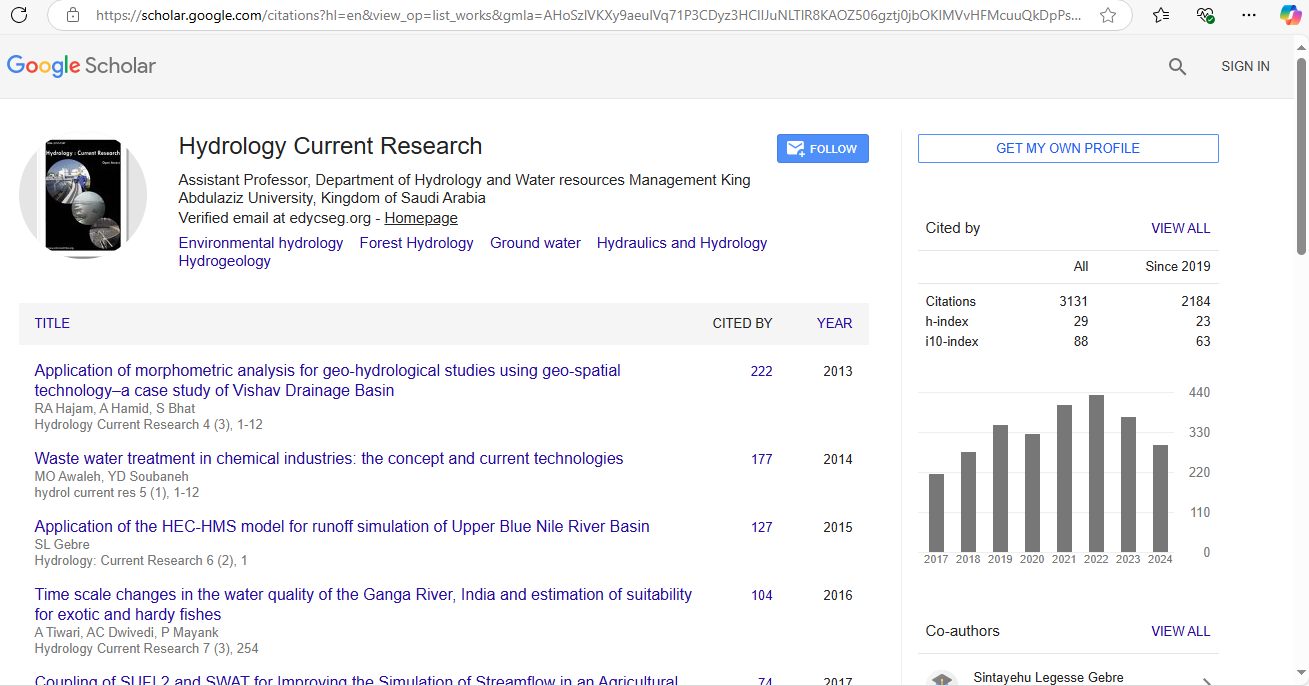
Hydrology: Current Research received 2843 citations as per Google Scholar report