Short Communication - (2025) Volume 11, Issue 3
Received: 02-Jun-2025, Manuscript No. icoa-25-173590;
Editor assigned: 04-Jun-2025, Pre QC No. P-173590;
Reviewed: 18-Jun-2025, QC No. Q-173590;
Revised: 23-Jun-2025, Manuscript No. R-173590;
Published:
30-Jun-2025
, DOI: 10.37421/2469-9756.2025.11.305
Citation: Nair, Priya K.. ''Diverse Checkpoints: Stability, Cancer, Therapy Targets.'' Immunochem Immunopathol 11 (2025):305.
Copyright: © 2025 Nair K. Priya This is an open-access article distributed under the terms of the Creative Commons Attribution License, which permits unrestricted use,
distribution and reproduction in any medium, provided the original author and source are credited.
Cellular checkpoints represent fundamental regulatory mechanisms indispensable for safeguarding genomic integrity and ensuring appropriate cellular function across various biological contexts. These intricate systems are vital for overseeing critical processes such as DNA replication, cell division, and the cellular responses to myriad forms of stress.DNA damage checkpoints are crucial for maintaining genome stability, orchestrating precise DNA repair, inducing cell cycle arrest to allow for repair, and ultimately triggering apoptosis if the damage is beyond repair to prevent the propagation of errors within the cellular lineage [1].
These essential checkpoints highlight key signaling pathways, including ATM/ATR and CHK1/CHK2, which demonstrate complex regulatory roles in a cell's overall response to genotoxic stress [1].
Critically, the dysfunction of these vital pathways is strongly implicated in contributing to the initiation and progression of cancer [1].
Furthering this understanding, the pivotal roles of checkpoint kinases CHK1 and CHK2 in the comprehensive DNA damage response and their significant implications for contemporary cancer therapy have been thoroughly examined [6].
These specific kinases function downstream of ATM/ATR to enforce necessary cell cycle arrest and actively facilitate DNA repair processes [6].
Their established potential as therapeutic targets is a significant area of research aimed at sensitizing cancer cells to various genotoxic agents, thereby enhancing treatment efficacy [6].
The regulation of DNA repair pathways during the broader DNA damage response involves a highly precise and orchestrated coordination [5].
Here, signaling cascades are vital in synchronizing cell cycle arrest with the recruitment and subsequent activation of specific repair machinery [5].
This integrated and highly controlled cellular response is absolutely critical for maintaining complete genomic integrity [5].
Beyond direct DNA repair, the intricate control of cell cycle checkpoints in both healthy and cancerous cells is a central theme in cellular regulation [3].
These checkpoints meticulously ensure accurate DNA replication and proper chromosome segregation, which is fundamental in preventing genomic instability [3].
Recognizably, the dysregulation of these specific checkpoints stands as a hallmark of cancer, presenting clear targets for future therapeutic intervention strategies [3].
A key example is the G1/S cell cycle checkpoint, which operates as a critical gatekeeper for cell division [7].
This checkpoint rigorously ensures the cell is fully prepared to commit to DNA replication only after a thorough assessment of growth conditions and DNA integrity [7].
Dysregulation at this crucial checkpoint can unfortunately lead to uncontrolled cell proliferation, directly contributing to tumorigenesis [7].
Furthermore, the G2/M DNA damage checkpoint is another extensively investigated mechanism, playing a critical role in cell survival and serving as a potent target in cancer therapy [8].
This checkpoint effectively prevents cells with damaged DNA from progressing into mitosis, thereby robustly maintaining genomic stability [8].
The strategic inhibition of this checkpoint in cancerous cells has shown promise in enhancing the efficacy of various DNA-damaging treatments [8].
Protein kinases also play a critical regulatory role in the spindle assembly checkpoint (SAC) [4].
These specific kinases are responsible for ensuring proper chromosome segregation during mitosis by diligently monitoring microtubule attachment to kinetochores [4].
Disruptions in this finely tuned regulation can unfortunately lead to aneuploidy, which is a well-established hallmark of many aggressive cancers [4].
Beyond the core cell cycle, the intricate relationship between telomere replication, the comprehensive DNA damage response, and cancer holds significant implications for genomic health [9].
Telomeres, which act as protective caps on chromosome ends, are actively monitored by specific checkpoints to prevent critically short or dysfunctional telomeres from initiating a persistent DNA damage signal [9].
Such an unchecked signal could ultimately lead to widespread genomic instability or premature cellular senescence [9].
In the realm of infectious diseases, the complex interplay between viral infection and host cell cycle checkpoints presents a fascinating biological dynamic [10].
Viruses frequently manipulate or outright hijack these host checkpoints to create a highly favorable environment for their own replication and propagation [10].
Concurrently, the host cell attempts to activate its checkpoints as a defense mechanism to restrict viral spread, establishing a continuous and dynamic battle for cellular control [10].
Understanding this intricate dynamic is absolutely crucial for developing innovative and effective antiviral strategies [10].
Lastly, the regulation of immune checkpoints, particularly within the context of liver cancer, represents another highly complex and therapeutically relevant area of research [2].
Immune checkpoints, such as PD-1/PD-L1 and CTLA-4, profoundly influence the tumor microenvironment, directly impacting mechanisms of immune evasion utilized by cancer cells [2].
A comprehensive understanding of these specific regulatory pathways is therefore crucial for developing highly effective immunotherapies, especially for challenging conditions like hepatocellular carcinoma [2].
Cellular checkpoints serve as sophisticated regulatory mechanisms vital for maintaining the integrity and proper function of a cell. These systems are especially critical in managing responses to DNA damage and controlling the precise progression of the cell cycle. For instance, DNA damage checkpoints are crucial for maintaining genome stability, orchestrating DNA repair, inducing cell cycle arrest, and even triggering apoptosis if DNA damage is irreparable [1]. This complex regulatory role involves key signaling pathways like ATM/ATR and CHK1/CHK2, highlighting how their dysfunction can contribute significantly to cancer development [1].
The regulation of DNA repair pathways during the DNA damage response is a precisely coordinated process [5]. Signaling cascades ensure that cell cycle arrest is synchronized with the recruitment and activation of specific repair machinery, which is essential for maintaining genomic integrity [5]. Moreover, checkpoint kinases CHK1 and CHK2 play pivotal roles in the DNA damage response and hold significant implications for cancer therapy [6]. These kinases operate downstream of ATM/ATR to enforce cell cycle arrest and facilitate DNA repair, representing potential therapeutic targets to sensitize cancer cells to genotoxic agents [6].
Cell cycle checkpoints are intricately controlled in both healthy and malignant cells, ensuring accurate DNA replication and chromosome segregation to prevent genomic instability [3]. Dysregulation of these checkpoints is a recognized hallmark of cancer, offering avenues for therapeutic intervention [3]. Specifically, the G1/S cell cycle checkpoint acts as a critical gatekeeper, ensuring the cell is ready for DNA replication after assessing growth conditions and DNA integrity [7]. Its dysregulation can lead to uncontrolled cell proliferation and tumorigenesis [7]. Similarly, the G2/M DNA damage checkpoint is crucial for cell survival and is a target in cancer therapy, preventing cells with damaged DNA from entering mitosis to maintain genomic stability [8]. Inhibiting this checkpoint in cancer cells can enhance the efficacy of DNA-damaging treatments [8]. The spindle assembly checkpoint (SAC) is another critical regulator, where protein kinases ensure proper chromosome segregation during mitosis by monitoring microtubule attachment; disruptions in this fine-tuned regulation can result in aneuploidy, a hallmark of many cancers [4].
The intricate relationship between telomere replication, the DNA damage response, and cancer is also a significant area of study [9]. Telomeres, as protective caps, are monitored by specific checkpoints to prevent dysfunctional telomeres from triggering persistent DNA damage signals that would lead to genomic instability or cellular senescence [9]. Beyond intrinsic cellular processes, immune checkpoint regulation, particularly in liver cancer, involves complex mechanisms like PD-1/PD-L1 and CTLA-4, which influence the tumor microenvironment and immune evasion [2]. Understanding these regulatory pathways is crucial for developing effective immunotherapies for hepatocellular carcinoma [2]. Additionally, the complex interplay between viral infection and host cell cycle checkpoints reveals how viruses often manipulate these checkpoints for replication, while host cells activate them to restrict viral spread, a dynamic crucial for antiviral strategies [10].
In sum, the extensive research across these various checkpoint systems underscores their fundamental importance in maintaining cellular homeostasis and preventing disease. From orchestrating DNA repair to modulating immune responses and resisting viral threats, these checkpoints are central to life. Their profound connections to cancer etiology and therapy highlight their ongoing significance in biomedical research and clinical applications.
Cellular checkpoints are fundamental regulatory mechanisms crucial for maintaining genomic stability and orchestrating vital cellular processes. They encompass DNA damage checkpoints, such as ATM/ATR and CHK1/CHK2 pathways, which coordinate DNA repair, cell cycle arrest, and apoptosis to prevent the propagation of errors [1]. These checkpoints are vital for regulating DNA repair during the DNA damage response, ensuring integrated cell cycle control and activation of repair machinery [5]. Cell cycle checkpoints, including G1/S [7], G2/M DNA damage [8], and the spindle assembly checkpoint (SAC) [4], meticulously control cell division, ensuring accurate DNA replication and chromosome segregation. Their dysregulation is a hallmark of cancer, presenting significant targets for therapeutic intervention [3]. For instance, inhibiting the G2/M checkpoint can enhance the efficacy of DNA-damaging cancer treatments [8], and disruptions in SAC regulation lead to aneuploidy [4]. Beyond these intrinsic controls, immune checkpoints like PD-1/PD-L1 and CTLA-4 modulate the tumor microenvironment, impacting immune evasion in cancers such as hepatocellular carcinoma. Understanding these pathways is crucial for developing effective immunotherapies [2]. The scope of checkpoint function also extends to monitoring telomere integrity to prevent genomic instability [9], and to mediating host-virus interactions where viruses manipulate these systems for replication while host cells activate them to restrict viral spread [10]. Overall, the intricate regulation and dysfunction of these diverse checkpoints are central to biology and therapeutic development, especially in oncology.
None
None
1. Yi H, Qi T, Xiaochao D. "DNA Damage Checkpoint Signaling: From Repair to Apoptosis".Int J Mol Sci 24 (2023):11202.
Indexed at, Google Scholar, Crossref
2. Peng L, Shen Y, Hui W. "Immune checkpoint regulation in liver cancer: an update".Front Pharmacol 13 (2022):833072.
Indexed at, Google Scholar, Crossref
3. Andrea M, Rowan O, Sanja R. "Cell Cycle Checkpoint Control in Normal and Malignant Cells".Int J Mol Sci 22 (2021):9726.
Indexed at, Google Scholar, Crossref
4. Diansheng L, Huizi W, Siqi W. "Regulation of the spindle assembly checkpoint by protein kinases".J Biol Chem 298 (2022):102377.
Indexed at, Google Scholar, Crossref
5. Kun Z, Huaming W, Wenhao X. "The regulation of DNA repair pathways during the DNA damage response".Cell Prolif 54 (2021):e13144.
Indexed at, Google Scholar, Crossref
6. Reza G, Somaye S, Fatemeh G. "CHK1 and CHK2 in DNA damage response and cancer therapy".Cell Biol Int 47 (2023):1735-1752.
Indexed at, Google Scholar, Crossref
7. Hongyan L, Xiaona Y, Xiuli L. "Regulation of the G1/S cell cycle checkpoint".Int J Mol Sci 21 (2020):6799.
Indexed at, Google Scholar, Crossref
8. Zhiqiang L, Ting X, Shuaikang H. "The G2/M DNA damage checkpoint and its implications for cancer therapy".Cell Cycle 20 (2021):1587-1598.
Indexed at, Google Scholar, Crossref
9. Xiaojie W, Jun C, Guojie L. "Telomere replication, DNA damage response and cancer".Cell Death Discov 8 (2022):296.
Indexed at, Google Scholar, Crossref
10. Mengyuan Z, Hui C, Yong Y. "The interplay between viral infection and cell cycle checkpoints".Microb Pathog 147 (2020):104388.
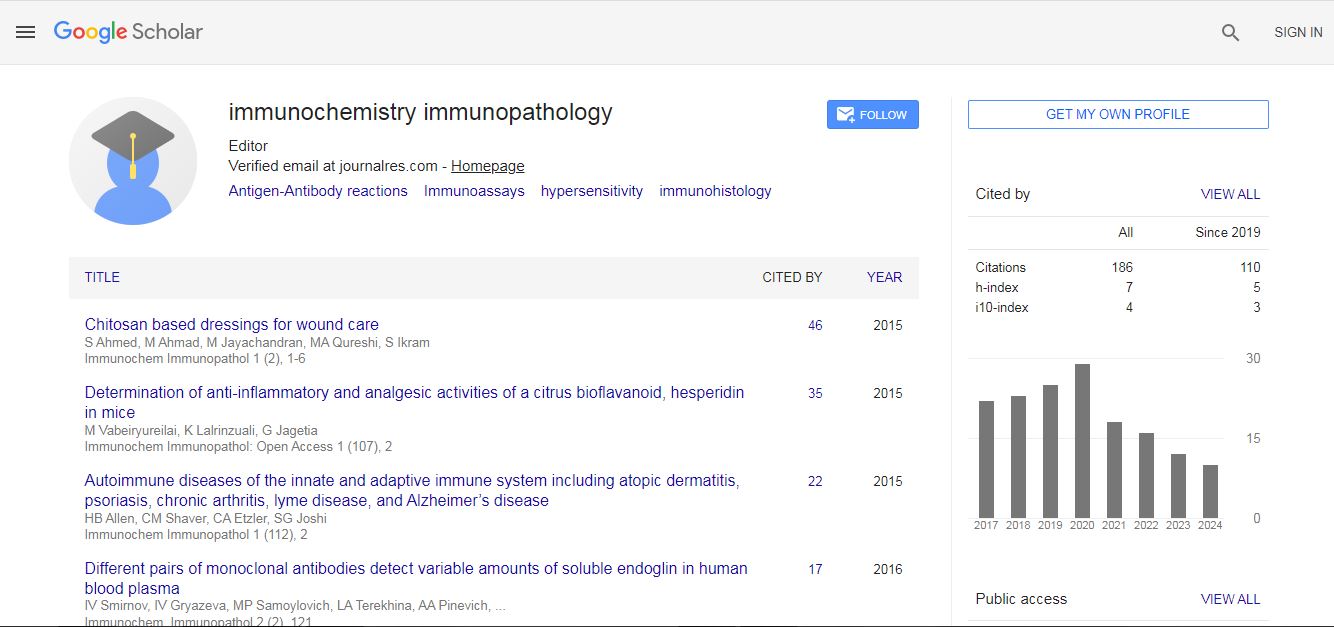
Immunochemistry & Immunopathology received 174 citations as per Google Scholar report