Perspective - (2025) Volume 14, Issue 6
Received: 01-Nov-2025, Manuscript No. VTE-26-180142;
Editor assigned: 03-Nov-2025, Pre QC No. P-180142;
Reviewed: 17-Nov-2025, QC No. Q-180142;
Revised: 24-Nov-2025, Manuscript No. R-180142;
Published:
29-Nov-2025
, DOI: 10.37421/2376-1318.2025.14.404
Citation: Rojas, Camila. ”Dietary Vitamins, Minerals: Sources, Stability, Bioavailability.” Vitam Miner 14 (2025):404.
Copyright: © 2025 Rojas C. This is an open-access article distributed under the terms of the Creative Commons Attribution License, which permits unrestricted use, distribution and reproduction in any medium, provided the original author and source are credited.
The intricate relationship between dietary components and human health is a subject of ongoing scientific inquiry. Essential vitamins and minerals, though required in small quantities, play pivotal roles in numerous physiological processes, making their dietary origins and subsequent fate within the body of paramount importance. Understanding how these micronutrients are obtained from various food sources lays the foundation for developing effective dietary strategies to promote well-being. This foundational knowledge is critical for both nutritional science and public health initiatives aiming to combat deficiencies and optimize health outcomes. The diverse array of food sources for vitamins and minerals necessitates a thorough examination of their inherent properties and the factors that can influence their nutritional value [1].
Fat-soluble vitamins, including vitamins A, D, E, and K, are crucial for a myriad of bodily functions, ranging from vision and bone health to immune support and blood clotting. Their absorption and utilization are intrinsically linked to dietary fat intake. Identifying the primary food sources of these vitamins is the first step in ensuring adequate consumption. However, their chemical structures render them susceptible to degradation under various environmental conditions, posing challenges for maintaining their nutritional integrity from farm to fork [2].
In contrast to their fat-soluble counterparts, water-soluble vitamins, such as the B vitamins and vitamin C, are vital for energy metabolism, cellular function, and antioxidant defense. These vitamins are readily found in a wide range of fruits, vegetables, and whole grains. Their solubility in water means they are more easily lost during food processing and cooking, particularly through methods involving water or heat. Consequently, understanding their stability during these transformations is essential for preserving their nutritional benefits [3].
Minerals, the inorganic building blocks of life, are equally indispensable for health. They participate in everything from nerve signal transmission and muscle contraction to fluid balance and structural integrity. Plant-based foods are significant sources of many essential minerals, including iron, zinc, calcium, magnesium, and potassium. However, the bioavailability of these minerals from plant sources can be modulated by the presence of various dietary compounds, requiring a nuanced approach to dietary planning [4].
Fortification of foods with essential micronutrients has become a widespread strategy to address nutritional gaps in populations. This practice involves adding vitamins and minerals to commonly consumed foods to enhance their nutritional profile. The effectiveness of fortification relies not only on the initial addition of these nutrients but also on their stability throughout the product's shelf life and their subsequent bioavailability to the consumer. Evaluating the efficacy of these interventions is crucial for their public health impact [5].
Cooking methods represent a significant stage in the food journey where nutrient integrity can be compromised. Different thermal treatments, such as boiling, steaming, frying, and baking, can lead to varying degrees of vitamin and mineral loss. The choice of cooking method can profoundly influence the nutrient content of the final dish, highlighting the importance of selecting techniques that minimize nutrient degradation and maximize retention [6].
Macrominerals, including calcium, magnesium, potassium, and sodium, are required in larger amounts compared to trace minerals and are fundamental for maintaining electrolyte balance, cellular function, and skeletal structure. Their presence in diverse food matrices and their absorption characteristics are influenced by dietary patterns. Understanding their sources and factors affecting their uptake is vital for managing chronic diseases and promoting overall health [7].
The post-harvest handling and storage of fresh produce significantly impact the nutritional quality of the food we consume. Factors like temperature, humidity, and exposure to light and oxygen can accelerate the degradation of vitamins, particularly sensitive ones like vitamin C. Optimizing storage conditions is therefore a critical aspect of preserving the nutrient content of fruits and vegetables from the point of harvest to consumption [8].
Carotenoids, a class of fat-soluble pigments found in plants, serve as important antioxidants and precursors to vitamin A. Their stability is influenced by the food matrix in which they are embedded, as well as the processing methods employed. The presence of fat and the nature of the processing technique play a crucial role in determining the bioaccessibility and retention of these beneficial compounds [9].
Dietary fiber, a non-digestible carbohydrate, has garnered attention not only for its role in digestive health but also for its complex interactions with mineral absorption. Certain types of fiber can either enhance or inhibit the uptake of essential minerals like iron and calcium. Understanding these interactions is key to optimizing mineral status, particularly in diets rich in plant-based foods [10].
The exploration of micronutrient origins highlights the inherent diversity of food sources and the critical role of understanding their composition. Essential vitamins and minerals are obtained from a wide spectrum of foods, each contributing uniquely to our nutritional intake. The stability and bioavailability of these nutrients, however, are not solely dependent on their initial presence in food but are significantly influenced by subsequent processing and storage conditions. Recognizing these dynamics is fundamental for optimizing nutrient absorption and preventing widespread deficiencies, underpinning the need for comprehensive knowledge in this area [1].
Focusing on the fat-soluble vitaminsâ??A, D, E, and Kâ??reveals their crucial roles in various physiological processes, from vision and bone metabolism to immune function and blood coagulation. Their absorption is intrinsically linked to dietary fat, and their primary food sources are diverse, ranging from animal products to fortified foods and certain plant oils. A significant aspect of their nutritional profile is their susceptibility to degradation by environmental factors such as heat, light, and oxygen, particularly during cooking and preservation. Practical guidance on minimizing these losses is therefore essential for maintaining their therapeutic and nutritional value [2].
In contrast, the water-soluble vitamins, notably vitamin C and the B-complex vitamins, are integral to energy metabolism, cellular repair, and antioxidant defense mechanisms. They are abundantly found in fruits, vegetables, and whole grains. Their high solubility in water makes them prone to leaching during cooking processes, especially those involving water. Quantifying nutrient losses during techniques like pasteurization and freeze-drying provides valuable insights for food product development aimed at preserving these vital nutrients [3].
Minerals, the essential inorganic elements, are indispensable for a myriad of bodily functions. Plant-based foods are rich reservoirs of minerals such as iron, zinc, and calcium. However, the effective utilization of these minerals from plant sources is often challenged by the presence of absorption inhibitors, like phytates and polyphenols, found in these foods. Strategies to mitigate these effects are crucial for enhancing mineral bioavailability and preventing deficiencies, particularly in populations relying heavily on plant-based diets [4].
Fortified foods represent a significant avenue for enhancing micronutrient intake at a population level. This approach involves the addition of specific vitamins and minerals to commonly consumed food items to address dietary gaps. Evaluating the effectiveness of these fortification processes and the stability of the added micronutrients throughout the product's shelf life is paramount. Such assessments provide a critical overview of current practices and their actual nutritional impact on consumers [5].
The impact of cooking methods on nutrient retention is a critical consideration in everyday food preparation. Various techniques, including boiling, steaming, and microwaving, are employed for vegetables, and each method results in different levels of vitamin and mineral retention. Quantifying these losses and offering recommendations for nutrient-preserving cooking techniques are essential for maximizing the nutritional value of cooked vegetables [6].
Macrominerals, such as calcium, magnesium, and potassium, are required in substantial amounts and are vital for maintaining bodily functions, including electrolyte balance, muscle function, and bone health. Their occurrence in various food matrices and the factors influencing their absorption, particularly in relation to the overall diet composition, are key areas of study. Understanding these dynamics contributes to dietary recommendations for maintaining optimal health and preventing related chronic conditions [7].
The storage conditions of fresh produce play a crucial role in preserving its nutritional quality. Vitamin C, a highly labile nutrient, and overall antioxidant capacity can be significantly affected by storage temperature and packaging materials. Research into optimal storage conditions aims to minimize nutrient degradation and extend the shelf life of fruits and vegetables while retaining their valuable nutritional components [8].
Carotenoids, a group of fat-soluble compounds with antioxidant properties and vitamin A activity, are found in various foods. Their stability is influenced by the food matrix and the processing methods used. Factors such as fat content and the specific processing techniques employed are highlighted as critical determinants for carotenoid retention and their subsequent bioaccessibility [9].
Dietary fiber, beyond its well-known role in digestive health, exerts a significant influence on mineral absorption. Different types of dietary fiber can modulate the uptake of minerals like iron and calcium in the gastrointestinal tract. A critical review of these interactions provides insights into how dietary fiber composition can impact mineral bioavailability, an important consideration for dietary planning and the prevention of mineral deficiencies [10].
This collection of research explores the multifaceted aspects of vitamin and mineral nutrition, focusing on their dietary sources, stability, and bioavailability. It examines how food processing, cooking methods, and storage conditions significantly impact nutrient content. Fat-soluble and water-soluble vitamins, along with macrominerals, are discussed in terms of their sources and susceptibility to degradation. The influence of dietary factors like phytates, polyphenols, and fiber on mineral absorption is also investigated. The effectiveness of food fortification and strategies for minimizing nutrient losses during food preparation and storage are highlighted. Ultimately, the information underscores the importance of informed food choices and preparation techniques to optimize nutrient intake and promote health.
None
None
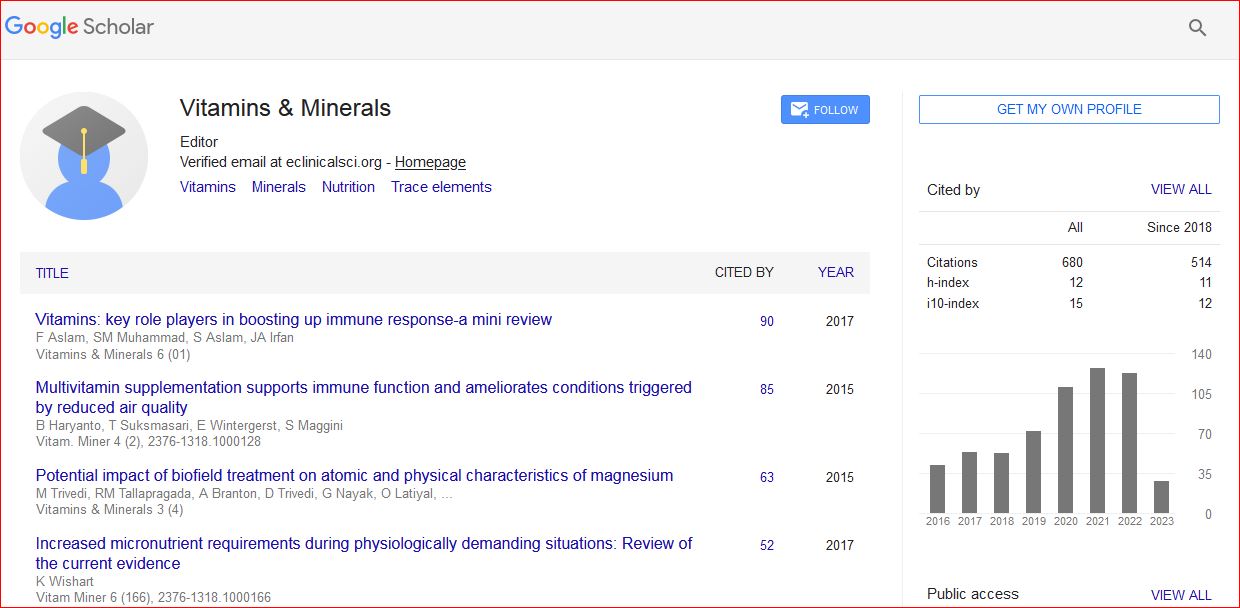
Vitamins & Minerals received 790 citations as per Google Scholar report