Opinion - (2025) Volume 9, Issue 3
Received: 01-Aug-2025, Manuscript No. jmbp-25-175102;
Editor assigned: 04-Aug-2025, Pre QC No. P-175102;
Reviewed: 18-Aug-2025, QC No. Q-175102;
Revised: 22-Aug-2025, Manuscript No. R-175102;
Published:
29-Aug-2025
, DOI: 10.37421/2684-4931.2025.9.265
Citation: Petrov, Anya. ”Diagnostic Innovations Combat Global Health Threats.” J Microbiol Patho 09 (2025):265.
Copyright: © 2025 Petrov A. This is an open-access article distributed under the terms of the Creative Commons Attribution License, which permits unrestricted use, distribution and reproduction in any medium, provided the original author and source are credited.
Antimicrobial resistance is a major global health threat, driven by inappropriate antibiotic use in both humans and animals. This paper highlights the urgency needed to combat rising resistance rates, advocating for improved surveillance, rapid diagnostics, and the development of new antimicrobial agents. It really emphasizes that addressing this issue requires a coordinated, multi-sector approach [1].
Rapid diagnostic tools are transforming clinical microbiology, allowing for faster identification of pathogens and resistance mechanisms. This speed means clinicians can make more timely and informed treatment decisions, which is crucial for improving patient outcomes and combating the spread of infections, especially in critical care settings. It's about getting the right answer quickly [2].
The gut microbiome plays a significant role in both health and various infectious diseases, influencing everything from susceptibility to pathogens to treatment responses. Understanding these complex interactions is key for developing new diagnostic and therapeutic strategies, offering novel ways to manage infections by modulating the microbial community [3].
Diagnosing invasive fungal infections quickly and accurately remains a challenge, but there have been exciting advancements. This article highlights new molecular and antigen-detection methods that are improving diagnostic sensitivity and specificity, making it easier for clinicians to start appropriate antifungal therapy earlier, which directly impacts patient survival [4].
Molecular diagnostics have revolutionized clinical microbiology, offering unprecedented speed and accuracy in identifying pathogens and their resistance profiles. This means we're moving beyond traditional culture methods, using technologies like PCR and next-generation sequencing to quickly get essential information that guides targeted therapies, ultimately improving patient care [5].
Diagnostic testing for SARS-CoV-2 has evolved dramatically, from initial PCR tests to rapid antigen tests and serological assays. This paper reviews the current landscape and looks to the future, highlighting the importance of accurate, accessible, and scalable diagnostics not just for managing outbreaks, but also for informing public health strategies and tracking viral evolution [6].
Antimicrobial stewardship programs are essential to optimize antibiotic use and combat antimicrobial resistance. This piece walks through the fundamental principles and practical implementation of stewardship, emphasizing that a multidisciplinary approachâ??involving pharmacists, microbiologists, and cliniciansâ??is vital for successful outcomes in healthcare settings [7].
Sepsis remains a life-threatening condition, and timely diagnosis is absolutely critical. This article covers the latest advancements in sepsis diagnostics, including biomarkers and rapid molecular tests, which aim to identify infection earlier and differentiate it from other inflammatory conditions, paving the way for more targeted and effective interventions [8].
Effective antimicrobial resistance surveillance is fundamental to tracking the spread of resistant pathogens and informing public health interventions. This paper discusses current challenges, like data standardization and global coverage, and outlines future directions for surveillance efforts, emphasizing the need for robust, integrated systems to tackle this complex health crisis [9].
Automation in clinical microbiology laboratories is becoming increasingly common, streamlining workflows and reducing manual errors. This article explores the benefits and hurdles of implementing total laboratory automation, showing how it can enhance efficiency, standardize processes, and allow skilled personnel to focus on more complex tasks, ultimately improving diagnostic turnaround times [10].
Antimicrobial resistance poses a profound global health threat, largely fueled by the inappropriate use of antibiotics in both human and animal health settings [1]. Addressing this requires urgent, coordinated action across multiple sectors. A critical component of this response involves establishing effective antimicrobial stewardship programs. These programs are essential for optimizing antibiotic use, ensuring that these vital medications are prescribed judiciously and appropriately to combat resistance. Successful implementation hinges on a multidisciplinary approach, actively involving pharmacists, microbiologists, and clinicians to achieve positive outcomes in diverse healthcare environments [7]. Furthermore, robust antimicrobial resistance surveillance is fundamental. Such systems are necessary for tracking the spread of resistant pathogens, which in turn informs public health interventions. Current challenges in surveillance include data standardization and achieving comprehensive global coverage. Future efforts must focus on developing integrated and resilient systems to effectively manage this complex health crisis [9].
The field of clinical microbiology is undergoing a significant transformation thanks to rapid diagnostic tools. These innovations enable much faster identification of pathogens and their resistance mechanisms [2]. This speed is crucial, as it allows clinicians to make more timely and informed treatment decisions. This approach directly improves patient outcomes and helps control the spread of infections, especially in critical care settings, where quick and accurate information is paramount. What this really means is getting the right answer quickly to guide immediate patient care [2]. Molecular diagnostics have further revolutionized the entire field. They offer unprecedented speed and accuracy in identifying pathogens and their specific resistance profiles [5]. Here's the thing: we are moving beyond traditional culture methods, using advanced technologies like Polymerase Chain Reaction (PCR) and next-generation sequencing. These techniques quickly provide essential information that directly guides targeted therapies, ultimately enhancing overall patient care [5].
Significant advancements are being made in the diagnosis of specific challenging infections. For instance, diagnosing invasive fungal infections quickly and accurately has historically been difficult [4]. However, recent breakthroughs in molecular and antigen-detection methods are improving both diagnostic sensitivity and specificity. This progress makes it easier for clinicians to initiate appropriate antifungal therapy earlier, which directly impacts patient survival [4]. Similarly, diagnostic testing for SARS-CoV-2 has seen dramatic evolution, progressing from initial PCR tests to rapid antigen tests and various serological assays. This continuous development highlights the importance of creating accurate, accessible, and scalable diagnostics. These tools are not just for managing immediate outbreaks, but also for informing broader public health strategies and tracking viral evolution [6]. Sepsis also remains a life-threatening condition where timely diagnosis is absolutely critical [8]. Recent advancements in sepsis diagnostics, including new biomarkers and rapid molecular tests, aim to identify infections earlier. They also help differentiate sepsis from other inflammatory conditions, thereby paving the way for more targeted and effective interventions [8].
The gut microbiome plays a significant and often underestimated role in both overall health and the manifestation of various infectious diseases [3]. It influences everything from an individual's susceptibility to pathogens to their responses to specific treatments. Understanding these complex interactions within the microbial community is key for developing new diagnostic and therapeutic strategies. This offers novel approaches to managing infections by carefully modulating the composition and function of the gut microbiome [3].
Automation in clinical microbiology laboratories is increasingly common, bringing substantial benefits [10]. It streamlines workflows and significantly reduces the potential for manual errors. This article explores the benefits and challenges of implementing total laboratory automation, demonstrating how it can enhance efficiency and standardize processes. Crucially, it allows skilled laboratory personnel to focus their expertise on more complex tasks, rather than routine manual procedures. Ultimately, this leads to improved diagnostic turnaround times, benefiting patients and clinicians alike [10].
Antimicrobial resistance represents a major global health threat, demanding a coordinated, multi-sector approach involving improved surveillance, rapid diagnostics, and new antimicrobial agent development. Rapid diagnostic tools are fundamentally changing clinical microbiology, allowing for quicker identification of pathogens and resistance mechanisms. This speed helps clinicians make faster, better-informed treatment decisions, especially in critical care, which improves patient outcomes and limits infection spread. Molecular diagnostics, including PCR and next-generation sequencing, provide unprecedented speed and accuracy, moving beyond traditional culture methods to guide targeted therapies. Recent advances extend to diagnosing invasive fungal infections and sepsis, employing molecular and antigen-detection methods to enable earlier, more appropriate treatment. Diagnostic testing for SARS-CoV-2 has evolved significantly, emphasizing the need for accurate and scalable tools for managing outbreaks and informing public health. The gut microbiomeâ??s role in infectious diseases also offers new diagnostic and therapeutic strategies. Effective antimicrobial stewardship programs are crucial for optimizing antibiotic use. Robust antimicrobial resistance surveillance is essential for tracking pathogen spread and guiding public health interventions. Finally, implementing total laboratory automation streamlines workflows, reduces errors, and improves diagnostic turnaround times, allowing skilled personnel to focus on complex tasks. These interconnected efforts are critical for tackling contemporary infectious disease challenges.
None
None
Suman S, Prakash B, Aayushma P. "Antimicrobial Resistance: A Global Threat That Needs Urgent Action".JNMA J Nepal Med Assoc 59 (2021):104-108.
Indexed at, Google Scholar, Crossref
Antony C, Guy P, Dominique SB. "Rapid Diagnostics in Clinical Microbiology".Clin Chem 67 (2021):104-118.
Indexed at, Google Scholar, Crossref
Siyuan G, Dan C, Xiao Z. "The gut microbiome in infectious diseases".Chin Med J (Engl) 134 (2021):928-941.
Indexed at, Google Scholar, Crossref
Olivier L, Jean-Pierre G, René P. "Recent Advances in Laboratory Diagnosis of Invasive Fungal Infections".Clin Microbiol Rev 33 (2020):e00055-19.
Indexed at, Google Scholar, Crossref
Yi-Wei T, Gary WP, Jayawant NM. "Molecular Diagnostics in Clinical Microbiology: A Comprehensive Review".J Clin Microbiol 59 (2021):e00138-21.
Indexed at, Google Scholar, Crossref
Rosanna WP, Christine JW, Patricia JG. "Diagnostic testing for SARS-CoV-2: current status and future directions".Lancet Infect Dis 22 (2022):e295-e309.
Indexed at, Google Scholar, Crossref
D N, J S, R N. "Antimicrobial stewardship: From principles to practice".J Antimicrob Chemother 76 (2021):vii1-vii4.
Indexed at, Google Scholar, Crossref
Michael AP, Bobbi SP, Mary KH. "Recent Advances in Sepsis Diagnostics".J Clin Microbiol 60 (2022):e00114-22.
Indexed at, Google Scholar, Crossref
Evelina T, Giorgia DA, Isabella DS. "Antimicrobial resistance surveillance: current challenges and future directions".J Antimicrob Chemother 75 (2020):523-531.
Indexed at, Google Scholar, Crossref
Alex V, Alex VB, Benoît L. "Total laboratory automation in clinical microbiology: challenges and perspectives".Eur J Clin Microbiol Infect Dis 38 (2019):1-9.
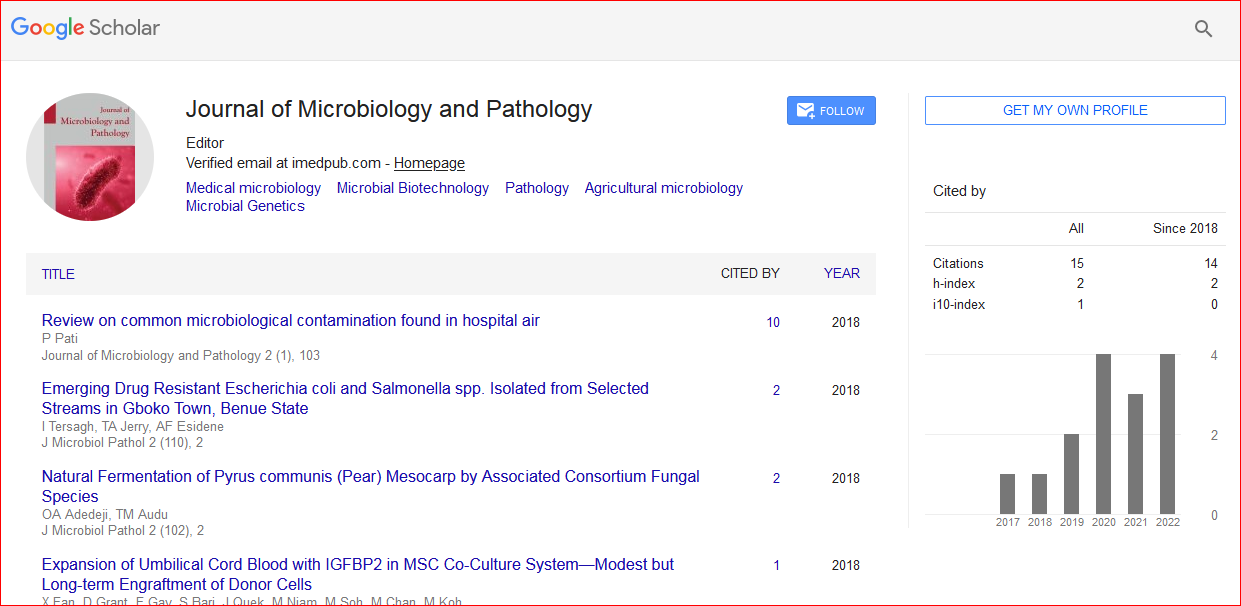
Journal of Microbiology and Pathology received 18 citations as per Google Scholar report