Short Communication - (2025) Volume 15, Issue 3
Received: 02-Jun-2025, Manuscript No. jeat-26-188615;
Editor assigned: 04-Jun-2025, Pre QC No. P-188615;
Reviewed: 18-Jun-2025, QC No. Q-188615;
Revised: 23-Jun-2025, Manuscript No. R-188615;
Published:
30-Jun-2025
, DOI: 10.37421/2161-0525.2025.15.848
Citation: El-Sayed, Ahmed. ”Detecting Emerging Contaminants:
Analytical Methods for Water.” J Environ Anal Toxicol 15 (2025):848.
Copyright: © 2025 El-Sayed A. This is an open-access article distributed under the terms of the Creative Commons Attribution License, which permits unrestricted use,
distribution and reproduction in any medium, provided the original author and source are credited.
The pervasive presence of chemical pollutants in drinking water represents a significant and multifaceted challenge to global public health and environmental integrity. Ensuring access to safe and clean drinking water necessitates a comprehensive understanding of the various contaminants, their origins, and the advanced analytical methodologies employed for their detection and quantification. This introductory exploration delves into the critical aspects of water quality monitoring, underscoring the importance of rigorous scientific investigation and technological advancement in safeguarding this vital resource. Emerging organic contaminants, a class of compounds that are continuously being introduced into the environment and often resist conventional water treatment processes, are a primary focus. Their detection and accurate quantification are paramount, with recent advancements in analytical techniques such as chromatography and mass spectrometry playing a crucial role in achieving the necessary sensitivity and specificity. The continuous evolution of these methodologies allows for the identification of previously undetectable substances, thereby informing public health strategies and regulatory frameworks [1].
Heavy metals, naturally occurring elements that can become toxic at elevated concentrations, pose another serious threat to drinking water quality. Their occurrence and distribution in various water sources, coupled with their inherent health risks, demand thorough investigation. Evaluating the efficacy of existing water treatment processes in removing these metallic pollutants is essential for developing effective remediation strategies. Spectroscopic methods are instrumental in the precise elemental analysis required for this assessment [2].
Pesticides, widely used in agriculture, can leach into groundwater, a critical source of drinking water for many communities. The challenges associated with detecting these organic pollutants at trace levels are substantial, as are their potential ecotoxicological impacts. Research efforts are directed towards developing and refining analytical techniques that can achieve improved detection limits, ensuring that even minute concentrations can be identified and managed to protect both human and ecological health [3].
Disinfection byproducts (DBPs) are inadvertently formed during the chlorination process used to treat drinking water. While essential for microbial inactivation, chlorination can lead to the formation of a complex array of DBPs, some of which have been linked to adverse health effects with long-term exposure. Analytical strategies for identifying and quantifying these DBPs are crucial for optimizing water treatment protocols and minimizing associated health risks, with gas chromatography-mass spectrometry (GC-MS) often being a key analytical tool [4].
Pharmaceuticals and personal care products (PPCPs) are increasingly recognized as emerging contaminants in drinking water. Their presence, often at very low concentrations, presents significant analytical challenges. These micropollutants can potentially exert endocrine-disrupting effects, raising concerns about chronic exposure. Liquid chromatography coupled with tandem mass spectrometry (LC-MS/MS) is frequently employed to tackle the complex task of their detection and characterization [5].
Industrial wastewater discharge is a significant contributor to the chemical contamination of drinking water sources. Identifying the specific pollutants originating from industrial activities and assessing their concentration levels is vital for implementing targeted pollution control measures. A diverse range of analytical techniques is often required to characterize the complex mixtures of contaminants found in such effluents, enabling a comprehensive assessment of water quality impacts [6].
Microplastics, a ubiquitous environmental pollutant, have also been detected in drinking water, raising growing concerns for environmental and human health. Developing reliable methods for sampling and analyzing these minuscule plastic particles is a key area of research. Understanding their potential toxicological effects, which may be linked to the adsorption of other contaminants, necessitates robust analytical approaches, including microscopy and spectroscopic identification techniques [7].
Per- and polyfluoroalkyl substances (PFAS), often termed 'forever chemicals' due to their extreme persistence in the environment, are another group of contaminants of growing concern in drinking water. Their potential health risks are significant, and the analytical challenges associated with their detection are considerable. Advanced chromatographic and mass spectrometric techniques are essential for their sensitive determination and for assessing the extent of contamination [8].
Volatile organic compounds (VOCs) can enter tap water through various pathways, including industrial pollution and the use of household products. Their identification and quantification in drinking water are critical for assessing associated health concerns. Analytical methods, particularly GC-MS, are employed to detect these compounds, allowing for the evaluation of exposure risks and the implementation of necessary control measures [9].
The critical issue of chemical pollutants in drinking water is extensively explored, with a particular emphasis on the sophisticated analytical techniques required for their detection and quantification. The inherent importance of continuous monitoring to safeguard public health is highlighted, providing a detailed overview of commonly encountered contaminants and their diverse origins. The study likely delves into advancements in analytical methodologies, such as chromatography and mass spectrometry, which are indispensable for achieving accurate and highly sensitive analyses of these substances [1].
The occurrence and distribution of specific heavy metals within various drinking water sources form the crux of another investigation. This research meticulously discusses the potential health risks associated with the presence of these metals and critically evaluates the effectiveness of established water treatment processes in their removal. The study's reliance on spectroscopic methods for precise elemental analysis is a key feature, enabling a robust assessment of water quality [2].
The presence of pesticides in groundwater, a substantial source of potable water for numerous communities, is thoroughly investigated. The paper underscores the inherent challenges encountered in detecting these organic pollutants at extremely low concentrations and meticulously discusses their potential ecotoxicological impacts. The exploration of advanced analytical techniques aimed at achieving improved detection limits is a significant contribution to this field [3].
Disinfection byproducts (DBPs), which arise as a consequence of water chlorination, are the central subject of a detailed examination of treated drinking water. The study meticulously examines the various analytical methods employed for the identification and quantification of different DBPs and thoroughly discusses the health implications linked to prolonged exposure. The likely utilization of gas chromatography-mass spectrometry (GC-MS) for this purpose is a notable aspect of the research [4].
The presence of pharmaceuticals and personal care products (PPCPs) in drinking water, often categorized as emerging contaminants, is the focus of a comprehensive paper. It elaborates on the significant analytical challenges associated with detecting these micropollutants at exceedingly low concentrations and explores their potential endocrine-disrupting effects. The probable use of liquid chromatography coupled with tandem mass spectrometry (LC-MS/MS) is central to the study's methodology [5].
The impact of industrial wastewater discharge on the quality of adjacent drinking water sources is rigorously investigated in another research paper. It meticulously identifies the key chemical pollutants originating from industrial activities and provides a thorough evaluation of their concentration levels. The study likely employs a wide array of analytical techniques to characterize the complex mixture of contaminants present in these water bodies [6].
The issue of microplastics in drinking water, a topic of escalating concern for both environmental and human health, is addressed in a dedicated article. It comprehensively discusses various methods for sampling and analyzing microplastic particles and offers a thorough review of their potential toxicological effects. The study may involve the application of microscopy and spectroscopic identification techniques for a detailed analysis [7].
The analytical challenges intrinsic to the detection of per- and polyfluoroalkyl substances (PFAS) in drinking water are explored in depth. The paper emphasizes the persistent nature of these 'forever chemicals' and highlights their potential health risks. The research likely centers on the application of advanced chromatographic and mass spectrometric techniques, essential for achieving the sensitive determination of these compounds [8].
The presence of volatile organic compounds (VOCs) in tap water, which can stem from industrial pollution or common household products, is examined. The paper details the analytical methods used for their identification and quantification, alongside a discussion of the health concerns associated with VOC exposure. The probable use of GC-MS as a key analytical tool in this investigation is noted [9].
The contamination of drinking water by endocrine-disrupting chemicals (EDCs) originating from diverse sources is the subject of a focused study. It thoroughly discusses the analytical difficulties encountered in detecting these compounds at trace levels and their potential to disrupt hormonal systems. The research likely emphasizes the use of LC-MS/MS and sophisticated sample preparation techniques as integral components of its methodology [10].
This collection of research highlights the critical need for robust analytical methods to detect and quantify various chemical pollutants in drinking water. Emerging organic contaminants, heavy metals, pesticides, disinfection byproducts, pharmaceuticals, industrial effluents, microplastics, PFAS, VOCs, and EDCs are identified as significant concerns. Studies emphasize the use of advanced techniques like chromatography and mass spectrometry to address challenges in detection sensitivity and accuracy. The research underscores the importance of monitoring water quality to protect public health and the environment, evaluating treatment process effectiveness, and assessing potential health and ecological risks associated with these contaminants.
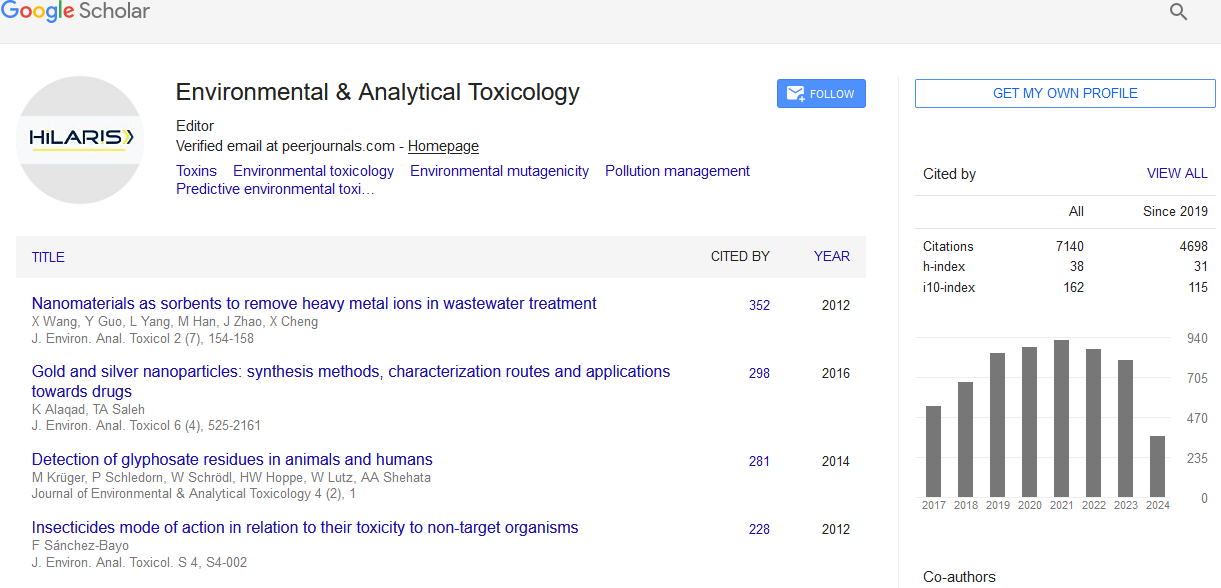
Environmental & Analytical Toxicology received 6818 citations as per Google Scholar report