Brief Report - (2025) Volume 11, Issue 4
Received: 02-Nov-2025, Manuscript No. jmt-25-175201;
Editor assigned: 04-Nov-2025, Pre QC No. P-175201;
Reviewed: 18-Nov-2025, QC No. Q-175201;
Revised: 24-Nov-2025, Manuscript No. R-175201;
Published:
29-Nov-2025
, DOI: 10.37421/2471-271X.2025.11.357
Citation: Collins, Richard. ”Dementia: Prevention, Diagnosis, Treatment Advances.” J Ment Disord Treat 11 (2025):357.
Copyright: © 2025 Collins R. This is an open-access article distributed under the terms of the Creative Commons Attribution License, which permits unrestricted use, distribution and reproduction in any medium, provided the original author and source are credited.
The global challenge of dementia demands a comprehensive strategy, spanning prevention, advanced diagnostics, genetic insights, and novel treatments. A significant finding indicates that up to 40% of dementia cases could be prevented or delayed by addressing 12 modifiable risk factors like less education, hypertension, obesity, hearing loss, and excessive alcohol consumption. This perspective underscores the importance of holistic care for individuals with dementia and their caregivers, advocating for personalized, integrated pathways from diagnosis to palliative stages. Public health initiatives and policy changes are crucial for tackling these risks and improving dementia care globally, as highlighted by a Lancet Commission update [1].
Revolutionizing early and accurate diagnosis, recent advances in multimodal neuroimaging, combining structural MRI, functional MRI, PET, and diffusion tensor imaging, offer a comprehensive view of brain pathology. These techniques identify subtle changes in brain structure, function, and connectivity that often precede clinical symptoms. Such integration enables better differential diagnosis among various dementia types and tracks disease progression, promising personalized treatment strategies and clinical trial enrichment [2].
Furthermore, blood-based biomarkers are transforming Alzheimer's disease research and clinical practice by providing less invasive and more accessible tools for diagnosis and monitoring. Advances in assays for amyloid-beta, phosphorylated tau (p-tau), and neurofilament light chain (NfL) can detect core Alzheimer's pathologies and neurodegeneration with high accuracy, often years before symptom onset. This utility extends to screening, risk stratification, and measuring treatment response, though standardization remains a challenge [3].
Understanding the complex genetics of dementia is crucial, encompassing highly penetrant single-gene mutations for early-onset forms and common genetic variants contributing to late-onset disease risk. Major genes involved in Alzheimer's (e.g., APOE, APP, PSEN1, PSEN2) and frontotemporal dementia (e.g., GRN, C9orf72, MAPT) are being outlined. These insights are vital for developing diagnostic tools, identifying at-risk individuals, and informing gene-targeted therapies, while ethical considerations for genetic testing remain important [4].
Prevention also heavily relies on lifestyle interventions. A systematic review consolidates evidence for the collective impact of multiple healthy behaviors. Strong support exists for physical activity, cognitive engagement, healthy diet (like Mediterranean diet), social participation, and managing cardiovascular risk factors in reducing dementia risk. This underscores that a multifaceted approach to lifestyle modification significantly contributes to brain health and can potentially delay dementia onset, advocating for public health strategies promoting these behaviors [5].
The treatment landscape for Alzheimer's disease is rapidly evolving from symptomatic relief to disease-modifying therapies targeting underlying pathologies. Emerging pharmacological agents include monoclonal antibodies against amyloid-beta and tau, alongside novel mechanisms like neuroinflammation and synaptic plasticity modulation. A growing pipeline of drugs in various clinical trial phases offers hope for slowing or halting disease progression, despite inherent challenges [6].
Machine learning (ML) algorithms are showing significant promise in enhancing the early and accurate diagnosis of Alzheimer's and related dementias. Reviews synthesize studies applying ML to neuroimaging (MRI, PET), genetic, and clinical data to predict disease onset and progression. ML can identify complex patterns and subtle biomarkers, potentially leading to earlier interventions and personalized treatment. However, data standardization and model generalizability require further addressing [7].
Frontotemporal dementia (FTD) is recognized as a group of neurodegenerative disorders distinct from Alzheimer's, primarily affecting personality, behavior, and language. Reviews elucidate clinical presentations, underlying pathologies (e.g., tauopathies, TDP-43 proteinopathies), and genetic underpinnings. Diagnostic challenges arise from varied manifestations and overlaps with psychiatric conditions. Current management focuses on symptomatic relief and caregiver support, with ongoing research into disease-modifying therapies [8].
The concept of cognitive reserve, the brain's ability to cope with pathology by efficiently using or recruiting alternative networks, delays clinical dementia manifestation. Factors like education, occupational complexity, and engaging leisure activities build this reserve. This has significant implications for prevention, suggesting that lifelong cognitive stimulation and intellectual engagement can buffer age-related brain changes and pathology, offering a non-pharmacological intervention pathway [9].
Finally, non-pharmacological interventions are crucial for managing dementia symptoms and improving quality of life for individuals and their caregivers. Evidence supports approaches like cognitive stimulation, exercise, music therapy, reminiscence therapy, and caregiver education. Many interventions effectively reduce behavioral and psychological symptoms, enhance mood, and support daily functioning. The emphasis is on personalized, person-centered care integrating these interventions to meet individual needs [10].
Dementia represents a significant global health challenge, with ongoing research providing crucial insights into its prevention, diagnosis, genetics, and management. A compelling finding suggests that up to 40% of dementia cases could be prevented or delayed by actively addressing 12 modifiable risk factors throughout an individual's life. These include factors such as lower education levels, hypertension, obesity, hearing loss, and excessive alcohol consumption [C001]. Beyond prevention, holistic care is emphasized for those living with dementia and their caregivers, advocating for personalized and integrated care pathways from initial diagnosis through to palliative stages. Public health initiatives and policy changes are seen as essential drivers for tackling these risk factors and enhancing dementia care worldwide [C001, C005]. Furthermore, lifestyle interventions are strongly supported as a key preventive measure. These encompass promoting physical activity, fostering cognitive engagement, encouraging healthy dietary patterns like the Mediterranean diet, facilitating social participation, and diligently managing cardiovascular risk factors. This multifaceted approach to lifestyle modification can significantly contribute to maintaining brain health and potentially delay the onset of dementia [C005]. The brain's capacity for cognitive reserve, built through factors such as education and intellectually engaging activities, also plays a crucial role in buffering the effects of age-related brain changes and pathology, offering a non-pharmacological pathway for prevention [C009].
The landscape of dementia diagnosis is undergoing rapid transformation thanks to technological advancements. Multimodal neuroimaging, which integrates techniques like structural Magnetic Resonance Imaging (MRI), functional MRI, Positron Emission Tomography (PET), and diffusion tensor imaging (DTI), is revolutionizing the early and accurate detection of dementia [C002]. These powerful techniques provide a comprehensive view of brain pathology, enabling the identification of subtle changes in brain structure, function, and connectivity that often manifest before any clinical symptoms appear. The ability to combine various imaging modalities allows for more precise differential diagnosis among different types of dementia and offers a means to track disease progression, holding significant promise for personalized treatment strategies and the enrichment of clinical trials [C002]. In parallel, blood-based biomarkers are proving to be game-changers in Alzheimer's disease research and clinical practice. These offer less invasive and more accessible tools for both diagnosis and disease monitoring. Notable advances in assays for amyloid-beta, phosphorylated tau (p-tau), and neurofilament light chain (NfL) can now detect core Alzheimer's pathologies and neurodegeneration with high accuracy, often years before symptoms begin [C003]. These biomarkers are invaluable for screening, risk stratification, and objectively measuring treatment response, despite ongoing challenges in standardization and widespread clinical implementation [C003]. Machine learning algorithms further augment these diagnostic capabilities, demonstrating significant promise in enhancing the early and accurate diagnosis of Alzheimer's and related dementias by identifying complex patterns and subtle biomarkers in neuroimaging, genetic, and clinical data that human analysis might overlook [C007].
Understanding the genetic underpinnings of dementia is another critical area. The genetics of dementia are complex, involving both highly penetrant single-gene mutations responsible for early-onset forms and common genetic variants that contribute to late-onset disease risk [C004]. Key genes involved in Alzheimer's disease include APOE, APP, PSEN1, and PSEN2, while specific genes like GRN, C9orf72, and MAPT are implicated in frontotemporal dementia. These genetic insights are paramount for developing targeted diagnostic tools, identifying individuals who may be at higher risk, and informing the development of gene-targeted therapies. However, ethical considerations surrounding genetic testing remain an important aspect of this research [C004]. Frontotemporal dementia (FTD) itself is recognized as a distinct group of neurodegenerative disorders that primarily affect personality, behavior, and language, differentiating it from Alzheimer's disease. Research has shed light on its varied clinical presentations, underlying pathologies such as tauopathies and TDP-43 proteinopathies, and specific genetic underpinnings. The diagnosis of FTD can be particularly challenging due to its diverse manifestations and overlaps with psychiatric conditions [C008].
Finally, the management and treatment of dementia are continuously evolving. The focus in Alzheimer's disease treatments is rapidly shifting beyond mere symptomatic relief to disease-modifying therapies that directly target the underlying pathologies [C006]. Emerging pharmacological agents include monoclonal antibodies designed to target amyloid-beta and tau proteins, alongside other novel mechanisms such as neuroinflammation and synaptic plasticity modulation. A growing pipeline of drugs in various clinical trial phases offers considerable hope for slowing or even halting disease progression [C006]. Complementing pharmacological approaches, non-pharmacological interventions play a crucial role in managing dementia symptoms and improving the quality of life for individuals with the condition and their caregivers [C010]. Evidence supports a range of approaches, including cognitive stimulation, structured exercise programs, music therapy, reminiscence therapy, and comprehensive caregiver education. While evidence strength varies across interventions, many are effective in reducing behavioral and psychological symptoms, enhancing mood, and supporting daily functioning. The emphasis is on providing personalized, person-centered care that thoughtfully integrates these interventions to meet the unique needs of each individual [C010].
Dementia research highlights crucial aspects of prevention, diagnosis, and treatment. Up to 40% of dementia cases may be preventable by addressing 12 modifiable risk factors like low education, hypertension, obesity, hearing loss, and excessive alcohol consumption, advocating for comprehensive public health strategies and holistic care. Diagnosis is advancing rapidly with multimodal neuroimaging, combining structural MRI, functional MRI, PET, and diffusion tensor imaging for early and accurate detection of subtle brain changes. Blood-based biomarkers, including amyloid-beta, phosphorylated tau (p-tau), and neurofilament light chain (NfL), offer less invasive methods for detecting Alzheimer's pathologies and monitoring disease progression, often before symptoms appear. Machine learning further enhances diagnostic capabilities by identifying complex patterns in neuroimaging, genetic, and clinical data. Understanding the genetics of dementia is also critical, involving both single-gene mutations for early-onset forms and common variants for late-onset risk, which informs diagnostic tools and gene-targeted therapies. Frontotemporal Dementia (FTD) is recognized as a distinct group of neurodegenerative disorders affecting personality, behavior, and language, with specific pathologies and genetic underpinnings that pose diagnostic challenges. Prevention strategies extend to building cognitive reserve through lifelong cognitive stimulation, education, and engaging activities. Lifestyle interventions such as physical activity, healthy diet, and social participation are strongly supported in reducing dementia risk. For managing existing dementia, non-pharmacological interventions like cognitive stimulation, exercise, music therapy, and caregiver education significantly improve quality of life and reduce behavioral symptoms. New pharmacological treatments are emerging, shifting towards disease-modifying therapies that target underlying pathologies, offering hope for slowing or halting progression. This integrated approach across prevention, early diagnosis, genetic understanding, lifestyle interventions, and emerging treatments reflects a dynamic and hopeful outlook in the fight against dementia.
None
None
Gill L, Sara H, Andrea S. "Dementia: diagnosis, management, and prevention: an update from the Lancet Commission 2020".Lancet 396 (2020):413-431.
Indexed at, Google Scholar, Crossref
Yu-Liang Z, Yi-Ning W, Yu-Xin L. "Recent advances in multimodal neuroimaging for dementia diagnosis".Front Aging Neurosci 15 (2023):1157975.
Indexed at, Google Scholar, Crossref
Teemu KK, Kaj B, Henrik Z. "Blood biomarkers for Alzheimer's disease: current landscape and future directions".Mol Neurodegener 16 (2021):76.
Indexed at, Google Scholar, Crossref
Katrien B, Rik V, Anne DR. "Genetics of dementia: a review".Transl Neurodegener 10 (2021):40.
Indexed at, Google Scholar, Crossref
Samar A, Maryam H, Rouhollah H. "Lifestyle interventions for the prevention of dementia: a systematic review of systematic reviews".Int J Environ Res Public Health 18 (2021):7123.
Indexed at, Google Scholar, Crossref
Jeffrey C, Bruna VL, Shayan N. "Emerging treatments for Alzheimer's disease".CNS Drugs 36 (2022):421-443.
Indexed at, Google Scholar, Crossref
Shivangi R, Vinay G, Naveen C. "Machine learning for the early diagnosis of Alzheimer's disease and related dementias: a systematic review".Neural Comput Appl 33 (2021):111-137.
Indexed at, Google Scholar, Crossref
Nicholas TO, Salvatore S, Bruce LM. "Frontotemporal dementia: a review".JAMA Neurol 78 (2021):1388-1398.
Indexed at, Google Scholar, Crossref
Yaakov S, Christian H, Qolamreza R. "Cognitive reserve and its implications for dementia prevention: a narrative review".Neurobiol Aging 129 (2023):96-107.
Indexed at, Google Scholar, Crossref
Linda C, Yi TW, Carol B. "Non-pharmacological interventions for people with dementia: a review of the evidence".Age Ageing 50 (2021):747-761.
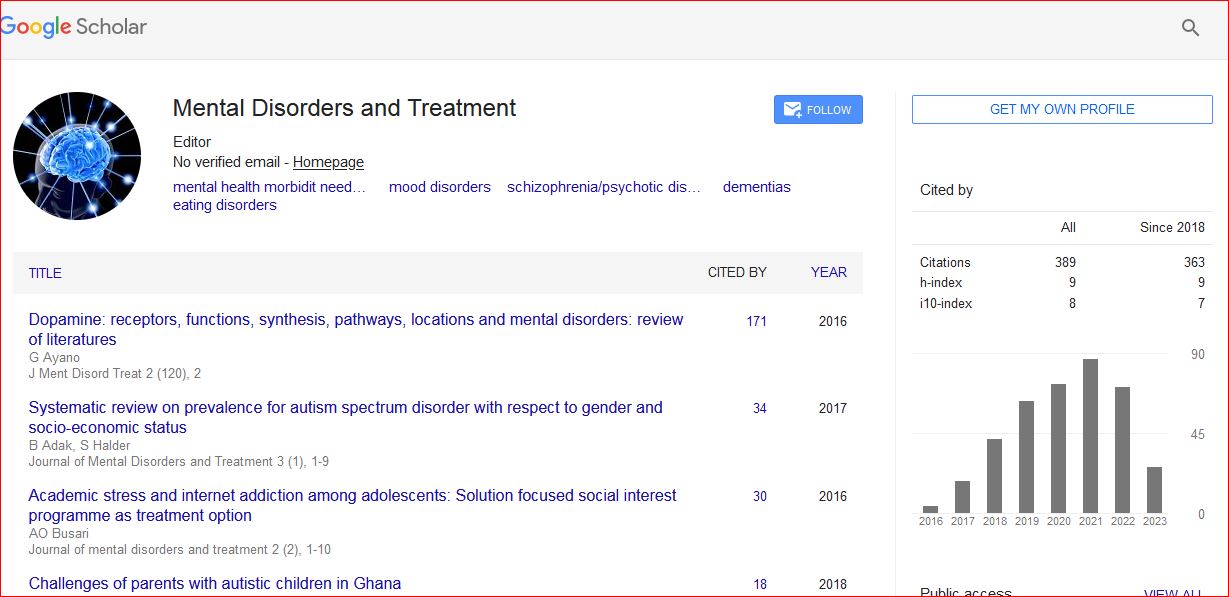
Mental Disorders and Treatment received 556 citations as per Google Scholar report