Short Communication - (2025) Volume 16, Issue 5
Received: 01-Sep-2025, Manuscript No. jch-26-178792;
Editor assigned: 03-Sep-2025, Pre QC No. P-178792;
Reviewed: 17-Sep-2025, QC No. Q-178792;
Revised: 22-Sep-2025, Manuscript No. R-178792;
Published:
29-Sep-2025
, DOI: 10.37421/2157-7099.2025.16.820
Citation: Al‑Rahman, Omar. ”Cytopathology Of Liver, Biliary, And Pancreatic Lesions.” J Cytol Histol 16 (2025):820.
Copyright: © 2025 Al‑Rahman O. This is an open-access article distributed under the terms of the Creative Commons Attribution License, which permits unrestricted use, distribution and reproduction in any medium, provided the original author and source are credited.
The accurate cytopathological evaluation of hepatobiliary and pancreatic lesions is paramount for effective patient management and treatment planning. Fine-needle aspiration (FNA) and related techniques have become indispensable tools in this diagnostic arena, offering minimally invasive methods to obtain cellular material for detailed morphological assessment. This review consolidates current knowledge and advances in the field, underscoring the critical role of cytopathology in characterizing a spectrum of lesions within these vital organ systems [1].
Pancreatic cystic lesions represent a heterogeneous group of neoplasms with varying malignant potential, necessitating precise cytological characterization. Differentiating between benign entities like serous cystadenomas and potentially premalignant mucinous cystic neoplasms and intraductal papillary mucinous neoplasms is crucial. Furthermore, the cytological identification of adenocarcinoma arising within these cysts informs therapeutic strategies and patient stratification [2].
In the assessment of liver lesions, liquid-based cytology (LBC) has emerged as a valuable technique, offering several advantages over conventional smear methods. LBC preparations often exhibit improved cellularity and better preservation of cellular morphology, with reduced obscuring factors such as blood and debris. This enhances the diagnostic accuracy for both benign and malignant liver conditions, facilitating ancillary testing and refined diagnoses [3].
Biliary tract cancers, including cholangiocarcinoma and gallbladder carcinoma, present unique diagnostic challenges in cytopathology. Characteristic architectural and cytological features, such as cellular cohesiveness, nuclear atypia, and intracytoplasmic mucin, are key diagnostic clues. FNA cytology plays a significant role in the detection of these cancers, especially in cases of biliary obstruction, with immunocytochemistry often employed to distinguish adenocarcinoma from reactive epithelial changes [4].
Pancreatic neuroendocrine tumors (PNETs) possess distinct cytomorphological features that aid in their identification on FNA specimens. Uniform nuclei with finely granular chromatin, often described as 'salt and pepper' chromatin, and scant to moderate cytoplasm are typical. Immunocytochemistry, utilizing markers like synaptophysin and chromogranin A, is essential for confirming the diagnosis and plays a vital role in prognostication and treatment planning [5].
The integration of molecular techniques into cytological diagnostics is revolutionizing the approach to hepatobiliary and pancreatic lesions. Molecular markers can significantly aid in differentiating benign from malignant conditions, predicting treatment response, and enabling personalized therapeutic strategies. Specific molecular alterations identified in common malignancies like hepatocellular carcinoma and pancreatic adenocarcinoma can be detected on cytological samples, highlighting the evolving landscape of cytodiagnostics [6].
Hepatocellular carcinoma (HCC) is a common liver malignancy, and its accurate cytological diagnosis is critical. Characteristic cytomorphology, including enlarged pleomorphic cells, atypical nuclei with prominent nucleoli, and intracytoplasmic inclusions, are key diagnostic indicators. Immunohistochemical markers, such as glypican-3 and arginase-1, are invaluable in enhancing diagnostic confidence, particularly in cases with suboptimal cellular material [7].
Pancreatic adenocarcinoma, the most prevalent malignancy of the pancreas, requires meticulous cytological evaluation. FNA cytology typically reveals malignant epithelial cells with marked nuclear atypia, hyperchromasia, irregular nuclear contours, and prominent nucleoli. While cytology is highly effective, differentiating well-differentiated adenocarcinoma from chronic pancreatitis can be a limitation that requires careful assessment [8].
Metastatic lesions to the liver and pancreas are frequently encountered and require accurate cytopathological identification. Understanding common primary sites, such as lung, breast, and gastrointestinal malignancies, is essential. Cytomorphological features of these metastatic tumors on FNA specimens, coupled with immunohistochemistry to determine the primary tumor origin, are crucial for guiding patient management and treatment decisions [9].
Advancements in interventional cytopathology have significantly improved the diagnostic yield for hepatobiliary and pancreatic lesions. The integration of imaging guidance, such as ultrasound and CT, with FNA ensures precise lesion sampling. Techniques like endoscopic ultrasound-guided fine-needle aspiration (EUS-FNA) and percutaneous FNA offer distinct advantages and are applied based on specific indications and technical considerations for optimal evaluation [10].
The cytopathological evaluation of hepatobiliary and pancreatic lesions relies heavily on fine-needle aspiration (FNA) and associated techniques to obtain critical diagnostic information. These minimally invasive procedures allow for detailed morphological analysis of cellular material, enabling the differentiation of benign from malignant conditions. The comprehensive review of this subject highlights the indispensable role of cytopathology in the assessment of complex diseases affecting these organs [1].
Pancreatic cystic lesions present a significant diagnostic challenge due to their diverse nature and varying malignant potential. Cytology plays a pivotal role in distinguishing between entities such as serous cystadenomas, mucinous cystic neoplasms, and intraductal papillary mucinous neoplasms. The accurate identification of adenocarcinoma arising within these cysts is essential for appropriate patient management and risk stratification [2].
Liquid-based cytology (LBC) has demonstrated considerable utility in the evaluation of liver lesions, often surpassing conventional smear techniques. The improved cellularity, enhanced morphological preservation, and reduction of obscuring elements in LBC preparations lead to more accurate diagnoses of common benign and malignant liver lesions, while also facilitating the use of ancillary tests [3].
Cytopathology of biliary tract cancers, including cholangiocarcinoma and gallbladder carcinoma, requires a thorough understanding of characteristic cytomorphological findings. Features such as cellular cohesiveness, nuclear atypia, and the presence of intracytoplasmic mucin are important diagnostic indicators. FNA is a key method for detecting these cancers, particularly in obstructive settings, and immunocytochemistry aids in differentiating adenocarcinoma from reactive changes [4].
Pancreatic neuroendocrine tumors (PNETs) exhibit specific cytomorphological attributes that are diagnostic on FNA. These include uniform nuclei with finely granular chromatin and characteristic 'salt and pepper' patterns, along with scant to moderate cytoplasm. Immunocytochemistry for neuroendocrine markers like synaptophysin and chromogranin A is crucial for confirming the diagnosis and informs prognostic assessment and treatment planning [5].
The incorporation of molecular techniques into the cytological assessment of hepatobiliary and pancreatic lesions represents a significant advancement. Molecular profiling can enhance the ability to differentiate benign from malignant entities, predict treatment responses, and guide personalized therapies. Identifying specific molecular alterations in hepatocellular carcinoma, cholangiocarcinoma, and pancreatic adenocarcinoma from cytological specimens is becoming increasingly important [6].
Cytologic diagnosis of hepatocellular carcinoma (HCC) is critical, and distinguishing it from benign liver conditions and other malignancies relies on recognizing specific cytomorphological features. Enlarged pleomorphic cells, atypical nuclei with prominent nucleoli, and intracytoplasmic inclusions are characteristic. Immunohistochemical markers like glypican-3 and arginase-1 further bolster diagnostic confidence, especially when cellular material is limited [7].
Pancreatic adenocarcinoma, the most common pancreatic malignancy, is diagnosed through FNA cytology by identifying malignant epithelial cells exhibiting marked nuclear atypia, hyperchromasia, irregular nuclear contours, and prominent nucleoli. While cytology is effective, distinguishing well-differentiated adenocarcinoma from chronic pancreatitis remains a recognized limitation requiring careful morphological analysis [8].
Cytopathological evaluation of metastatic lesions in the liver and pancreas is essential, as these organs are common sites for metastasis from various primary cancers. Identifying characteristic cytomorphological features of these metastatic tumors on FNA specimens, combined with immunohistochemistry to pinpoint the primary tumor origin, is vital for effective patient management and treatment selection [9].
Interventional cytopathology, which integrates imaging guidance with FNA, has greatly improved the accuracy and efficacy of diagnosing hepatobiliary and pancreatic lesions. Techniques such as ultrasound-guided, CT-guided, and endoscopic ultrasound-guided fine-needle aspiration (EUS-FNA) are employed to ensure precise sampling, optimizing the diagnostic yield for complex lesions in these anatomical regions [10].
This collection of articles provides a comprehensive overview of cytopathological evaluations for hepatobiliary and pancreatic lesions. It emphasizes the critical role of fine-needle aspiration (FNA) in diagnosing a variety of conditions, including hepatocellular carcinoma, cholangiocarcinoma, pancreatic adenocarcinoma, and pancreatic neuroendocrine tumors. The articles detail specific cytomorphological features, the advantages of techniques like liquid-based cytology (LBC), and the importance of ancillary methods such as immunocytochemistry and molecular testing for improving diagnostic accuracy. Special attention is given to pancreatic cystic lesions, metastatic disease, and interventional cytopathology techniques. The use of advanced molecular pathology and imaging guidance is highlighted as key to personalized patient management and treatment planning in these complex organ systems.
None
None
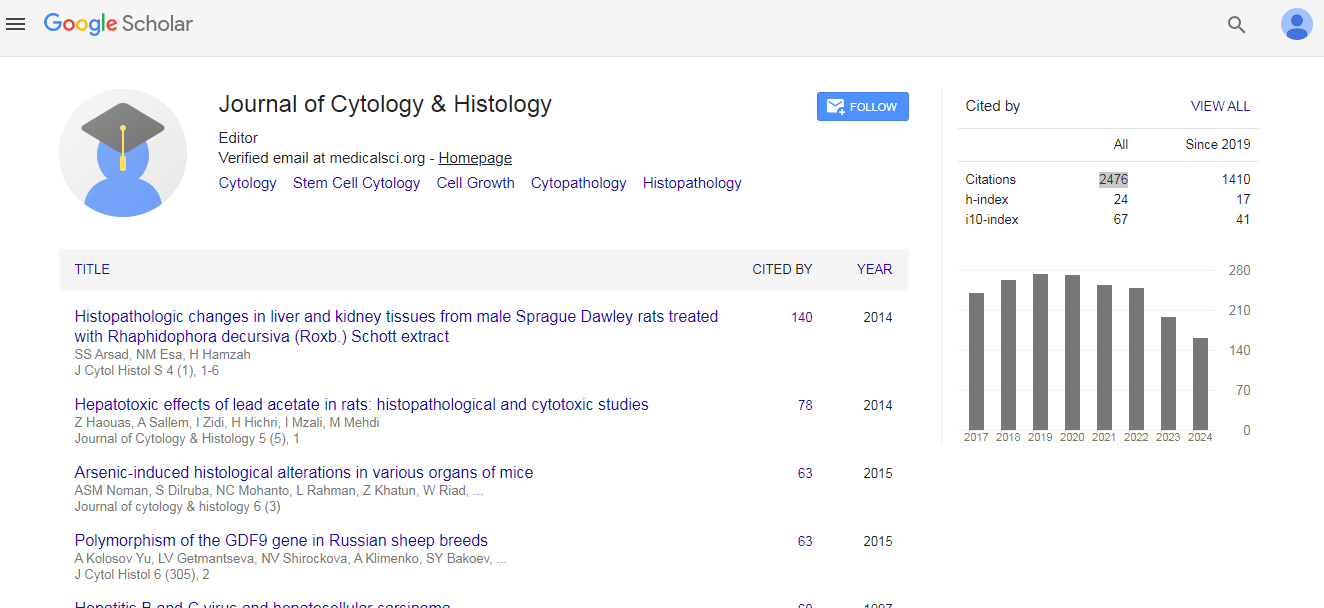
Journal of Cytology & Histology received 2476 citations as per Google Scholar report